Amazon S3 Alternatives That Cut Storage Costs 70%
Amazon S3 currently stores a vast number of objects, yet its dominance no longer guarantees optimal value. This scale, confirmed by technologychecker.io, masks a reality where object storage economics have shifted decisively against the market incumbent. The sheer volume of data, now spanning hundreds of exabytes, demands a reevaluation of where enterprises anchor their digital assets.
While Amazon Simple Storage Service (Amazon Simple Storage Service) remains a standard, competitors are delivering improved value through simplified pricing and enhanced data resiliency. The era of accepting premium fees for standard performance is ending.
Readers will discover why specific S3 competitors outperform the incumbent in critical metrics. We examine the strategic role of open-source object storage in reducing vendor lock-in and detail smooth migration strategies using tools like MultCloud. The analysis provides a clear path for moving away from complex billing structures toward models that actually speed up your data without the historical baggage.
The Role of Object Storage in Modern Cloud Infrastructure
Amazon S3 Object Storage and Pay-As-You-Go Pricing Set
Flat buckets holding discrete objects replaced the rigid hierarchy of traditional file systems. This architecture enables the defining economic model: pay-as-you-go pricing. Organizations incur charges strictly for consumed capacity and outbound transfer volume rather than pre-provisioned blocks. Engineers rely on this elasticity to handle unpredictable AI training datasets without over-provisioning hardware.
Durability remains a primary technical constraint for critical backups, with S3 engineered to provide exceptional object durability over a given year. Yet high availability often arrives with complex billing structures that obscure true costs until the monthly invoice arrives. Teams frequently underestimate how quickly API request fees and data retrieval charges inflate the base storage rate.
Reliability metrics protect against data loss but fail to shield budgets from cost spikes during intensive machine learning workflows. Organizations must balance these guarantees against the need for transparent, flat-rate economics.rabata.io helps teams navigate this by benchmarking S3-compatible alternatives that maintain performance while simplifying the cost model. Understanding baseline S3 metrics allows architects to identify when a different storage tier or provider better suits their specific throughput requirements.
Applying S3 Alternatives for Performance and Integration Needs
Latency bottlenecks and opaque invoices drive teams to select an Amazon S3 alternative. Performance requirements dictate this shift; some services offer quicker data access for specific workloads like AI model training. Organizations managing high-performance needs often find that combining storage with GPU cloud infrastructure notably improves analytics throughput.
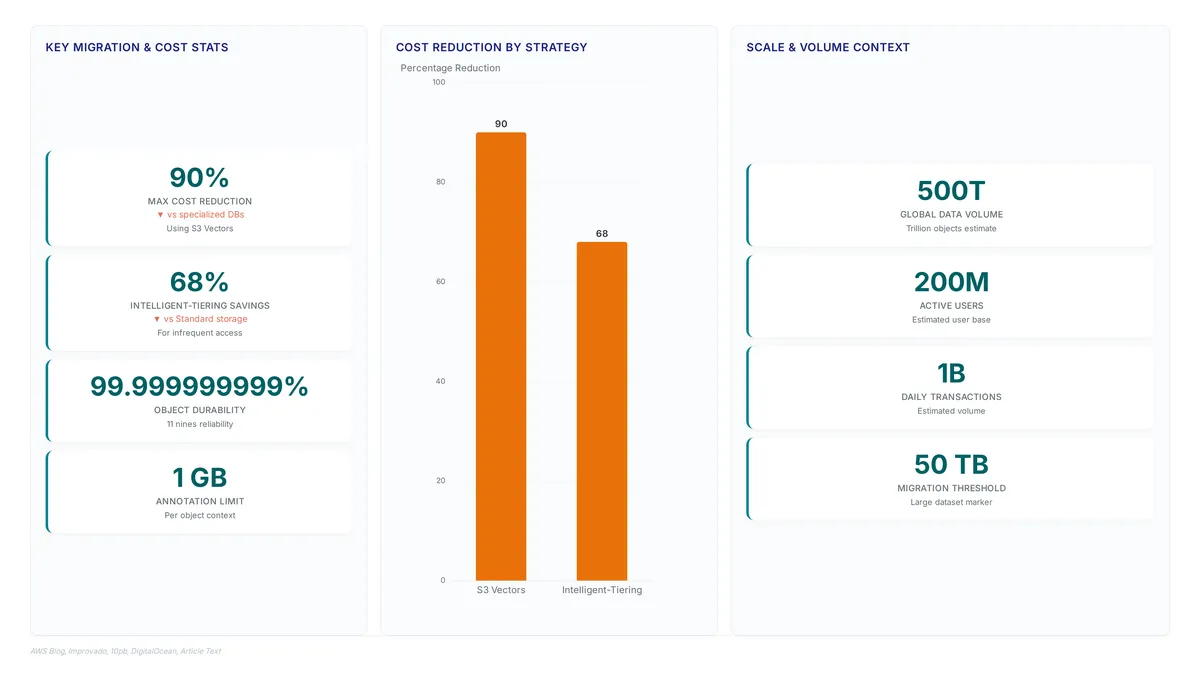
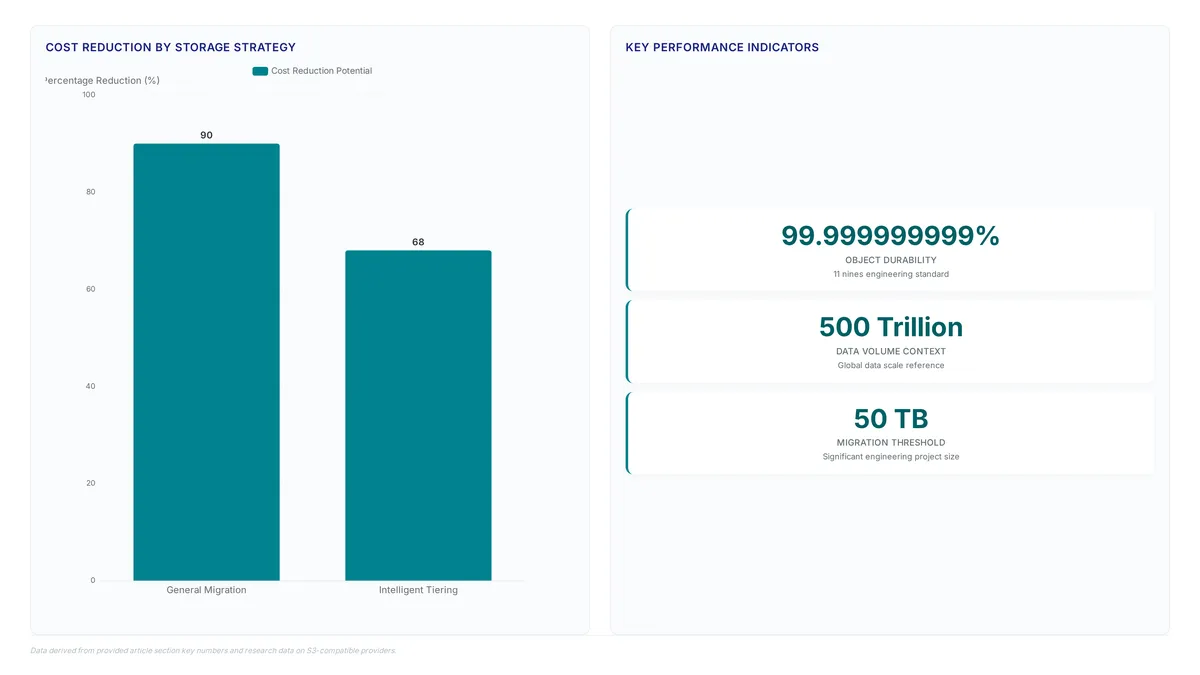
S3 compatible storage is often 30, 70% cheaper than AWS S3, depending on usage patterns and data egress volume. This cost efficiency allows startups to scale object storage capacity without the penalty of unpredictable outbound transfer fees. Integration with existing systems remains equally critical for enterprises preferring tools that smoothly work with current setups. Relying solely on a single vendor creates friction when migrating data across different system boundaries. Avoiding vendor lock-in matters more as data volumes grow, allowing organizations to switch providers or run hybrid setups without rearchitecting their entire stack.rabata.io emphasizes that matching the storage backend to the specific access pattern prevents costly performance mismatches.
Risks of Complex Pricing and Security Gaps in S3
Complex billing structures obscure true costs until operators face unexpected egress charges. Amazon S3 remains the industry standard, yet rising cloud costs and unpredictable billing push businesses to rethink their storage strategy. Security and privacy considerations impact decision-making, particularly for users prioritizing measures that may not be fully met by default configurations.
Granular permissioning requires careful management to ensure data does not remain publicly accessible despite organizational policies. Engineering teams frequently discover security gaps only after a breach event rather than through proactive governance. This opacity drives the search for an Amazon S3 alternative offering transparent flat-rate models. Budget forecasting becomes unreliable for expanding datasets without clear visibility into cost drivers. Enterprises must weigh system integration against the financial risk of unbounded variable pricing. Simplifying storage architecture reduces the attack surface while stabilizing operational expenditures.
Top Competitors Delivering Improved Value Than Amazon S3
Defining Competitive Pricing Structures in Cloud Storage
Rising cloud costs drive organizations to seek alternatives with competitive pricing structures that avoid complex tiering. Users hunt for services matching project needs without hidden operational overhead. A common pitfall involves assuming all pay-as-you-go models offer identical value despite varying performance characteristics.
Latency benchmarks reveal that response times vary notably between providers. This variation impacts data throughput for AI training pipelines where speed dictates model iteration. Such disparity matters for workloads where retrieval speed is necessary. Unpredictable billing forces many teams to rethink storage strategy entirely. Cloud storage pricing comparison requires analyzing total cost of ownership rather than unit price alone. S3 compatible storage is often cited as being notably cheaper than standard AWS S3 depending on usage. This approach helps prevent the financial penalty of over-provisioning while maintaining necessary durability standards. Improved pricing flexibility allows teams to allocate budget toward compute resources instead of idle bytes.
Applying Azure Blob Storage and Google Cloud Storage Classes
Matching data access patterns to specific storage tiers prevents overspending on infrequently accessed assets. Substantial cloud providers offer deep system integration. Teams build thorough solutions without complex data movement between services. This strategy contrasts with selecting a single performance tier for all workloads. Such uniformity often inflates costs for cold data. Leading platforms address cost optimization through distinct storage classes. Users optimize expenses based on retrieval frequency.
Aggressive tiering introduces latency penalties for unexpected reads. A common error involves moving backup sets to Archive class without verifying restore time objectives. Missed recovery windows result from this oversight. Substantial providers offer multiple distinct tiers, yet the administrative overhead of managing lifecycle policies can offset savings for smaller datasets. Teams must evaluate whether application logic tolerates the delay inherent in colder storage levels before committing. Engineers validate these configurations against actual I/O profiles rather than theoretical models. Maximizing theoretical savings sometimes reduces operational agility during incidents. Without rigorous monitoring, the cost of unexpected retrievals from deep archive tiers exceeds baseline storage fees notably.
the provider vs Amazon S3: High-Speed Performance and Resiliency
Alternatives like the provider position themselves as quicker options in direct comparisons. Raw throughput takes priority for active workflows. This approach contrasts with architectures emphasizing geographic distribution. Other providers provide Cross-Region Data Resiliency to maintain availability across multiple locations. Teams evaluating cloud storage pricing comparison metrics weigh single-region speed against durability offered by distributed systems.
Benchmark response times vary roughly six times between different providers. Significant latency gaps exist. Such differences demonstrate that not all object storage platforms deliver equivalent performance for time-sensitive AI training or media streaming pipelines. The limitation lies in assuming uniform speed across vendors without validating specific regional endpoints. Operators often overlook that maximizing read velocity reduces the effective redundancy footprint if cross-region replication is disabled to save costs. This tension between performance and durability requires clear definitions of recovery point objectives before deployment. Engineers balance these trade-offs by reviewing transparent performance data for cost-conscious enterprises. Choosing the right storage tier depends on whether workload demands immediate access or survival during a regional outage.
Smooth Migration Strategies Using S3-Compatible Tools
Defining Direct Cloud Transfer Architecture
S3-compatible object storage describes systems matching the Amazon S3 API while offering distinct pricing or self-hosted models. Direct transfer functions move files between these providers without local downloads. This server-side architecture prevents local bandwidth consumption during migration events. MultCloud is a free and professional cloud file transfer service.
- Add source credentials to the dashboard interface.
- Select the Cloud Transfer module for execution.
- Define source and destination buckets for the job.
- Configure offline transfer settings to reduce client load.
- Initiate the job to begin direct data movement.
Destination buckets must accept incoming write traffic for direct transfers to succeed. Transfer speed often conflicts with API rate limits imposed by storage endpoints. Teams migrating large datasets should verify destination configurations sustain required write throughput. Complex file selection criteria can be applied before transfers begin. Organizations using S3-compatible object storage avoid vendor lock-in while gaining flexibility in pricing and data center locations. Both cloud accounts must remain accessible via API keys throughout the duration. Validating network paths before scheduling full-scale migrations is a recommended best practice.
Executing S3 to Alternative Storage Migration via Credential Integration
Initiating a transfer requires pressing Add Cloud, selecting the Amazon S3 icon, and entering the Bucket Name, Access Key ID, and Secret Access Key. This specific configuration sequence validates source identity before authorizing data movement between buckets.
- Navigate to the chosen provider's portal to create an account.
- Input the required credential fields to register the source bucket.
- Authorize the destination connection to enable server-side data streaming.
- Execute the job to begin the direct migration process.
Destination systems must accept incoming write traffic at rates matching source read capabilities to prevent timeout errors. Migration speed often conflicts with production workload stability since aggressive parallel threading can saturate network links. Most operators prioritize evening windows to minimize impact on live applications. Credential rotation during an active transfer will halt the job until new keys are propagated. Teams should plan for a maintenance window if rotating secrets is part of their security protocol. This method avoids local bandwidth consumption by keeping data paths entirely within the cloud provider network.
Validating Scheduled Tasks and Offline Transfer Integrity
Scheduled tasks and offline transfer capabilities automate data movement without requiring active client connections. Operators must configure these scheduled tasks to run during off-peak hours so production workloads remain unaffected by bandwidth contention. The system supports file selection filters that restrict transfers to specific object prefixes or extensions, preventing accidental migration of temporary cache files.
- Define the source and destination buckets within the Cloud Transfer module interface.
- Apply file selection rules to exclude non-necessary data patterns before execution.
- Enable the offline transfer option to allow the server to complete the job independently.
- Verify the task status log to confirm zero manual intervention was required.
| Feature | Function | Operator Benefit |
|---|---|---|
| Scheduled Tasks | Time-based automation | Aligns I/O with low-cost windows |
| Offline Transfer | Server-side execution | Eliminates local network dependency |
| File Filters | Pattern matching | Reduces unnecessary storage costs |
Migration speed often conflicts with source bucket stability because aggressive parallelism can trigger throttling if the source cannot sustain read throughput. Testing with a small subset of data to calibrate concurrency limits before scaling to full volume is a recommended best practice. Automation reduces human error, yet relying entirely on unmonitored scripts risks propagating configuration errors across the entire dataset. Teams should implement a verification step that samples object checksums post-transfer to guarantee integrity.
Operational Benefits of Diversifying Cloud Storage Environments
Defining Vendor Lock-In Through S3 Integration Constraints
Unique feature sets bind applications to single providers, creating a condition known as vendor lock-in. This constraint reaches beyond simple storage costs to include specific capabilities that complicate portability. Teams often discover these barriers only when attempting to move workloads, finding that bespoke logic creates hidden switching costs. Integration with existing systems matters greatly for organizations preferring alternatives that work smoothly with current setups.
Flexibility serves as the primary advantage, allowing engineers to keep using all existing S3 tools and code without confinement to one vendor's pricing or data center locations. Avoiding vendor lock-in gains urgency as data volumes grow, creating tension between immediate development velocity and long-term operational freedom. Migrating large volumes of data becomes a significant engineering project rather than a configuration change without S3-compatible interfaces. Cloud or on-premise object storage systems using the same API as Amazon S3 are referred to as S3 compatible storage, ensuring that storage remains a commodity. Operators must verify that their chosen platform supports standard tools to prevent future migration friction. Strategic storage planning demands evaluating not current performance but the ease of future exit.
Application: Applying Cost Optimization via Storage Classes
Organizations addressing whether to switch from Amazon S3 often find immediate relief by mapping data lifecycles to specific storage classes. Google Cloud Storage offers different storage classes including Standard, Nearline, Coldline, and Archive, enabling users to optimize costs based on data access patterns. High-frequency datasets remain in primary storage while compliance logs migrate to archive tiers where retrieval latency is acceptable.
Understanding cloud storage migration involves more than simple data copying; it demands a structural review of retrieval penalties and pricing structures. A common oversight occurs when teams migrate active datasets to infrequent access tiers without adjusting application retry logic, causing performance bottlenecks. Engineering teams should validate these transitions through reproducible performance benchmarks before committing to long-term retention policies. Backup software must support direct tiering APIs to avoid manual lifecycle management overhead. The true optimization lies in enforcing lifecycle rules at the bucket level to ensure automatic down-tiering. This approach prevents the accumulation of stale data in premium storage classes, securing long-term budget predictability for expanding data lakes.
Azure Blob Storage System Integration vs S3 Standalone Performance
Architectural coupling reduces latency for teams already deploying within the Azure cloud but introduces complexity for heterogeneous environments. Operators must weigh the convenience of shared identity management against the risk of proprietary API dependence. Tight coupling improves initial velocity but restricts long-term portability.
Standalone S3-compatible providers prioritize interface standardization over system lock-in. These platforms deliver consistent API compatibility that supports diverse tooling without custom adapters. Teams asking should I switch from Amazon S3 often find that generic interfaces simplify disaster recovery planning. A comparative view highlights the strategic divergence between suite breadth and specialized performance. This cost differential allows enterprises to redirect capital toward compute resources or data redundancy. The limitation involves losing some native orchestration features found in monolithic clouds. Standalone S3-compatible storage is recommended for AI training data where raw throughput matters more than proprietary hooks. Teams gain cost efficiency while maintaining the flexibility to move workloads freely. The strategic win lies in decoupling storage persistence from compute logic.
About
Marcus Chen is a Cloud Solutions Architect and Developer Advocate at Rabata.io, where he specializes in S3-compatible object storage and AI/ML data infrastructure. His daily work involves rigorous performance benchmarking and designing cloud architectures that directly address the challenges of migrating from Amazon S3. This hands-on experience with S3 API implementation and cost optimization makes him uniquely qualified to analyze alternatives that genuinely accelerate data workflows. At Rabata.io, an S3-compatible provider focused on eliminating vendor lock-in, Marcus helps enterprises and startups navigate complex cloud storage pricing comparisons and achieve true cross-region resiliency. His insights stem from helping developers integrate smooth, high-performance storage into existing ecosystems without the hidden egress fees often found elsewhere. By using his expertise in Kubernetes persistent storage and multi-cloud strategies, this article provides a factual, technical evaluation of storage options that prioritize speed and transparency over proprietary constraints.
Conclusion
Scaling storage architecture reveals that durability guarantees alone cannot justify premium pricing when data access patterns shift toward high-throughput AI workloads. The operational friction emerges not from data loss risks, but from the cumulative cost of retaining active datasets in tiers designed for archival stability. Teams must recognize that system lock-in creates a hidden tax on portability that erodes the very budget predictability lifecycle rules promise to secure.
Migrate cold or bulk data to standalone S3-compatible providers immediately if your current spend exceeds standard thresholds and your workflow relies on standard APIs rather than proprietary orchestration hooks. This transition preserves the 11 nines of durability you require while unlocking the capital needed for compute expansion. Begin this week by running a read/write ratio analysis on your largest three buckets to identify candidates for migration before the next billing cycle closes. Validating these patterns against your backup software's direct tiering capabilities ensures you do not introduce latency during the switch. The goal is to align storage persistence with actual access velocity, ensuring that your infrastructure supports rapid iteration without being dragged down by unnecessary system dependencies.
Frequently Asked Questions
S3 offers 99.999999999% object durability to protect critical data assets. This extreme reliability ensures that only one in a trillion objects might be lost over a given year, making it suitable for essential long-term archival needs.
Compatible storage options often cost 70% less than standard AWS S3 rates. This significant reduction allows organizations to scale their object storage capacity dramatically without incurring the penalty of unpredictable outbound transfer fees.
The platform currently manages over 500 trillion objects across global data centers. This massive volume indicates that while the service handles immense scale, its dominance no longer guarantees optimal value for every enterprise workload.
Complex billing often hides true costs until unexpected egress charges appear on invoices. Teams switch to transparent models to prevent budget spikes, ensuring that API request fees do not inflate the base storage rate unexpectedly.
Avoiding vendor lock-in allows organizations to run hybrid setups without rearchitecting their entire stack. This flexibility prevents integration friction when migrating data across different ecosystem boundaries as data volumes continue to grow rapidly.
References