Wasabi buys Lyve: My take on S3 lock-in risks
Seagate's stock jumped significantly as the hardware giant offloads Lyve Cloud to Wasabi, cementing a substantial market consolidation. This isn't just a portfolio shuffle; it's survival. Independent storage providers are merging because the economics of going it alone against hyperscalers have broken. The deal signals a definitive shift where specialized software services separate from legacy manufacturing to create leaner, unified storage platforms.
We need to look at how this transaction reshapes the competitive environment for enterprise-grade storage by eliminating redundant overhead. Consider the scale: Seagate, a company with 30,000 employees and $10.05 billion in trailing revenue, is divesting its cloud arm to retain only an equity stake. Why? Because the math changed. The FinOps Foundation notes that cloud adoption rates hit 63% in 2025, creating urgent scale requirements that only a combined entity can efficiently meet without the baggage of traditional hardware margins.
The critical question for operators is whether operational continuity holds for backup workflows relying on S3-compatible APIs. By integrating Lyve's customer base into Wasabi's infrastructure, the merged organization secures deeper certifications with vendors like Veeam and Rubrik. This strategic realignment ensures that data protection strategies do not fracture during the transition, offering a predictable alternative to the volatile pricing models of public cloud giants.
The Strategic Consolidation of Independent Cloud Storage Markets
Wasabi Acquisition of Lyve Cloud from Seagate
April 9, 2026 marked the the acquisition of the Lyve Cloud business unit by Wasabi Technologies, creating a unified independent storage entity while Seagate Technology retained an equity position. Ownership of the S3-compatible service layer shifted entirely to Wasabi, allowing Seagate to focus exclusively on mass-capacity hardware manufacturing. The deal structure grants Seagate shareholder status in the acquiring firm, aligning incentives without retaining operational control over the cloud platform. Market reaction to the divestiture was immediate, with Seagate stock rising significantly following the public disclosure of the sale terms.
Strategic separation isolates software service risks from hardware production cycles. Gianluca Romano confirmed the transaction enables resource reallocation toward high-density storage development rather than cloud service management. Wasabi absorbs the existing enterprise customer base, integrating these workloads into its global infrastructure to eliminate vendor fragmentation for backup architects. Financial specifics beyond the equity swap remain undisclosed, yet the consolidation signals a broader shift where independent providers aggregate scale to compete with hyperscalers.
Operational continuity relies on maintaining API compatibility during the migration of petabyte-scale datasets from legacy Lyve endpoints to Wasabi namespaces. The primary risk involves potential service latency spikes if backend storage pools require physical re-racking or logical re-sharding during the handover. Administrators must verify that egress policies and immutability settings transfer correctly, as configuration drift often occurs when merging distinct tenancy models. This acquisition creates a single point of failure for independent S3 storage, reducing vendor diversity but simplifying contract negotiations for large-scale deployments.
Lattice Semiconductor moved 400TB of backup archives to Lyve Cloud using managed migration services to slash Total Cost of Ownership. This deployment proves the acquired asset delivers immediate TCO relief before full integration into Wasabi Technologies infrastructure. The migration used Lyve Managed Migration Services to digitize substantial tape archives, bypassing network bandwidth bottlenecks common in large-scale transfers. Such volume shifts highlight why hardware manufacturers divest software arms to focus on core drive production while specialized providers absorb these workloads.
Transition paths move these enterprise clients onto a unified global fabric featuring Covert Copy security tools. Wasabi Technologies intends to maintain high technical support levels for incoming users, preserving existing partner integrations during the handover. This continuity prevents workflow disruption for teams relying on S3-compatible APIs for automated backups. However, the long-term economic model shifts as customers migrate from Seagate's infrequent access tier priced at $45 per TB per year toward Wasabi's standard hot storage rates. Operators must recalculate retention budgets since the specific low-cost tier structure may not persist under new ownership. The consolidation eliminates vendor fragmentation but introduces pricing uncertainty for deep archive strategies previously built around Seagate's specific SKUs. Auditing current storage classes against future rate cards before the final cutover completes is mandatory.
Independent providers compete against hyperscalers holding a significant market share by offering predictable S3-compatible storage pricing. AWS dominates cloud infrastructure, yet pure-play vendors target archival workloads where egress fees inflate operational expenses. Wasabi Technologies lists rates at $0.0069/GB, contrasting sharply with the $0.09/GB standard charged by substantial public clouds for retrieval. This disparity drives enterprises toward specialized platforms that eliminate variable cost structures inherent in general-purpose environments. Seagate Technology reported substantial revenue while shifting focus away from direct cloud operations. Analysts note this separation allows hardware firms to avoid competing with their own customers in the service arena. The consolidation trend indicates that independent entities must scale rapidly to survive against integrated giants.
Operators face a distinct constraint between system breadth and cost predictability. Hyperscalers offer thousands of ancillary services but obscure total spend through complex billing. Independent providers restrict features to core object storage while guaranteeing flat rates. This limitation suits backup targets but fails for applications requiring serverless compute integration. Evaluating workload retrieval patterns before committing to a single-vendor strategy is the only prudent path forward.
Economic Drivers and Competitive Advantages of Unified Storage Platforms
Zero egress fee models eliminate variable retrieval costs by charging strictly for stored capacity, removing the financial penalty associated with data access. Hyperscalers typically levy transfer charges reaching $0.087/GB for initial outbound volumes, creating unpredictable operational expenses during disaster recovery scenarios. Independent providers replace this complexity with a flat capacity-based pricing model that decouples storage retention from network utilization. The mechanism relies on absorbing transit costs internally rather than passing them to the consumer as line-item fees. This cost structure favors workloads with frequent restoration needs. Cold archives might incur premiums compared to deep-glacier tiers offered by Google Cloud. Validating restoration frequency before migrating petabyte-scale datasets ensures the unified rate structure yields net savings. Operators must calculate total cost of ownership based on access patterns rather than raw storage volume alone.
Applying $3.75/TB Infrequent Access Tiers for Petabyte Analytics
Seagate Lyve Cloud infrequent access tier delivers storage at $3.75/TB. Organizations managing massive datasets face a tension between low base rates and the operational complexity of multi-tiered lifecycle policies found in competitor environments. Unlike the fragmented pricing structures of substantial public clouds, this model uses a capacity-based pricing model that eliminates variable egress charges entirely. Migration latency presents a constraint. Shifting existing petabyte archives requires careful bandwidth planning to avoid disrupting active analytics pipelines during the transition. This consolidation forces a strategic choice between maintaining fragmented vendor relationships for marginal feature differences or accepting a unified platform for simplified billing. Evaluating current retrieval patterns before committing to the infrequent access tier is critical, as frequent data access negates the primary cost advantage. The merger ultimately removes vendor fragmentation, allowing engineering teams to focus on data utility rather than billing arbitration.
Wasabi Hot Storage $6.90/TB Versus Google Cloud Standard at a higher rate
Wasabi Hot Storage lists rates at $6.90/TB, undercutting the higher monthly charge for Google Cloud Standard in US regions. This differential stems from divergent billing architectures rather than temporary promotional pricing. Hyperscalers apply a multi-tiered system where retrieval costs fluctuate based on access frequency and data volume. Independent providers absorb transit expenses internally to offer a flat capacity-based pricing model. The mechanical advantage lies in eliminating variable line items for API requests and outbound traffic. A single full-dataset restore on a hyperscaler incurs transfer fees that can exceed annual storage costs. Wasabi Technologies positions its zero egress fees as a primary differentiator to neutralize this risk vector. Reduced granularity in storage classes represents a limitation compared to the four distinct tiers available on competitor platforms. Enterprises managing petabyte-scale archives benefit most from predictable overhead. Flexible workloads requiring frequent cold-to-hot transitions might use granular controls elsewhere. This pricing gap forces a strategic choice between billing simplicity and feature depth. Auditing historical egress patterns before locking into a single-vendor architecture is essential.
Operational Continuity for Backup Workflows and Partner Integrations
SigV4 Authentication and AES-GCM Encryption in Lyve Cloud Workflows
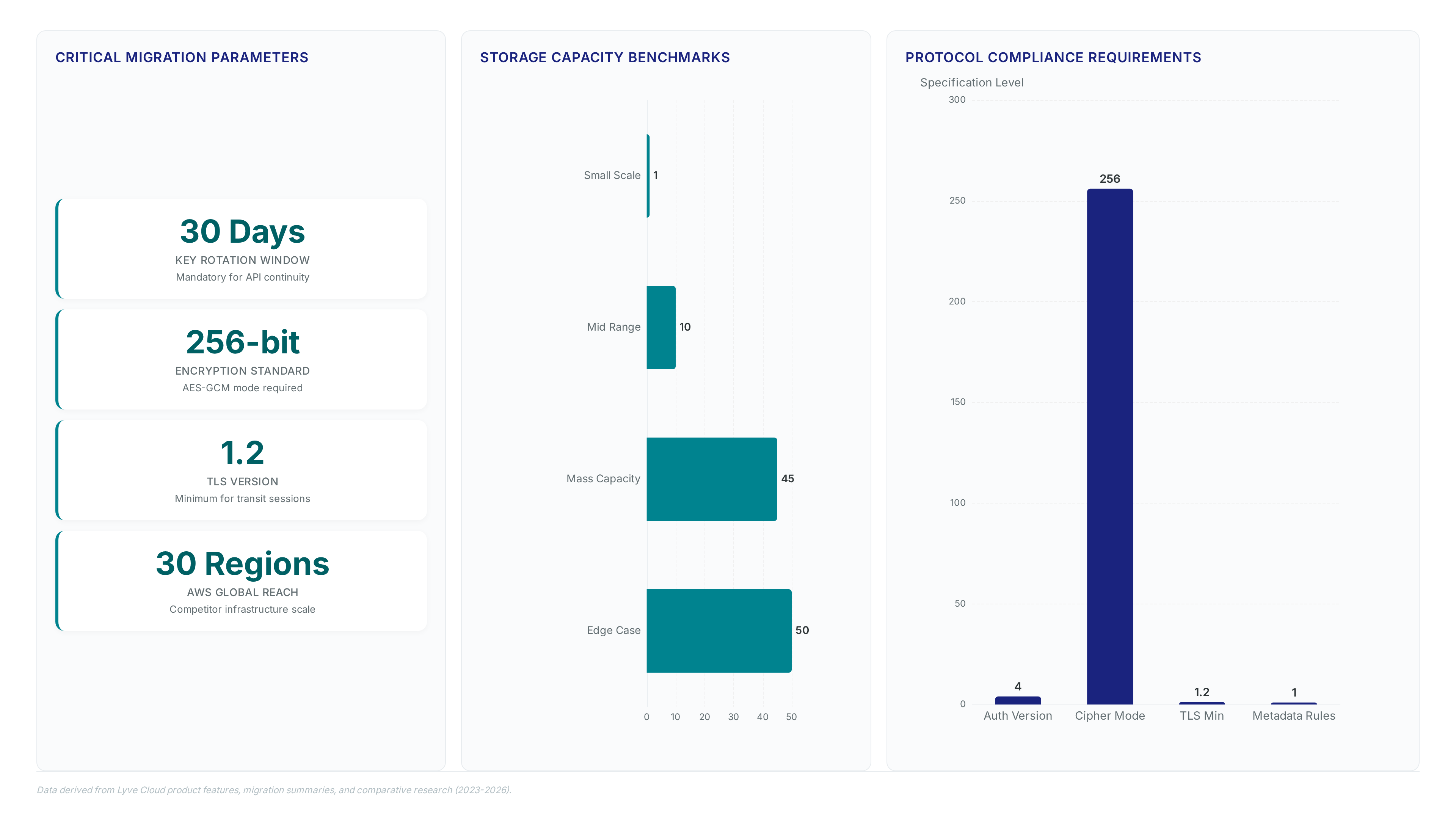
Lyve Cloud resolves S3 API transition failures by enforcing Signature Version 4 authentication alongside strict metadata sequencing rules. Operators migrating backup jobs often encounter signature mismatches because the platform processes custom metadata headers in a sequence distinct from AWS S3 standards. Correcting the header sort order before generating the cryptographic string fixes these authentication rejections without altering application logic. Data integrity relies on TLS 1.2 for all transit sessions and 256-bit AES-GCM encryption for objects at rest. This specific cipher mode provides authenticated encryption, detecting tampering attempts that standard CBC modes might miss during bulk restores.
However, strict adherence to supported S3 API calls reveals incompatibilities with non-standard vendor extensions used by some legacy backup agents. The limitation forces administrators to validate agent versions against the official compatibility matrix before cutover. Ignoring these Lyve Cloud limitations regarding metadata ordering causes silent job failures rather than immediate connection drops.
| Security Layer | Protocol Standard | Operational Constraint |
|---|---|---|
| Authentication | SigV4 | Requires exact header canonicalization |
| Transit Protection | TLS 1.2 | Rejects legacy cipher suites |
| At-Rest Encryption | AES-GCM | Needs hardware acceleration for throughput |
The consequence of this rigid implementation is higher initial configuration overhead but eliminated risk of undetected data corruption during petabyte-scale migrations.
Maintaining Veeam and Rubrik Automated Workflows Post-Acquisition
Existing Veeam and Rubrik jobs continue executing because both platforms share certified S3 compatibility with the unified infrastructure. Administrators face no immediate reconfiguration burden since the underlying SigV4 authentication and object immutability standards remain constant across the transition. The technical mechanism relies on multi-copy geographically distributed data protection, which prevents data from being changed or deleted regardless of the billing entity. This continuity eliminates the risk of backup chain breaks that typically plague storage vendor migrations.
However, the consolidation reduces the number of independent S3-compatible targets available for air-gapped redundancy strategies. Relying on a single certified system for key data protection partners like Commvault and Acronis creates a singular point of policy enforcement. Operators must verify that Covert Copy replication rules do not conflict with existing retention locks set in previous Lyve Cloud configurations. The implication is a simplified management plane but a potential reduction in vendor diversity for disaster recovery architectures.
| Workflow Component | Pre-Acquisition State | Post-Acquisition State |
|---|---|---|
| Authentication | SigV4 via Lyve Cloud | SigV4 via Wasabi |
| Certification | Independent validation | Unified validation |
| Egress Policy | Zero fee | Zero fee |
Auditing object immutability settings within backup software consoles immediately after the DNS cutover is non-negotiable. While API endpoints change, the logical behavior of TLS 1.2 transit encryption ensures that data integrity checks pass without manual intervention. This stability allows engineering teams to focus on capacity planning rather than troubleshooting broken pipelines.
Validating Object Immutability and Multi-Copy Geographically Distributed Protection
Administrators must verify object immutability settings match AWS S3 Object Lock behavior to prevent accidental deletion during migration. The platform employs multi-copy geographically distributed data protection by default, ensuring durability across distinct physical zones without manual sharding. Operators should confirm backup software like Veeam or Rubrik correctly interprets these retention policies before cutting over production jobs.
| Validation Step | Expected Outcome | Failure Symptom |
|---|---|---|
| Immutability Toggle | Write-once-read-many enforced | Objects deletable via API |
| Geo-Redundancy Check | Copies exist in multiple regions | Single-zone storage exposure |
| SigV4 Handshake | Authentication succeeds | 403 Forbidden errors |
A common oversight involves assuming certification guarantees automatic policy inheritance; distinct bucket configurations often revert to permissive defaults post-transition. The cost of neglecting this verification is measurable: unprotected backups become vulnerable to ransomware encryption chains that target mutable object stores. Testing restore procedures against locked objects validates that the distributed architecture does not introduce latency penalties during recovery windows. This specific check confirms that geographic separation supports rather than hinders restoration speed.
Executing the Migration from Lyve Cloud to the Wasabi Platform
Implementation: Defining the Lyve Cloud to Wasabi Platform Transition Scope

Defining the migration boundary requires validating SigV4 authentication strings against the new endpoint while preserving AES-GCM encryption states. Administrators must map existing bucket policies to the unified infrastructure without altering the cryptographic signature generation logic. The transition scope explicitly excludes re-architecting backup jobs because certified integrations with Veeam and Rubrik remain functional post-consolidation. Operators should verify that object immutability settings match previous retention locks before initiating data movement.
- Audit current TLS 1.2 session configurations to ensure compatibility with Wasabi ingress nodes.
- Confirm that Lyve Mobile 3.
Reconfiguring endpoints requires swapping the DNS target while preserving SigV4 signing logic to avoid authentication failures. Administrators must update the storage gateway URL in backup software configurations before restarting jobs. The migration process uses shared support for TLS 1.2 to maintain encryption standards during the handover. A specific failure mode involves custom metadata header sequencing, which differs from standard AWS implementations and causes signature mismatches if uncorrected. Operators should verify header sort orders against the supported S3 API calls documentation to prevent rejection. Physical data transfer via Lyve Mobile offers an alternative for large datasets where network bandwidth creates bottlenecks.
Certified connectors for Veeam and Rubrik require explicit re-verification against the new Wasabi endpoint to prevent silent authentication failures.
- Update the S3 gateway URL in backup policies while preserving SigV4 signing logic to avoid signature mismatches.
- Test object retention locks using supported S3 API calls to confirm immutability flags persist post-migration.
- Validate that multi-copy geographically distributed protection replicates data across zones without manual sharding intervention.
- Execute a full restore cycle to verify data durability metrics meet compliance thresholds before decommissioning legacy buckets.
| Workflow Component | Pre-Migration State | Post-Migration Requirement |
|---|---|---|
| Authentication | SigV4 on Lyve Cloud | SigV4 on Wasabi Endpoint |
| Immutability | AWS S3 Object Lock equivalent | Wasabi Object Lock Policy |
| Data Transfer | Network or Lyve Mobile | Wasabi Ingestion Nodes |
API header sequencing differences between providers often trigger 403 errors during the initial cutover phase. Operators must sort custom metadata headers explicitly to match Wasabi's parsing engine expectations. This specific configuration nuance represents a hidden failure mode unaddressed by standard migration wizards. Scripting these header validations prior to production job resumption is the only way to mitigate this risk.
About
Alex Kumar serves as a Senior Platform Engineer and Infrastructure Architect at Rabata. Io, where he specializes in Kubernetes storage architecture and cost optimization for cloud-native applications. His daily work designing S3-compatible object storage solutions for AI startups and enterprises provides unique insight into the strategic implications of Wasabi's acquisition of Seagate's Lyve Cloud business. As the industry consolidates around pure-play cloud storage, Kumar's expertise in eliminating vendor lock-in and managing egress fees allows him to critically analyze how this merger impacts market competition and pricing models. At Rabata. Io, a provider focused on high-performance, GDPR-compliant storage, he directly addresses the same scalability challenges that drive such substantial sector shifts. This background ensures his analysis of the transaction reflects the real-world needs of engineers seeking transparent, affordable alternatives to hyperscale providers in an evolving environment.
Conclusion
The real fracture point emerges not during migration, but when egress patterns shift under accelerated adoption rates projected for 2025. As organizations double their cloud footprint, the operational debt of managing disparate S3 implementations compounds, turning minor API header mismatches into systemic backup failures. Relying solely on per-gigabyte price differentials ignores the hidden labor costs of maintaining custom authentication scripts and validating immutability flags across heterogeneous environments. Predictable pricing models fail if the underlying application logic cannot sustain the throughput required by modern backup suites like Veeam or Rubrik without constant manual intervention.
Teams must standardize header normalization logic before Q4 2027 to prevent silent data corruption as scale increases. Do not wait for a failed restore to discover parsing engine incompatibilities; the window for proactive remediation closes as legacy architectures interlock with new cloud-native workflows. Start by auditing all custom backup scripts for hardcoded metadata sequencing this week, specifically targeting any logic that assumes uniform S3 header handling across providers. Execute a controlled test restore against the new endpoint using production-sized datasets to verify SigV4 signing persistence before decommissioning any legacy storage gates. This specific validation step isolates parsing failures early, ensuring that cost savings do not evaporate through unplanned downtime or compliance gaps.
Frequently Asked Questions
Seagate stock rose immediately following the public disclosure of the sale terms. The market reaction was significant, with shares jumping exactly 16.6% as investors welcomed the strategic shift.
Lattice Semiconductor moved a massive 400TB of backup archives to Lyve Cloud using managed services. This deployment demonstrated immediate Total Cost of Ownership relief before full integration into Wasabi.
Seagate offered an infrequent access tier priced at $45 per TB per year for retention. This cost structure provided relief before customers transitioned to the new unified Wasabi platform.
Seagate reported $10.05 billion in trailing revenue while deciding to divest its cloud arm. This financial scale allowed the company to prioritize core mass-capacity hardware manufacturing instead.
Cloud adoption rates hit 63% in 2025, creating urgent scale needs for providers. This growth forced independent storage vendors to merge to survive economic pressure from hyperscalers.