Swiss sovereign cloud blocks US CLOUD Act risks
Ailanto is launching a 1 PB sovereign cloud in Switzerland using Cubbit's DS3 Composer software to bypass US jurisdiction.
This deployment proves that federated cloud architectures now offer a viable, cost-competitive alternative to hyperscale giants for strict data residency needs. As Blocks & Files reports, IT integrator Ailanto is using this technology to construct a storage network fully hosted within Swiss borders, directly addressing the vulnerabilities organizations face under the US CLOUD Act. With global data storage demand forecast to triple by 2027, the urgency for such scalable, localized solutions has never been higher.
Readers will learn how Swiss cantonal sovereignty changes data governance by allowing geofenced deployments tailored to specific regional regulations rather than broad national zones. Finally, the analysis covers the strategic advantages of this federated model over traditional providers like AWS or Azure, highlighting how local control mitigates legal risks while maintaining S3 compatibility for backup and low-latency application hosting.
The Definition of Sovereign Cloud in the Swiss Cantonal Context
Sovereign Cloud Definition Under Swiss CLOUD Act Constraints
Sovereign cloud architecture in Switzerland mandates that data storage remains physically isolated within national borders to nullify extraterritorial legal reach. US-owned public clouds including Azure, Google, and AWS remain susceptible to data access demands under the CLOUD Act, creating inherent risk for sensitive cantonal records. A public cloud owned and operated within a sovereign territory faces significantly lower probability of external data access requests. This legal distinction drives the requirement for infrastructure where no foreign entity holds administrative control or physical key access.
Custom geo-distribution rules enforce data residency at the cantonal level by restricting object placement to specific Swiss nodes. Ailanto deployed this architecture with an initial 1 petabyte capacity to serve municipalities without cross-border exposure. Hyperscalers typically rely on broad regional zones that fail strict local mandates unless expensive sovereign add-ons are purchased. The DS3 Composer software defines these boundaries through policy tags rather than physical rack isolation. Operators configure the geo-fencing policy to reject any write operation targeting storage nodes outside the assigned canton. This approach eliminates the legal risk of foreign subpoena while maintaining S3 compatibility for legacy applications.
Operators purchasing add-ons often overlook that data egress points remain vulnerable to foreign subpoenas despite local processing promises. True sovereignty requires the infrastructure itself to reject non-compliant write operations automatically. The custom geo-distribution capability ensures objects never traverse nodes outside the set Swiss cantons. This architectural rigidity prevents the accidental exposure common in flexible global clouds. Mission and Vision recommends native models for any dataset subject to strict sectoral mandates.
Inside DS3 Composer Architecture for Geo-Distributed Object Storage
DS3 Composer Peer-to-Peer Swarm Architecture
DS3 Composer constructs a peer-to-peer swarm where customer nodes function as gateways and brokers in a distributed mesh, eliminating centralized data centers . The software ingests physical or virtual hardware from on-premises sites, MSP facilities, or co-locations to form a unified single data domain. This architecture fragments and encrypts objects before distribution, contrasting sharply with the replication models of provider-owned data centers Capacity scales from terabytes to petabytes without requiring proprietary appliance purchases.
| Component | Traditional Hyperscaler | DS3 Composer Swarm |
|---|---|---|
| Node Ownership | Provider | Customer or MSP |
| Data Placement | Centralized Zones | Distributed Mesh |
| Failure Domain | Availability Zone | Individual Node |
| Scaling Unit | Fixed Rack | Incremental Node |
Operators deploy this S3-compatible storage by connecting bare metal servers to the logical pool. Herabit utilized this model across three facilities to satisfy data sovereignty demands while supporting AI data lakes. The trade-off involves increased operational complexity: network engineers must manage node health and connectivity across disparate physical locations rather than relying on a single vendor SLA. Fragmentation ensures that no single node holds a complete object, enhancing security but demanding consistent low-latency links between peers. Mission and Vision recommends validating underlying network topology before scaling the swarm to prevent bottlenecks during erasure coding reconstruction.
Deploying Ailanto's Federated Swiss S3 Cloud
Ailanto integrates DS3 Composer into partner datacenters to launch a sovereign S3 service in minutes. This federated model ingests on-premises, MSP, or co-lo nodes to form a unified single data domain without proprietary hardware. Operators configure geo-fencing policies that restrict object placement strictly within Swiss territory, satisfying cantonal mandates that hyperscalers often miss. The deployment process uses automated scripts to stand up the cluster rapidly, bypassing the lengthy procurement cycles typical of traditional infrastructure projects.
| Deployment Phase | Traditional Hyperscaler | Ailanto Federated Model |
|---|---|---|
| Node Provisioning | Vendor-managed zones | Partner-owned hardware |
| Sovereignty Control | Contractual add-ons | Native geo-distribution rules |
| Time to Service | Weeks | Minutes |
| Data Residency | Regional | Cantonal |
The architecture fragments data across independent nodes rather than replicating within a single availability zone, eliminating single points of failure. This approach enables the project to scale from an initial 1 petabyte. However, the reliance on partner hardware introduces variability in node performance that centralized providers mask through abstraction. Network engineers must validate underlying physical links to prevent uneven erasure coding reconstruction times. The tension between rapid deployment and heterogeneous hardware quality requires strict baseline checks before adding nodes to the peer-to-peer swarm. Mission and Vision recommends auditing partner network latency prior to production cutover.
Minimum Bare Metal Requirements for Cluster Durability
Cluster stability fails immediately if operators provision fewer than three bare metal servers to form the initial mesh. This hard threshold prevents split-brain scenarios inherent in distributed consensus protocols, ensuring the swarm architecture maintains quorum during node failures. Cubbit describes its technology as providing hyper-resilient and cybersecure technology only when this minimum hardware baseline is met across the deployment. Attempting to run the software on dual-node configurations introduces a single point of failure that voids the redundancy guarantees necessary for sovereign data retention.
The operational overhead for standing up this resilient fabric remains low despite the hardware constraints. Automated Ansible playbooks compress the entire configuration cycle into roughly 15 minutes, bypassing manual tuning errors common in traditional storage arrays. This speed allows rapid iteration on geo-fencing policies without sacrificing the underlying fault tolerance required by Swiss cantonal laws.
| Constraint | Impact on Durability | Compliance Risk |
|---|---|---|
| < 3 Nodes | Total cluster collapse | High |
| 3+ Nodes | Full erasure coding | Low |
| Manual Config | High drift probability | Medium |
Mission and Vision recommends validating hardware inventory against the three-node rule before initiating any sovereign cloud migration to avoid immediate service degradation.
Strategic Advantages of Federated Cloud Over Hyperscale Providers
Federated Cloud Cost Structure Versus Hyperscaler Pricing Models
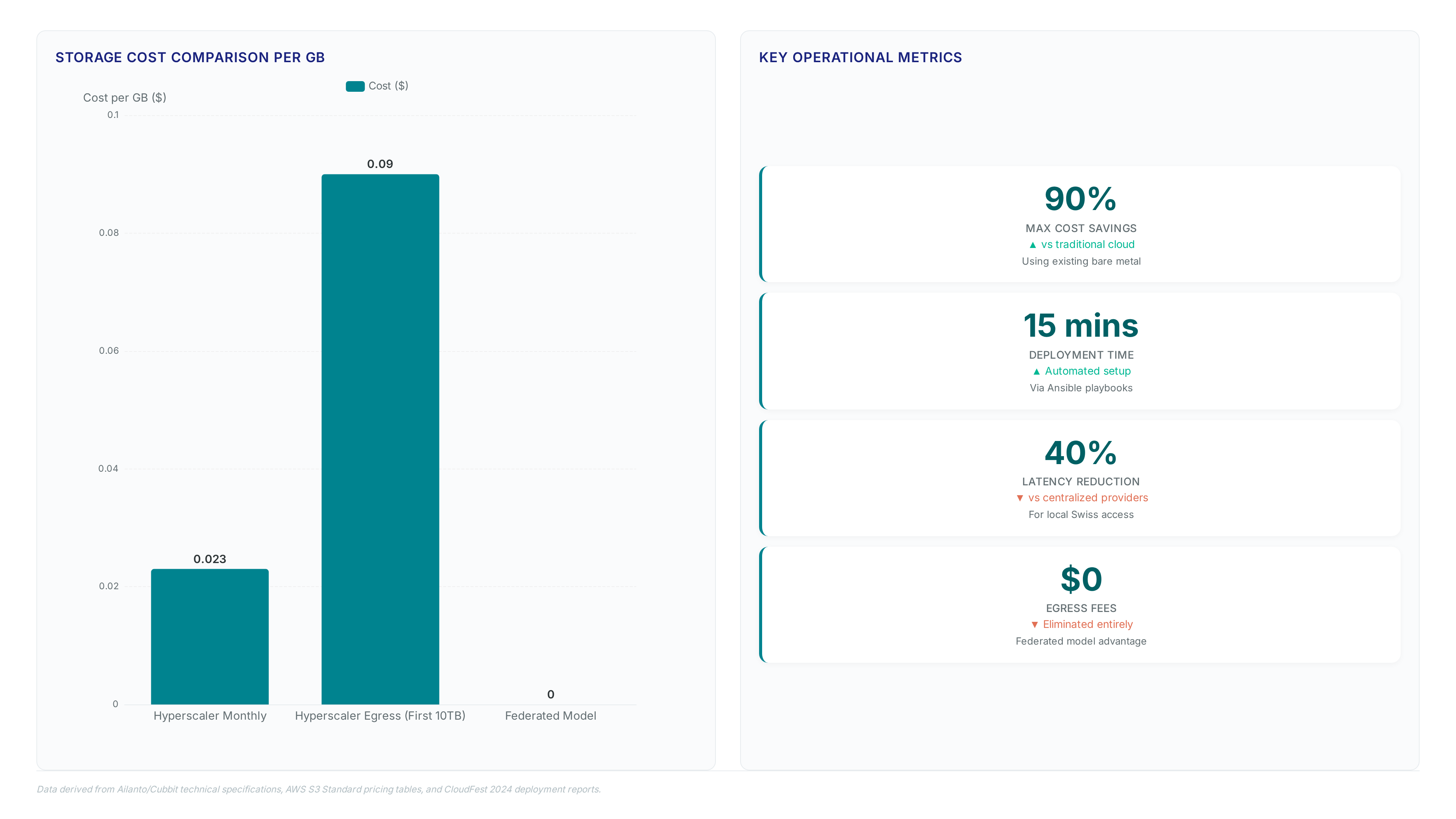
AWS charges $0.09/GB for egress on the first 10 TB, whereas Cubbit's distributed model avoids these fees entirely. This structural difference shifts the economic baseline from variable consumption charges to predictable hardware utilization. Hyperscalers like AWS S3 Standard levy rates near $0.023/GB/month alongside steep exit penalties, creating a financial lock-in that penalizes data retrieval. The federated approach uses existing bare metal to achieve claimed savings of a substantial portion to 90% against traditional cloud and on-premises solutions. Operators effectively replace recurring egress taxes with capital expenditure on commodity servers, altering the total cost of ownership curve notably. Ailanto uses this mechanic to offer software-set object storage that scales from terabytes to petabytes within a single domain. Eliminating egress fees removes the disincentive for local data processing, enabling high-frequency backup cycles without budget alerts. Hardware refresh cycles and physical security become the sole responsibility of the operator. This constraint favors organizations with existing datacenter footprints seeking to maximize asset utility. The elimination of per-gigabyte exit taxes fundamentally changes how architects design data retrieval workflows.
Real-World Federated Deployments at Leonardo and Herabit
Carlo Cavazzoni at Leonardo endorsed DS3 Composer to handle anticipated storage tripling without hyperscaler lock-in. This defense giant manages sensitive telemetry by enforcing strict geographic boundaries that US-owned providers cannot guarantee under the CLOUD Act. The architecture fragments data across a peer-to-peer mesh, eliminating single points of failure inherent in centralized racks. Herabit executed a similar migration across three data centers Italian regulators demanded local residency, forcing a shift away from public cloud regions lacking cantonal-level granularity. The deployment utilized existing bare metal to construct a sovereign single data domain for machine learning workloads. Capital expenditure moves from recurring rental fees to upfront infrastructure investment. Sovereignty requires managing the underlying bare metal servers directly. Mission and Vision recommends validating network latency between distributed nodes before committing to a multi-site swarm architecture.
Managed Swiss Hosting Versus On-Prem DS3 Composer Clusters
Choosing between Ailanto's managed Swiss service and self-hosted DS3 Composer clusters depends on whether an organization prioritizes immediate operational simplicity or total infrastructure control. The managed option eliminates hardware procurement delays, using partner datacenters to align with the market shift toward hybrid cloud as default architecture. This path suits entities lacking dedicated storage engineers, as it abstracts the complexity of maintaining the underlying swarm architecture. Conversely, on-premises deployment grants full authority over geo-fencing policies and physical security boundaries. Operators using automated playbooks can stand up a compliant cluster in roughly 15 minutes, bypassing the friction typical of traditional infrastructure projects described in recent deployment speed analyses. The limitation involves assuming full responsibility for hardware lifecycle and power efficiency, directly impacting the organization's contribution to regional green data centers initiatives. Mission and Vision recommends the managed tier for rapid compliance needs, while reserving on-premises builds for entities requiring absolute physical custody of storage media.
Deploying a Cantonal Sovereign Cloud with DS3 Composer
DS3 Composer Software-Set Object Storage Capabilities

Three bare metal servers establish the minimum quorum for a functional DS3 Composer cluster, preventing split-brain consensus failures.
- Provision hardware meeting the three-node baseline to enable erasure coding across independent physical units.
- Execute automated Ansible playbooks to instantiate the peer-to-peer swarm in approximately 15 minutes deployment time
- Define cantonal geo-fencing policies that restrict data shards to specific Swiss territories before writing objects.
The software scales capacity from terabytes to petabytes within a single data domain without architectural refactoring.
Meanwhile, three bare metal servers form the mandatory quorum to prevent split-brain consensus failures during cluster initialization. 1. Provision hardware nodes meeting the minimum baseline to enable erasure coding across independent physical units. 2.3. Install the DS3 Gateway on a conformant Kubernetes cluster using the provided installer script Kubernetes resources. | Deployment Mode | Control Level | Compliance Scope | | :--- | :--- | :--- | | Managed Swiss Hosting | Low | Cantonal | | On-Premises Cluster | High | Custom |
Operators skip manual configuration steps that frequently introduce syntax errors in legacy storage stacks. The rapid rollout capability supports the initial capacity Speed introduces risk if geo-fencing policies remain undefined before the first object write. Mission and Vision recommends validating geo-fencing policies immediately after playbook execution to lock data within Swiss borders. Automated scripts accelerate deployment but cannot verify legal residency constraints without explicit operator input.
About
Alex Kumar, Senior Platform Engineer and Infrastructure Architect at Rabata. Io, brings deep technical expertise to the evolving environment of sovereign cloud infrastructure. His daily work designing Kubernetes storage architectures and optimizing disaster recovery strategies directly aligns with the critical requirements of data residency and control discussed in sovereign cloud deployments. At Rabata. Io, a specialized S3-compatible object storage provider, Kumar engineers solutions that eliminate vendor lock-in while ensuring strict GDPR compliance across EU data centers. This practical experience in building cost-effective, high-performance storage alternatives to substantial hyperscalers provides him with unique insights into how organizations can achieve true data sovereignty. By using his background in scaling infrastructure for AI/ML startups and enterprise clients, Kumar effectively bridges the gap between theoretical sovereign cloud mandates and the tangible engineering realities required to implement secure, localized data storage solutions globally.
Conclusion
Sovereign cloud architectures break when organizations mistake rapid deployment for complete governance. While Ansible playbooks compress setup time to minutes, the ongoing operational cost shifts from hardware procurement to continuous legal verification. As global data storage demand triples by 2027, relying solely on automated scripts without set residency boundaries invites severe compliance drift. The real friction emerges not during installation, but when egress policies conflict with unverified node locations across distributed swarms.
Organizations must adopt a hybrid sovereignty model by Q4 2027, reserving on-premises clusters for regulated core data while using managed Swiss hosting for archival workloads. This approach balances the significant share to 90% cost savings of distributed metal against the absolute control required for sensitive state data. Do not attempt to force a single deployment mode across all data classes; the complexity of managing geo-fencing at scale will erode those initial efficiency gains.
Start by auditing your current data classification schema this week to identify which datasets legally require physical node ownership versus those suitable for managed cantonal hosting. Map these requirements against your existing Kubernetes capabilities before executing any further cluster expansions. This specific inventory prevents the costly refactoring of storage policies after petabytes of non-compliant data have already been written to the swarm.
Frequently Asked Questions
US-owned clouds face data access demands under the CLOUD Act. Foreign capital infusion like the recent $400 million investment does not automatically resolve this jurisdictional exposure for data at rest.
The software-defined storage solution allows operators to stand up a compliant cluster in roughly 15 minutes. This speed bypasses the friction typical of traditional cloud infrastructure provisioning methods.
Ailanto deployed this architecture with an initial 1 petabyte capacity to serve municipalities. This setup ensures objects never traverse borders or leave specific municipal jurisdictions without cross-border exposure.
Operators configure geo-fencing policies to reject writes targeting nodes outside the designated canton. This approach eliminates legal risk of foreign subpoena while maintaining S3 compatibility for legacy applications.
Hyperscalers retrofit broad regional zones, whereas native federated models enforce data residency at the cantonal level. This ensures strict local mandates are met without purchasing expensive sovereign add-ons.