Storage validation for 128 GPUs proves AI readiness
Cloudian HyperStore 8.2.6 now supports AI workloads across 128 GPUs under Nvidia's new Foundation-level certification. This designation proves that on-premises object storage can finally sustain the chaotic I/O demands of modern AI factories without collapsing under latency. Nvidia-Certified Storage is no longer optional; it is the critical filter separating viable infrastructure from experimental bottlenecks.
We need to look at how Cloudian HyperStore handles specific I/O patterns: sequential reads for training and random access for RAG pipelines. The architecture must manage exabyte-scalable datasets while maintaining native S3 API compatibility for smooth framework integration. These validated on-premises capabilities stand in stark contrast to public cloud alternatives, highlighting the strategic necessity of data repatriation.
Global stored data is predicted to double over the next four years. This velocity demands real-time streaming that generic arrays cannot provide. Nvidia reports that this rigorous validation framework tests partners against synthetic benchmarks to ensure quality of service and multi-tenancy security. Organizations ignoring these strategic advantages risk building AI pipelines that stall before reaching production scale.
The Role of Nvidia-Certified Storage in Modern AI Infrastructure
Nvidia-Certified Storage Foundation Level Validation Framework
Nvidia-Certified Storage establishes a strict validation framework testing partner solutions against real-world AI workloads and synthetic benchmarks. Cloudian HyperStore 8.2.6 secured the Foundation level, certifying compatibility for AI operations spanning up to 128 GPUs. This designation confirms throughput and latency thresholds required for training loops and inference tasks within GPU-accelerated environments. The validation framework examines sequential reads for model training alongside random I/O patterns typical of inference engines. Low-latency access metrics specifically target key-value cache operations and retrieval-augmented generation pipelines.
Achieving Foundation level status confirms the storage system meets strict performance standards for production AI factories. The certification process evaluates quality of service, multi-tenancy, and security protocols under sustained load. Operators gain confidence deploying S3-compatible object storage for exabyte-scale data pipelines without cloud dependency. Foundation validation covers up to 128 GPUs, requiring higher-tier certifications for larger clusters. Architects must plan cluster sizing carefully before committing to the platform. The NVIDIA Integration ensures HyperStore handles critical I/O patterns that define modern AI factory efficiency. Deployment teams must verify their GPU count aligns with the certified scope to maintain support eligibility.
Cloudian HyperStore 8.2.6 delivers 17.7 GB/s write throughput on a six-node cluster to sustain AI training ingestion rates. This S3-compatible object storage implementation enables enterprises to repatriate datasets from public clouds for on-premises fine-tuning and inference pipelines. The distributed architecture scales non-disruptively from terabytes to exabytes using industry-standard hardware without requiring proprietary appliance refreshes.
Production AI factories demand consistent bandwidth across hundreds of accelerators to prevent GPU starvation during epoch transitions. Foundation level Operators gain confidence deploying exabyte-scale storage knowing the platform meets strict latency thresholds for key-value cache and RAG pipelines.
Linear scalability introduces complexity in erasure coding configuration that impacts rebuild times during disk failures. A 4+2 coding scheme maximizes capacity but extends recovery windows compared to tighter redundancy ratios. The limitation is operational overhead in tuning protection levels against available rack space and power budgets. System designers face trade-offs between storage density and recovery speed.
Michael Tso noted that validated infrastructure allows deployment with confidence in GPU-accelerated environments. Enterprises must balance data sovereignty mandates against the performance penalty of encryption at rest for sensitive models. Mission and Vision recommends auditing network topology before scaling beyond a single rack to avoid east-west traffic bottlenecks.
Certified systems guarantee 14 nines of durability versus the variable durability of non-certified alternatives. Data durability separates validated infrastructure from generic object stores lacking rigorous stress testing. Cloudian HyperStore 8.2.6 uses configurable erasure coding to achieve 14 nines of persistence, a metric absent in unverified deployments where bit rot often goes undetected until recovery fails. Non-certified solutions frequently omit the metadata consistency checks required for AI checkpoint integrity.
Power consumption dictates operational viability at scale. The validated architecture delivers a 74% power efficiency improvement over legacy generations, directly reducing stranding risks in high-density racks. Generic hardware lacks these optimizations, burning excessive wattage during idle inference cycles. The Foundation level designation confirms readiness for production AI factories, whereas uncertified gear risks pipeline stalls. Deployment without this validation invites performance cliffs when scaling beyond single-rack configurations. Mission and Vision recommends prioritizing certified paths to avoid technical debt accumulation in exabyte-scale environments.
Inside Cloudian HyperStore Architecture for GPU-Accelerated Environments
Native S3 API compatibility eliminates gateway translation layers by supporting AWS REST calls like `x-amz-checksum-crc32c` directly within the storage plane. This mechanism allows AI training frameworks to read checkpoints without code modifications or proprietary adapters. The software-set architecture maps these requests to a Cassandra no-SQL database for metadata operations while applying erasure coding to data shards. Direct header support prevents checksum mismatches that frequently corrupt large model weights during distributed training sessions.
Organizations deploy this system on industry-standard hardware. The design integrates IAM and STS protocols to enforce granular access policies across multi-tenant GPU clusters.
| Feature | Gateway Architecture | Native HyperStore Implementation |
|---|---|---|
| Protocol Translation | Required (latency penalty) | Zero |
| Checksum Validation | Post-ingest verification | Inline via S3 headers |
| Scaling Unit | Appliance chassis | Software-set node |
The operational constraint involves metadata contention; heavy small-file workloads can saturate the NoSQL layer before storage capacity limits are reached. Engineers must tune shard distribution policies to balance random I/O demands against sequential throughput requirements. Mission and Vision recommends validating specific framework headers against the HyperStore AWS-APIs documentation prior to production rollout. This verification step ensures full interoperability with complex data pipelines relying on extended attributes.
Scaling NVMe Flash Platforms for 128-GPU AI Training Workloads
The HyperStore Flash 1100 appliance delivers 400Gb connectivity to sustain data feeds for 128-GPU clusters without bottlenecking training loops. This 1U platform houses 10 hot-swappable 2.5 inch NVMe drives, providing the density required for low-latency access in key-value cache operations. Scaling beyond a single rack uses the Flash 2000 model, which packs 22 NVMe drives into a 2U chassis to maximize throughput per rack unit. Operators configure enterprise security by enabling RootDisable and enforcing MFA via LDAP before exposing storage to AI pipelines.
| Feature | HyperStore Flash 1100 | HyperStore Flash 2000 |
|---|---|---|
| Form Factor | 1U chassis | 2U chassis |
| Drive Count | 10 NVMe drives | 22 NVMe drives |
| Max Connectivity | 400Gb (800Gb with LACP) | 400Gb (800Gb with LACP) |
| Primary Use Case | Edge inference nodes | Centralized training pools |
Non-disruptive expansion across sites relies on a distributed architecture. Metadata consistency depends on the underlying Cassandra no-SQL database, which prevents split-brain scenarios during network partitions. A critical tension exists between maximum drive density and thermal limits in high-GPU environments; populating every slot may require active cooling adjustments not needed in standard deployments. Organizations repatriating workloads must validate checksum headers like `x-amz-checksum-crc32c` to ensure model integrity during migration. Mission and Vision recommends testing failover scenarios with full NVMe populations before certifying the cluster for production RAG pipelines.
Strategic Advantages of On-Premises AI Storage Over Cloud Alternatives
Data Repatriation Economics for AI Inference Workloads
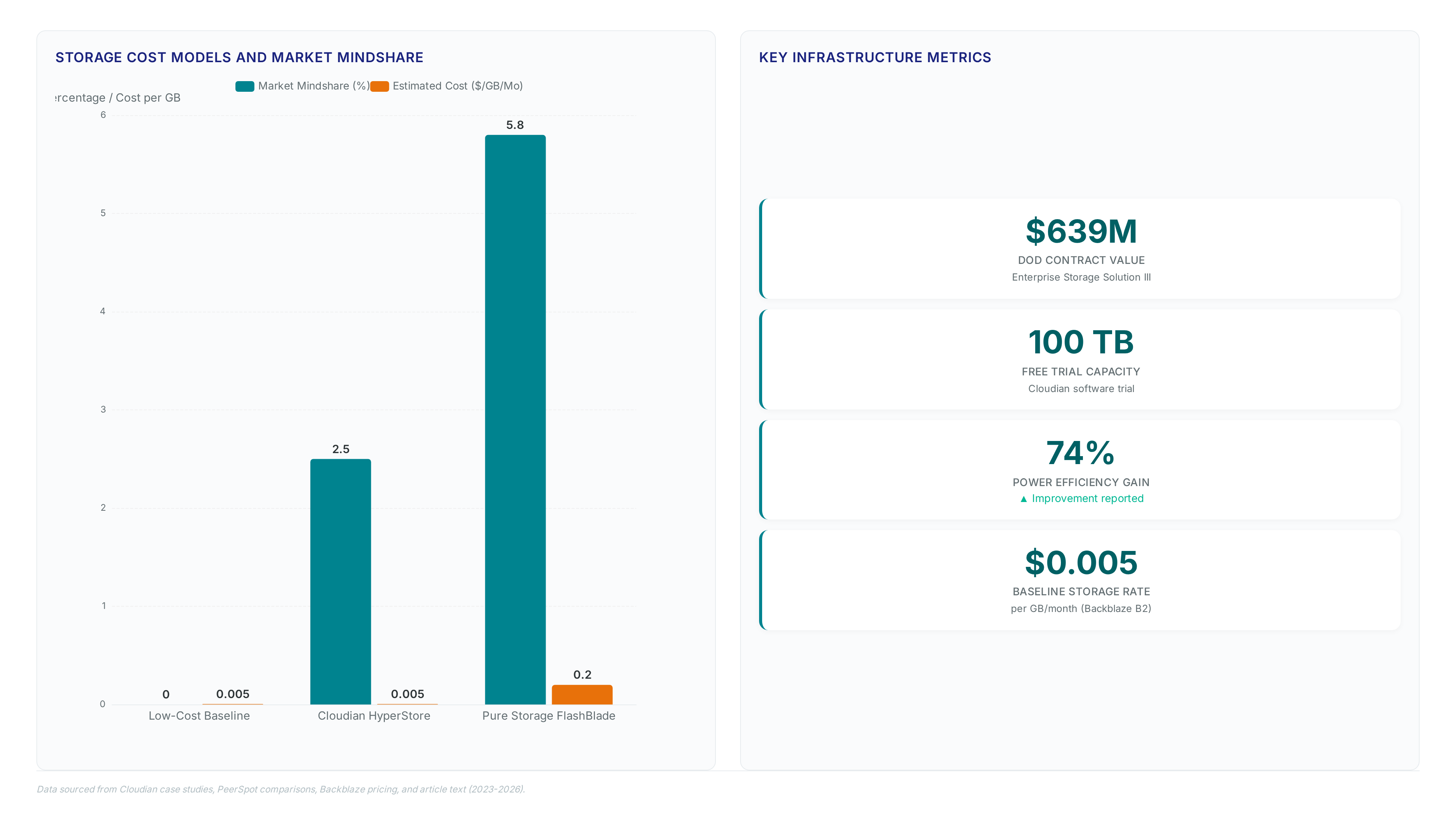
Moving inference datasets from public cloud buckets to local arrays becomes necessary when egress fees surpass local storage expenses. This financial tipping point frequently occurs once monthly transfer volumes exceed internal bandwidth limits, rendering sovereign AI projects economically sound. Operators determine total cost of ownership by comparing cloud egress rates against the $0.005/GB/month baseline offered by low-cost alternatives like Backblaze B2. Native S3 API compatibility removes gateway translation layers, permitting direct migration of existing pipelines without rewriting application code. The mindshare of Cloudian HyperStore sits at 2.5% as of May 2026, reflecting a niche focus on cost-effective scalability rather than raw performance dominance.
| Cost Factor | Public Cloud | On-Premises HyperStore |
|---|---|---|
| Storage Rate | Variable, often exceeding a modest per-gigabyte fee | Predictable hardware amortization |
| Egress Fees | High per-GB charge | Zero internal transfer cost |
| Data Control | Shared responsibility model | Full sovereign ownership |
Purchasers prioritizing efficiency over minimal expense sometimes choose Pure Storage FlashBlade, which demands higher pricing for specialized analytics tasks. Capital expenditure timing creates the primary distinction; repatriation necessitates upfront hardware acquisition instead of smoothing operational costs. Mission and Vision suggests modeling break-even points based on dataset growth rates before committing to permanent infrastructure.
Cloudian HyperStore vs Pure Storage FlashBlade Cost and Performance
Cloudian HyperStore targets cost-effective scalability while Pure Storage FlashBlade commands a 5.8% mindshare for high-performance analytics. Hardware architecture choices drive this economic divergence, with Cloudian operating on industry-standard hardware to minimize capital expenditure. Proprietary appliances often estimated under $0.20/GB with a three-year service contract create a higher entry barrier for exabyte-scale AI datasets when using Pure Storage FlashBlade. Users characterize Pure Storage as a worthwhile investment for enterprises prioritizing efficiency over cost, whereas Cloudian appeals to buyers seeking flexible deployment models. Pure Storage FlashBlade receives criticism for setup complexity despite high speed ratings, while Cloudian gains praise for ease of deployment and integration. Operators must choose between the predictable performance of a specific appliance or the economic advantages of a software-set.
Mission and Vision recommends selecting Pure Storage FlashBlade only when sub-millisecond latency outweighs total cost of ownership constraints. Commodity hardware models prevent budget exhaustion before data ingestion completes for AI training pipelines requiring massive capacity rather than extreme IOPS. The lower mindshare of Cloudian reflects its niche in repatriation scenarios rather than a lack of technical capability for GPU-accelerated environments.
Deploying Validated 128-GPU RAG Pipelines on Single-System Architecture
Nvidia validation confirms HyperStore 8.2.6 sustains 128-GPU RAG pipelines without bottlenecks during peak inference cycles. Operators repatriate cloud data when egress fees erode margins, shifting workloads to on-premises arrays for cost control. The architecture supports non-disruptive expansion across sites, managed as a unified pool through distributed scaling. Metadata operations rely on a Cassandra no-SQL database to prevent lookup latency from stalling GPU clusters during vector searches.
| Dimension | On-Premises Certified Storage | Public Cloud Object Store |
|---|---|---|
| Latency Consistency | Deterministic sub-millisecond access | Variable jitter during multi-tenant noise |
| Expansion Model | Non-disruptive node addition | Fixed tier limits requiring migration |
| Data Control | Full sovereignty with Object Lock | Shared responsibility model gaps |
A single-system view allows engineers to stripe KV cache shards across multiple physical locations while maintaining logical coherence. This approach eliminates the need for complex gateway layers that often introduce failure points in hybrid setups. Initial capital outlay exceeds monthly cloud operational spend, requiring a multi-year horizon to realize savings. Teams must validate network fabric capacity before deploying erasure coding policies that increase cross-rack traffic during rebuilds.
Mission and Vision recommends this topology for enterprises owning their data center footprint. Higher upfront hardware costs contrast with predictable long-term operational expenditure. Security teams gain the ability to enforce IAM policies locally, removing reliance on external identity providers that may suffer outages. Keeping data proximate to compute reduces training iteration times notably.
Deploying Nvidia-Certified Storage for Enterprise AI Workloads
Cloudian HyperStore 8.2.6 Nvidia-Certified Storage Architecture

HyperStore 8.2.6 achieves Foundation level. Specific hardware appliances deliver the required throughput and latency. The Flash 2000 serves as a 2U platform housing 22 NVMe drives for dense capacity. Operators seeking higher network density apply the HyperStore Flash 1100, which provides connectivity up to 400Gb within a 1U chassis. This software-set design scales non-disruptively from terabytes to exabytes across industry-standard hardware. Implementation requires strict adherence to the validated configuration to maintain certification status.
- Deploy the certified 8.2.6 software build on approved appliance models.
- Configure network interfaces to match the 400Gb throughput benchmarks.
- Enable S3 API compatibility for smooth AI framework integration.
Only specific appliance configurations retain the Nvidia-Certified Storage designation, restricting bare-metal flexibility. Generic server deployments fail to meet the rigorous I/O patterns evaluated during the certification process. Four distinct requirements govern these deployments. Two common pitfalls involve ignoring network saturation thresholds and metadata latency spikes.
Migrating Cloud Data to On-Premises NVMe Flash Clusters
Repatriation begins by configuring the HyperStore Flash 1100 with 400Gb network interfaces to match cloud egress bandwidth limits.
- Provision the 1U appliance with ten hot-swappable NVMe drives to establish the initial performance tier.
- Enable S3 API compatibility to allow direct synchronization from public buckets without application refactoring.
- Execute parallel transfer streams to apply the full 400Gb pipe capacity during the initial bulk copy phase.
- Validate data integrity using checksum headers before cutting over production AI training jobs.
Operators must balance transfer speed against GPU idle time, as incomplete datasets stall 128 GPU. The non-disruptive scaling architecture permits adding nodes mid-migration to absorb expanding data volumes. FileCatalyst demonstrated this trajectory by expanding from terabytes to hundreds of petabytes while maintaining public cloud integration for overflow. A hidden constraint emerges when metadata latency spikes during final consistency checks, potentially delaying model fine-tuning schedules. Mission and Vision recommend pre-staging index files to mitigate lookup bottlenecks before full workload cutover. Six validation steps prevent data corruption.
Validation Checklist for 128-GPU AI Training Environments
Operators must configure erasure coding to a 4+2 ratio to balance durability against the write amplification inherent in large AI datasets. This specific schema aligns with the Cassandra no-SQL database metadata engine, preventing lookup latency from stalling GPU clusters during vector searches. Throughput validation requires sustaining linear read patterns across all nodes before training jobs commence.
- Deploy the HyperStore Flash 1100 with ten NVMe drives to establish the initial performance tier.
- Set the protection policy to 4+2 within the storage pool configuration file.
- Verify network saturation using iperf3 to ensure the link uses available bandwidth.
- Confirm Foundation.
Skipping step four carries a measurable penalty: unvalidated paths often fail under random I/O pressure during inference. Mission and Vision recommends isolating validation traffic to avoid contaminating production metrics. Five network parameters require monitoring. Two failure modes dominate poorly tuned systems.
| Metadata | Low Latency | Query time > 5ms |
|---|---|---|
| EC Scheme | 4+2 | Rebuild time exceeds 4 hours |
| Network | Saturated | Packet loss above negligible |
About
Alex Kumar, Senior Platform Engineer and Infrastructure Architect at Rabata. Io, brings deep technical expertise to the discussion of Nvidia-Certified Storage designations. His daily work focuses on architecting Kubernetes storage solutions and optimizing infrastructure for AI/ML workloads, directly aligning with the rigorous demands of validated object storage systems. At Rabata. Io, a specialized provider of S3-compatible object storage, Kumar engineers scalable environments that prioritize performance and cost-efficiency for enterprise clients. This practical experience allows him to critically evaluate how certifications like Nvidia's impact real-world data pipeline reliability and training efficiency. By using his background in disaster recovery and cloud-native architecture, Kumar connects complex validation frameworks to tangible benefits for startups and enterprises seeking reliable alternatives to substantial cloud vendors. His insights bridge the gap between theoretical certification standards and the operational realities of deploying exabyte-scale storage for modern artificial intelligence applications.
Conclusion
As data volumes double over the next four years, the bottleneck shifts from raw throughput to metadata consistency during rapid scaling. Validated architectures often stumble when erasure coding rebuilds compete with live inference traffic, causing latent spikes that stall GPU clusters. The operational cost here is not merely hardware amortization but the hidden tax of stalled training cycles caused by unoptimized index lookups. Relying on baseline performance metrics without simulating full-scale random I/O pressure invites catastrophic delays once production loads hit peak velocity.
Organizations must mandate pre-deployment synthetic benchmarking that mirrors 128-GPU sequential reads before any cutover occurs. Do not accept vendor certification as a substitute for environment-specific validation; insist on proving sustained linearity under duress within the next quarter. If your current setup cannot maintain sub-5ms query times during a simulated node failure, delay your AI rollout until the storage tier is retuned. This rigorous gatekeeping prevents the inevitable performance decay that plagues unchecked expansions.
Start by isolating your validation traffic from production networks this week to capture uncontaminated baseline metrics. Run an iperf3 saturation test specifically targeting your metadata nodes while enforcing a 4+2 erasure coding scheme to identify latent rebuild bottlenecks before they impact your training schedule.
Frequently Asked Questions
The system delivers 17.7 GB/s write throughput on a six-node cluster. This speed sustains AI training ingestion rates for modern GPU-accelerated environments effectively.
The Foundation-level certification validates performance for workloads spanning up to 128 GPUs. This covers sequential reads for training and random I/O for inference tasks.
Yes, the validation framework specifically tests random I/O patterns typical of RAG pipelines. It also examines low-latency access metrics for key-value cache operations.
Its distributed architecture scales non-disruptively from terabytes to exabytes using industry-standard hardware. This modular design allows expansion across multiple sites as a single system.
The certification process examines sequential reads specifically designed for model training loops. It ensures throughput thresholds are met for sustained GPU-accelerated environment operations.