Neocloud storage bottlenecks: Why GPUs stall
Neoclouds managing five exabytes of data can now bypass years of engineering to support AI workloads with Backblaze's new B2 Neo launch.
The industry's pivot toward integrated object storage is no longer optional but a critical survival mechanism for providers racing to feed hungry GPU clusters. As generative AI demand surges, with over 70% of enterprises expanding capacity specifically for training datasets in 2024, the bottleneck has shifted from compute power to data throughput. Backblaze addresses this by offering a write-through cache design that delivers 1 terabit per second throughput without the scalability ceilings of all-flash architectures. This approach allows emerging platforms to offload the heavy lifting of storage infrastructure while maintaining the illusion of a native, unified service.
Readers will examine how neocloud platforms use this integration to avoid diverting capital from core compute expansion. Finally, the analysis covers white-label integration, detailing how providers retain full control over billing and provisioning while outsourcing the underlying complexity. By adopting these turnkey solutions, operators can eliminate the latency penalties of data shuttling and ensure expensive silicon never sits idle waiting for bytes.
The Role of Integrated Object Storage in Modern Neocloud Platforms
Backblaze B2 Neo Definition for Neocloud Platforms
Backblaze launched B2 Neo on February 23, 2026, as a white-label object storage layer for AI-focused neocloud platforms like CoreWeave and Nebius. This integrated object storage system lets providers outsource complex disk management while presenting a native service tier to end users. The architecture uses a write-through cache design with strategically deployed flash layers to capture high aggregate throughput without the cost penalties of all-flash arrays. Such a configuration sustains performance at the multi-petabyte scale where pure flash architectures face hard scalability limits.
Neocloud adoption hinges on this specific trade-off between capital expenditure and operational focus. A substantial global edge services platform selected the solution to avoid diverting engineering resources from their GPU roadmap toward building custom storage stacks. The company currently manages more than five exabytes of data, providing the density required for training large models on upcoming "Rubin" hardware.
| Feature | Traditional Build | B2 Neo Integration |
|---|---|---|
| Deployment Time | 12+ months | Weeks |
| Capital Outlay | High | Operational Expense |
| Scaling Limit | Flash Cost | Disk Density |
Operators surrender direct control over physical media placement. They accept vendor-managed latency profiles in exchange for rapid scaling. This dependency creates a single point of failure for the storage plane, distinct from the compute layer. Platforms must evaluate whether losing granular tiering control outweighs the speed of deployment for time-sensitive AI workloads.
Storage Throughput Demands for Rubin GPU Training
Aggregate throughput must exceed 1 terabit per second to prevent GPU starvation during large-model checkpointing on the upcoming "Rubin" platform. Training cycles stall when disk I/O cannot match compute velocity, rendering expensive silicon idle. B2 Neo delivers this specific bandwidth ceiling through its write-through cache architecture, ensuring data pipelines remain saturated. A substantial global edge services platform selected this infrastructure to avoid diverting engineering resources from their core GPU roadmap. Pure flash arrays often hit scalability walls at multi-petabyte volumes, forcing a return to slower disk tiers that bottleneck training runs. The Rubin GPU platform release in late 2026 will exacerbate this strain without dedicated high-speed object layers.
Sacrificing maximum random IOPS for sustained aggregate throughput is the necessary operational consequence. All-flash offers lower latency for small blocks, yet AI workloads primarily demand sequential read velocity during model checkpointing. Relying solely on flash forces providers to overspend on capacity they do not need, diverting capital from compute expansion. Neocloud platforms avoiding this architectural balance risk inflated unit economics that undermine competitiveness against traditional hyperscalers. Prioritize throughput density over raw IOPS for generative AI pipelines.
Architectural Mechanics of High-Throughput Storage for GPU Workloads
Write-Through Cache Mechanics in B2 Neo Disk Infrastructure
Routing write operations through strategically deployed flash layers allows B2 Neo to commit data to high-capacity disk platters without stalling the GPU cluster. This write-through cache design secures the low-latency advantages of solid-state media while sidestepping the economic ceiling that limits all-flash arrays at multi-petabyte scales. The system acknowledges write completion only after data persists in the flash tier, guaranteeing immediate availability for subsequent read operations during model training. Operators achieve performance consistency without inheriting the scalability penalties tied to pure flash infrastructure, a detail outlined in technical documentation Aggregate throughput matches the velocity of next-generation accelerators, preventing the I/O starvation that frequently halts large-model checkpointing.
Flash capacity must exceed the burst write rate of the connected GPU cluster to avoid backpressure. Sizing this cache incorrectly forces direct disk writes, collapsing performance to mechanical speeds. This constraint demands precise calculation of write amplification factors during the initial deployment phase. Neocloud providers should configure these parameters to align with specific workload profiles rather than adopting generic templates. Validate cache hit ratios under peak load before exposing the service to production traffic. Such verification confirms the storage layer absorbs transient spikes without propagating latency to the compute plane.
Eliminating GPU Idle Time via 1 Terabit Per Second Throughput
Storage lag forces expensive silicon into idle states, wasting capital during critical AI training cycles. B2 Neo addresses this bottleneck by delivering 1 terabit per second of aggregate throughput, a capacity specifically engineered to match the data ingestion velocity of the upcoming Rubin . Training pipelines stall when disk I/O cannot sustain compute velocity, rendering hardware useless until data arrives. The write-through cache architecture ensures that massive datasets flow continuously, preventing the starvation that plagues slower storage tiers.
Building in-house object storage diverts engineering talent from core differentiation efforts, slowing time-to-market. Outsourcing this layer allows platforms to focus on GPU expansion while using [Backblaze] decades of operational scale. This strategic shift eliminates the multi-year development cycle required to build comparable infrastructure internally.
Delayed deployment carries risks beyond missed revenue; it threatens obsolescence before the first cluster goes live. Market projections indicate the neocloud segment will expand from $35.22 billion in 2026 to $236.53 billion by 2031, growing at a 46.37% compound annual rate. Operators who fail to resolve storage latency quickly will lose share to competitors who deploy quicker. White-label success depends entirely on the provider's ability to integrate these APIs smoothly into their existing billing and provisioning workflows.
Mechanics: Disk-Based Write-Through Cache vs All-Flash Architectures at Multi-Petabyte Scale
B2 Neo routes writes through strategically deployed flash layers to sustain throughput where all-flash arrays hit physical density limits. This write-through cache design acknowledges completion to the GPU cluster only after data persists in the flash tier, ensuring immediate availability for subsequent read operations during model training. Operators gain performance consistency without inheriting the scalability penalties associated with pure flash infrastructure, a distinction highlighted in technical documentation Pure flash configurations often struggle to scale cost-effectively beyond specific capacity thresholds, creating a bottleneck for AI training datasets that grow exponentially.
Data shuttling between disparate storage tiers introduces latency that leaves expensive silicon idle. The hybrid model avoids this by keeping hot data near compute while archiving cold blocks to high-density disk platters. This approach eliminates the hidden egress fees common in multi-region hyperscaler architectures, such as the $0.02/GB inter-region transfer charges found in competitor pricing models for Amazon S3.
Operational complexity in cache eviction policies presents a challenge, requiring precise tuning to prevent flash exhaustion during burst writes. Neocloud providers must balance flash allocation ratios against dataset growth rates to maintain optimal performance. Deploy this hybrid topology to avoid the capital expenditure traps of building in-house all-flash systems.
Operational Control Through White-Label Integration and Billing Systems
White-Label Storage Endpoints and API-Driven Provisioning Mechanics
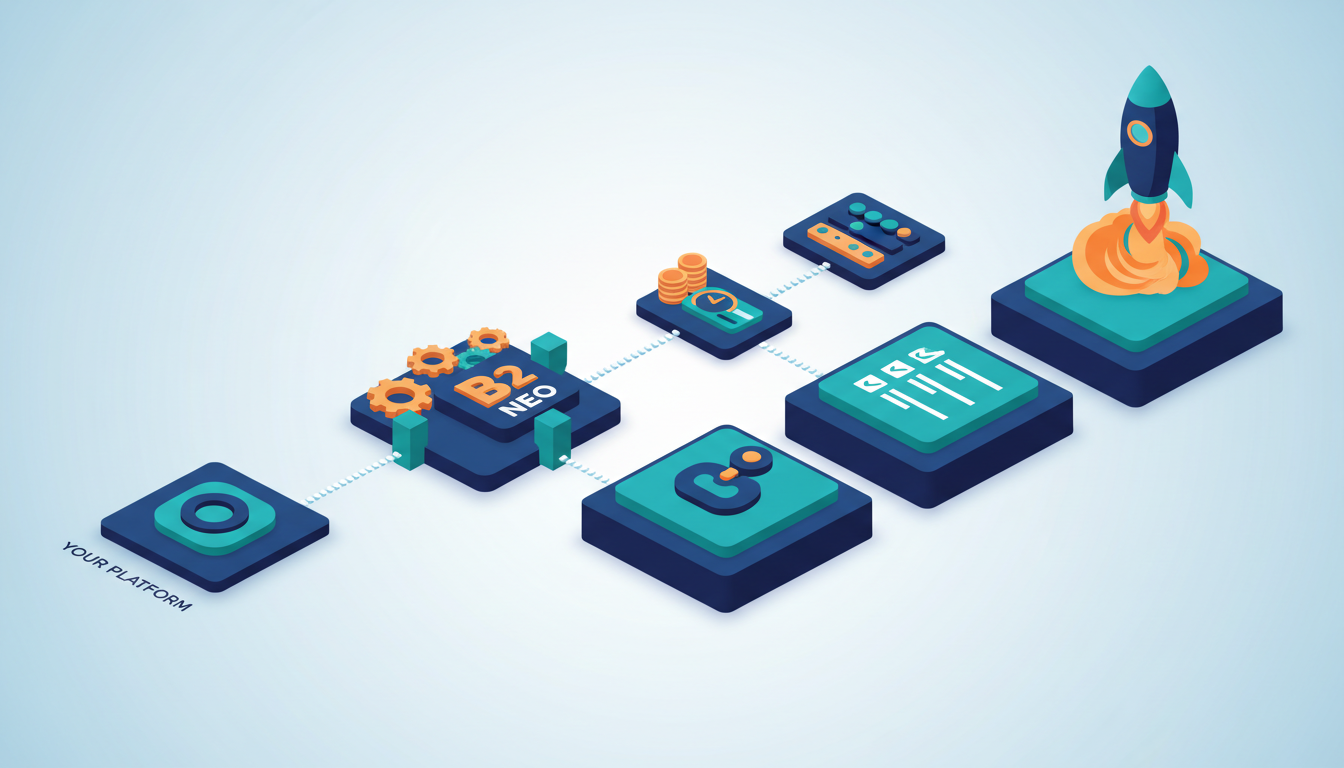
Branded endpoints allow neoclouds to present storage as a native service without separate administrative consoles. Integration begins by mapping the partner's billing system to Backblaze's API layer, enabling partner-controlled pricing that preserves margin flexibility. This architecture shifts operational burden from infrastructure build-out to API orchestration.
- Configure the Backblaze B2 Native API to accept provisioning requests from the neocloud control plane.
- Map user identities to isolated buckets using automated permission scripts.
- Route egress charges through the partner's existing invoicing workflow.
The S3-Compatible API enables migration for customers already using AWS tooling, reducing friction during onboarding. Operators gain full control over account lifecycle events via API-driven provisioning eliminating manual setup steps for end-users. A substantial global edge services platform
Strict dependency on the partner's billing integrity remains the limitation. Errors in the upstream system directly impact revenue recognition since Backblaze does not intervene in customer disputes. This centralization creates a single point of failure for financial operations if the neocloud's internal tools lack redundancy. Validate webhook reliability before exposing storage endpoints to production traffic.
Configuring Platform-Controlled Billing and Custom Margin Structures
Partners determine final pricing tiers, enabling neoclouds to retain custom margin structures while outsourcing backend complexity. This financial autonomy separates the infrastructure layer from the commercial offering, allowing operators to capture value without managing physical disk arrays.
- Initialize the Backblaze B2 Native API connection within the neocloud control plane to enable programmatic bucket creation.
- Map internal user identities to isolated storage namespaces using automated permission scripts that enforce tenant separation.
- Inject partner-set rate cards into the billing engine, bypassing default vendor pricing to preserve partner-controlled pricing
4.
Dual API support enables immediate toolchain reuse without rewriting application logic for object storage migration.
- Validate that existing automation scripts target the S3-Compatible API to use standard SDKs while accessing the new infrastructure.
- Configure branded endpoints to mask backend origins, ensuring end-users interact solely with the neocloud domain.
- Deploy API-driven provisioning hooks to sync account creation and permission management with local identity providers.
- Route all billing events through partner systems to maintain partner-controlled pricing
| Feature | Native Implementation | White-Label Neo Mode |
|---|---|---|
| Endpoint Visibility | Vendor URL exposed | Partner domain only |
| Billing Flow | Direct to provider | Aggregated by partner |
| Provisioning | Manual or vendor API | Fully automated via partner |
API compatibility does not guarantee identical error codes or retry behaviors between protocols. Testing failure modes under load prevents silent data corruption during high-velocity AI training jobs. The NAB Show 2026 Product of the Year Award Hyperscalers are projected to hold 67% of all data center capacity by 2031, forcing specialized providers to seek alternative infrastructure partners. This concentration creates a supply gap where GPU clusters sit idle waiting for persistent object storage layers to come online.
Businesswire. The limitation of in-house construction is temporal; fabricating a multi-petabyte system often takes years while demand spikes immediately. Micron Technology accelerating its M15X fab opening to February 2026 signals tight industry timeline alignment Operators attempting to build proprietary arrays face a binary choice: delay revenue generation or accept technical debt from rushed hardware procurement.
| Constraint | In-House Build | Outsourced Layer |
|---|---|---|
| Deployment Time | 1824 months | Weeks |
| Capital Focus | Diskarrays | GPU Clusters |
| Scalability Limit | Physical Rack Space | Elastic API Calls |
Neoclouds that outsource storage infrastructure preserve cash for compute differentiation rather than commodity disk management. Failure to decouple these layers risks missing the 2031 market window entirely.
Real-World Cost Savings: Tribute and Motion Case Studies
Tribute eliminated $15,000 in monthly expenses by migrating video workflows from hyperscaler tiers to Backblaze B2 infrastructure. This specific dollar figure validates the economic argument for outsourcing storage when internal build-outs face capital constraints. The video processing startup achieved these results through a smooth transition that maintained zero downtime, proving that production continuity does not require expensive redundant systems during migration. Operators often fear performance degradation when leaving established clouds, yet the Tribute case study demonstrates that cost reduction and reliability coexist without compromise.
Motion reduced cloud storage expenditures by 70% while reclaiming 10-20 hours of engineering time previously lost to workload management.
About
Alex Kumar serves as a Senior Platform Engineer and Infrastructure Architect at Rabata. Io, where he specializes in Kubernetes storage architecture and cost optimization for cloud-native applications. His daily work designing disaster recovery systems and managing high-scale infrastructure makes him uniquely qualified to analyze the complexities of cloud object storage for AI workloads. At Rabata. Io, a provider of S3-compatible storage tailored for AI/ML startups, Alex directly addresses the performance bottlenecks and vendor lock-in challenges that neocloud platforms face. His experience optimizing storage layers for data-intensive environments allows him to critically evaluate new solutions like Backblaze B2 Neo against Rabata's mission of delivering transparent pricing and superior performance. By connecting his hands-on engineering background with Rabata's focus on scalable, GDPR-compliant data centers, Alex provides an expert perspective on how emerging storage tools must evolve to support next-generation GPU-driven computing.
Conclusion
Raw capacity pricing becomes irrelevant when throughput bottlenecks stall GPU clusters during critical training windows. As generative AI demands surge, the hidden operational tax shifts from storage fees to latency-induced idle time, where cheap disks fail to feed fast silicon. Neocloud operators relying solely on low-cost archival tiers will face diminishing returns by late 2026 once dataset complexity outpaces simple retrieval models. The market expansion to a substantial valuation favors those who treat storage as a performance layer, not just a bucket. You must migrate high-frequency training datasets to providers guaranteeing consistent IOPS before your next model iteration cycle begins. Do not wait for contract renewals to test these limits. Start by auditing your current egress patterns against GPU utilization logs this week to identify where data starvation is silently inflating your cost per inference. If retrieval delays exceed a small fraction of total training time, renegotiate SLAs or shard workloads immediately. The window to optimize this architecture closes as competition tightens margins, making proactive throughput validation the only viable path to sustainable scale.
Frequently Asked Questions
Wasabi offers raw capacity near $4.10 per TB but lacks integrated throughput guarantees. B2 Neo provides necessary bandwidth for GPU clusters that cheap raw storage cannot support effectively.
The neocloud segment grows at a 46.37% compound annual rate, demanding rapid scaling. Building custom stacks takes too long compared to integrating ready-made solutions for immediate capacity expansion.
Providers avoid diverting resources from GPU roadmaps by using integrated layers instead of building custom stacks. This shift preserves capital for core compute expansion rather than complex storage infrastructure development.
Training cycles stall when disk I/O cannot match compute velocity, rendering expensive silicon idle. B2 Neo delivers required bandwidth to prevent starvation during large-model checkpointing on new hardware platforms.
As the market reaches $236.53 billion by 2031, speed becomes critical for survival. Operators must integrate turnkey solutions quickly to capture share before competitors secure dominant positions.