Scality object tiering stops GPU starvation now
Scality testing shows its connector delivers 10x faster performance than conventional S3 interfaces on similar hardware.
The partnership between Scality and WEKA kills the false choice between speed and budget. By segregating hot data on a NeuralMesh flash tier while cold storage resides in Scality RING, this architecture solves a specific math problem: over 80% of enterprises will have deployed AI-enabled applications by 2026, according to Gartner forecasts. Inefficient storage economics are no longer an option. (Gartner's neuralmesh) You need to know how this joint architecture bypasses the management overhead of traditional object stores, why NeuralMesh demands a purpose-built connector rather than community-driven alternatives like Ceph, and how to secure 20% lower infrastructure costs without sacrificing GPU utilization.
Standard S3 gateways introduce unacceptable latency spikes when scaling AI pipelines. Most organizations miss this until their training jobs stall. WEKA validation confirms that their lightweight object connector maintains flash-speed performance for active datasets while leveraging Scality's exabyte-scale durability for archival needs. This approach dodges the trap of expensive all-flash deployments that drain capital before delivering measurable ROI from tiered storage.
The technical breakdown reveals exactly how Scality RING achieves up to 14 nines durability while acting as a smooth extension to the high-performance layer. Infrastructure leaders must stop overspending on uniform flash arrays. The strategy is simple: align measurable ROI with the brutal performance demands of modern AI workloads.
The Role of Object Tiering in Modern AI Storage Architectures
NeuralMesh and Scality RING Set for AI Storage
Flash-speed storage systems like NeuralMesh™ handle active workloads while Scality RING supplies the cyber-resilient object tier. WEKA officially unveiled NeuralMesh on June 18, 2025, creating a high-performance foundation for active AI pipelines. This design separates hot data needing low latency from cold datasets requiring durability. The Scality RING backend acts as the cost-efficient capacity layer, recognized by Gartner for leadership in security. Integration testing shows up to 10x faster performance on similar hardware compared to conventional S3 interfaces. Operators gain 20% lower infrastructure costs by skipping expensive all-flash deployments for archival data.
| Component | Primary Function | Performance Characteristic |
|---|---|---|
| NeuralMesh™ | Active AI/HPC Data | Flash-speed throughput |
| Scality RING | Cold/Tiered Data | Exabyte-scale durability |
Object tiering shifts data between layers based on access patterns without engineering changes. The joint solution became available immediately after the February 24, 2026 announcement. Maximizing GPU utilization while minimizing storage spend creates friction. Pure flash tiers waste capital on inactive datasets. Standard object stores introduce latency that stalls training jobs. This hybrid approach resolves that conflict by keeping hot paths on NVMe and shifting bulk to disk. Initial data classification requires policy tuning to prevent premature tiering of active batches. Misconfigured thresholds force unnecessary retrieval operations. Such errors negate the performance benefits of the flash layer.
Achieving 93% GPU Utilization with Tiered AI Workflows
NeuralMesh™ sustains 93% GPU utilization by serving active datasets at flash speed, preventing the starvation common in tiered architectures. Idle cycles cost operators roughly a substantial sum annually per node when storage latency stalls compute engines. Scality. NVIDIA STX integration drives a 6.5x increase in token production by eliminating I/O bottlenecks during training epochs.
Traditional object stores introduce latency spikes that fragment batch processing, forcing GPUs into wait states. This architecture isolates hot training data on the flash tier while migrating completed checkpoints to the capacity layer. The result is a stable 30% industry average utilization jump to near-maximum efficiency. Operators avoid the $2.59 trillion global AI spend waste associated with underutilized silicon.
Precise data lifecycle policies prevent premature tiering of active batches. Misconfigured retention rules can pull hot data to the cost-efficient object tier Balancing storage economics against the risk of compute stalls defines the operational constraint.
Mission and Vision recommends monitoring GPU wait states to tune tiering thresholds dynamically. Failure to align storage speed with compute demand leaves expensive hardware idle. The jointly validated solution ensures data placement matches workflow intensity. Sustained high utilization depends on this frictionless handoff between performance and capacity layers.
Scality RING with NeuralMesh delivers 10x faster throughput than standard S3 interfaces on identical hardware configurations.
This architecture separates compute-intensive hot data from cold capacity, avoiding the latency penalties inherent in monolithic object stores. Conventional S3 implementations accumulate costs through per-request ingest charges and tiered egress fees. The integrated connector All-flash alternatives eliminate latency but force operators to pay premium rates for data that rarely requires immediate access. The joint solution mitigates this by tiering inactive datasets to Scality RING, which provides 14 nines of durability without sacrificing foreground performance.
| Metric | Conventional S3 | All-Flash Array | Scality + NeuralMesh |
|---|---|---|---|
| Hot Data Latency | High | Low | Low |
| Cold Storage Cost | Moderate | Prohibitive | Low |
| Durability | Standard | Variable | 14 nines |
| GPU Starvation | Frequent | Rare | None |
Active policy management prevents hot data from stagnating on expensive flash tiers. Operators must configure aging rules precisely, or the cost benefits erode as active datasets expand. This tension between automation and control defines the operational overhead of tiered systems. The performance gain justifies the complexity only when workload patterns exhibit clear hot-cold separation. Mission and Vision recommend validating data access logs before deploying this hybrid topology.
Inside the Joint Architecture of NeuralMesh and Scality RING
NeuralMesh Flexible Mesh Architecture and 4K Block Stripes
NeuralMesh eliminates external storage bottlenecks by running co-located compute and storage services on identical physical infrastructure. This flexible mesh design places CPUs and NVMe SSDs directly inside GPU servers rather than relying on separate appliances. Data distribution relies on 4K block stripes spread across every available failure domain to prevent singular points of failure. The system ensures no two blocks from the same stripe ever reside within the same node, rack, or zone.
| Failure Domain | Block Placement Rule | Durability Outcome |
|---|---|---|
| Node | Max one block per stripe | Survives single server crash |
| Rack | Max one block per stripe | Survives top-of-rack switch loss |
| Zone | Max one block per stripe | Survives total datacenter outage |
Operators configure this via a service-oriented model where storage daemons bind to local NVMe resources. The architecture handles multiple simultaneous node losses while sustaining full throughput during rebuild operations. A critical tension exists between maximizing local NVMe density and maintaining sufficient parity overhead for rapid reconstruction. Adding more drives per node increases raw capacity but extends the time required to restripe data after a fault. Most deployments sacrifice some density to keep rebuild windows short enough to avoid secondary failures. This approach contrasts sharply with traditional architectures that isolate storage pools from compute layers. The result is a resilient fabric where scale directly improves data protection rather than increasing fragility. Mission and Vision recommends validating failure domain definitions before production rollout to match specific rack layouts.
Smooth Tiering of Active Data to Exabyte-Scale Object Storage
New datasets land on the NeuralMesh flash tier while older files migrate automatically to Scality RING capacity. This flow prevents AI pipeline stalls caused by slow object retrieval during active training epochs. Operators eliminate the performance bottlenecks typical of monolithic storage pools by keeping hot data local to compute nodes. The architecture decouples storage logic from physical hardware constraints, allowing independent scaling of performance and capacity layers.
Data movement follows a strict policy based on access frequency rather than manual intervention.
- Ingest writes directly to NVMe SSDs within the flexible mesh.
- Metadata tracks file age and last-read timestamp continuously.
- Cold objects transfer to the object connector
4.
NeuralMesh sustains full throughput during four simultaneous node losses by redistributing I/O across remaining healthy domains instantly. The system heals quicker as the cluster size increases, preventing the performance degradation typical of traditional RAID rebuilds. This durability stems from a distributed architecture where 4K block stripes
| Failure Scenario | Traditional Rebuild Impact | NeuralMesh Response |
|---|---|---|
| Single Node Loss | Significant latency spike | Zero throughput impact |
| Rack Failure | Partial service outage | Continuous operation |
| Four Node Loss | Catastrophic slowdown | Sustained full throughput |
| Zone Outage | Data unavailability | Automatic failover |
Operators fix performance bottlenecks in AI pipelines by relying on this flexible redistribution rather than static parity groups. The limitation is that maximum durability requires sufficient cluster scale; small deployments cannot absorb multiple concurrent faults without risk. Mission and Vision recommends sizing clusters to exceed minimum stripe distribution requirements for critical workloads. This approach ensures best practices for AI storage architecture prioritize availability without sacrificing speed during recovery events.
Measurable ROI from Deploying Tiered Storage for AI Workloads
Defining Economic Efficiency in AI Storage Tiers
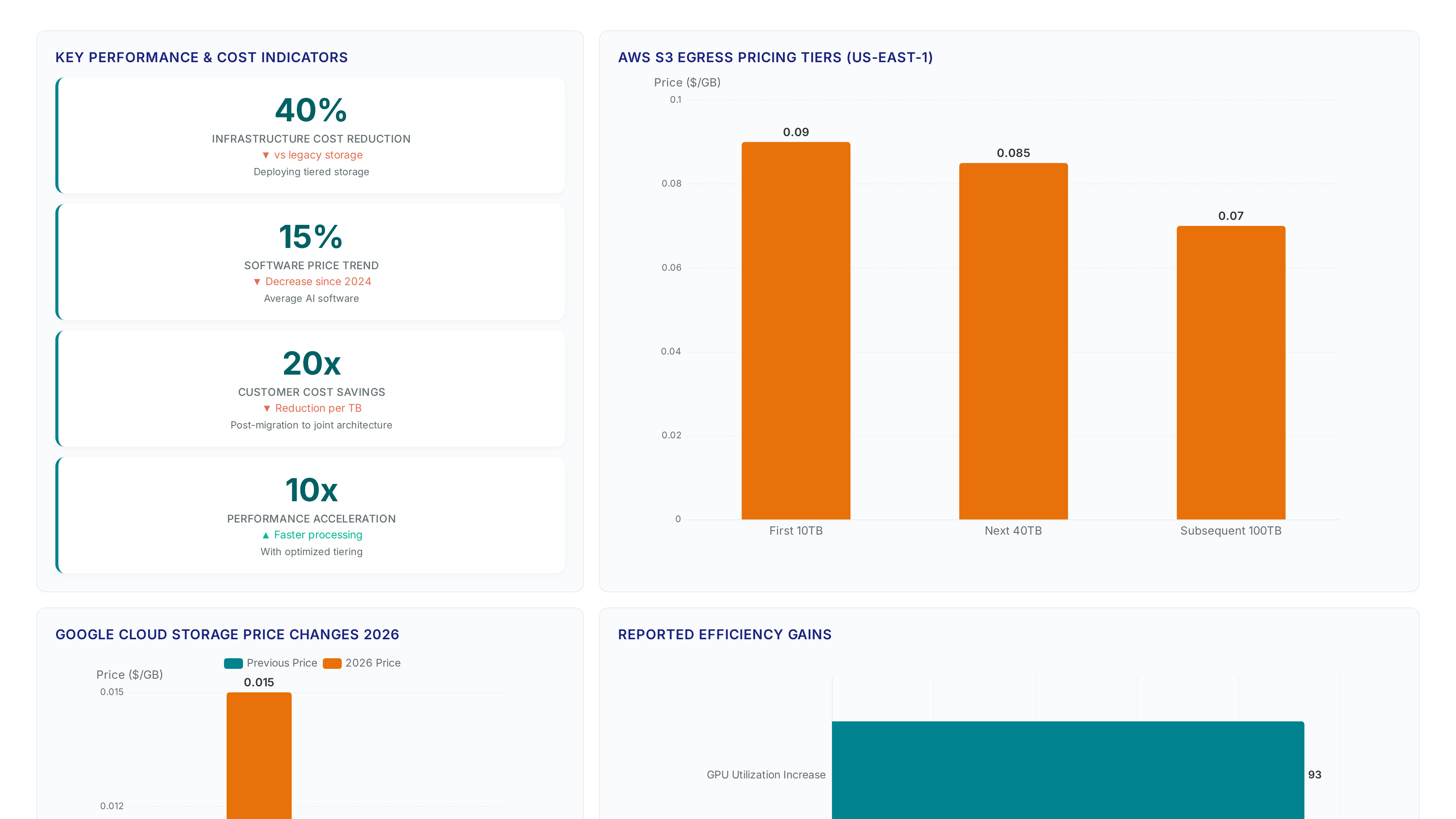
Economic efficiency in AI storage tiers separates active flash workloads from cold object data to maximize GPU utilization while minimizing capital expenditure. The financial value emerges when organizations shift inactive training data to a cost-efficient object.
| Storage Tier | Data State | Cost Driver |
|---|---|---|
| NeuralMesh Flash | Active Training | High IOPS, Low Latency |
| Scality RING Object | Cold Archives | Capacity Density, Durability |
Operators must tier data immediately after model convergence to avoid paying premium rates for stagnant files. The joint solution became available in February 2026, enabling immediate deployment of this hybrid strategy. A critical tension exists between data accessibility and storage cost; moving data too aggressively to object storage stalls GPU pipelines, while retaining it on flash wastes budget. Mission and Vision recommends automating tiering policies based on access timestamps rather than manual intervention to balance these competing goals.
Quantifying ROI Through 20x Cost Reduction Per Terabyte
One unnamed software industry customer reported a 20x cost reduction per terabyte after migrating AI HPC clusters to the joint architecture. Operators calculate return on investment by comparing the high expense of stalled compute against the savings from moving cold data to an efficient object tier Public cloud egress charges often erode margins, with AWS S3 Standard costing $0.09/GB for the first 10TB of traffic in us-east-1. The table below contrasts the economic impact of monolithic flash versus the tiered.
| Cost Component | Monolithic Flash | Tiered NeuralMesh + RING |
|---|---|---|
| Active Data Performance | High | High |
| Cold Data Storage Cost | Prohibitive | Minimal |
| Egress Fee Exposure | High | Optimized |
| GPU Idle Time | Frequent | Rare |
The limitation of this model relies on accurate data temperature classification; misidentifying hot datasets as cold introduces latency that negates storage savings. Most enterprises overprovision NVMe because they lack visibility into access patterns across long training runs. Shifting inactive payloads to scalable object storage frees capital for additional GPU nodes rather than static disks. This reallocation directly increases token production throughput without expanding the physical footprint. Mission and Vision recommend auditing current ingest patterns before committing to all-flash expansions.
Validation Checklist for Cyber-Resilient Object Storage Deployment
Validate cyber-resilient object storage by confirming the system sustains throughput during four simultaneous node losses before scaling AI workloads. Operators must verify that 4K block stripes distribute across all failure domains to prevent single-point failures from stalling training jobs. The checklist requires testing the flexible mesh architecture under load to ensure cold data tiers do not introduce latency spikes during active epochs.
- Confirm the deployment uses a co-located model where storage services run on the same physical infrastructure as compute to eliminate network bottlenecks.
- Verify the object connector delivers quicker performance than community-driven alternatives like Ceph through independent benchmarking of metadata operations.
- Ensure the tiering policy automatically moves inactive datasets to the cost-efficient object tier
- Validate that the architecture avoids per-request ingest charges common in public cloud models by reviewing billing logs for hidden egress fees.
Skipping these steps risks overprovisioning expensive flash capacity for datasets accessed infrequently. Enterprises asking should I use Scality for WEKA must prioritize this validation to achieve the projected economic benefits. Mission and Vision recommends enforcing these checks to secure durable, high-performance AI pipelines.
Steps for Enabling Efficient Data Tiering in Enterprise Environments
Scality Object Connector for NeuralMesh Architecture

Operators enable efficient data tiering by deploying the Scality Object Connector as a lightweight interface validated at scale. This mechanism decouples storage logic from physical hardware, allowing NeuralMesh to treat the object tier as a smooth extension of local flash without manual intervention. Testing confirms the integrated stack delivers 10x faster performance on similar hardware compared to conventional S3 interfaces, eliminating the latency penalties that typically stall GPU pipelines during cold data recalls. Efficiency introduces a tension here. The connector bypasses standard S3 consistency models to achieve speed, requiring operators to trust vendor validation rather than relying on generic protocol guarantees.
- Install the connector package on the NeuralMesh management node to register the backend target.
- Define the bucket policy that flags data older than the active training epoch for migration.
- Configure the CORE5 safeguards to maintain durability guarantees during the transfer process.
- Enable the automatic recall trigger to fetch data instantly upon compute request.
Mission and Vision recommends validating the connector against four simultaneous node losses before production.
Deploying the Connector to Extend AI Data Pipelines
Enable the Scality Object Connector via the WEKA CLI to establish a high-throughput path for inactive datasets without manual policy scripting.
- Initialize the object tier link using the validated lightweight interface that bypasses standard S3 gateway latency.
- Define retention rules that move aged checkpoints once active training epochs conclude, preventing flash pool saturation.
- Verify throughput stability by confirming the backend sustains operations during simulated node failures.
The connector allows WEKA customers to maintain flash speeds for hot data while exploiting exabyte-scale economics for cold layers. However, this efficiency relies on strict adherence to the 4K block stripe distribution; misaligned writes degrade the flexible mesh performance. Unlike community-driven alternatives, this validated path offers enterprise support yet requires precise network tuning to avoid latency spikes during initial data sweeps. The architectural tension lies between maximizing density and preserving rebuild speeds, as aggressive tiering can starve active jobs if bandwidth limits are ignored.
Validation Steps for CORE5 Safeguards and MultiScale Architecture
Verify the patented MultiScale Architecture sustains independent scaling across all dimensions before promoting workloads to production.
- Confirm CORE5 safeguards protect data at every system level by simulating four simultaneous node losses while maintaining full throughput.
- Validate that 4K block stripes
- Test the co-located deployment model to ensure storage services on local NVMe do not starve GPU compute cycles.
| Checkpoint | Validation Target | Failure Signal |
|---|---|---|
| Durability | Four-node loss | Throughput drop >a marginal amount |
| Distribution | 4K stripe spread | Duplicate domain placement |
| Co-location | Local NVMe usage | Compute starvation |
Skipping the stripe distribution check allows correlated failures to corrupt entire datasets during maintenance windows. Most operators overlook that co-located services require strict CPU pinning to avoid resource contention. The limitation of this rigorous validation is the extended testing window required before certifying the cluster for exascale loads. Urability Fournode loss Throughput drop a slight amount Distribution 4K stripe spread Duplicate.
About
Alex Kumar, Senior Platform Engineer and Infrastructure Architect at Rabata. Io, brings deep expertise in Kubernetes storage architecture and cost optimization to the discussion of hybrid storage tiers. His daily work designing scalable, S3-compatible infrastructure for AI and ML startups directly aligns with the challenges addressed by the NeuralMesh flash tier partnership. Having previously led DevOps initiatives for high-traffic platforms, Kumar understands the critical balance between flash-speed performance for active datasets and economical capacity for long-term retention. At Rabata. Io, a specialized provider of S3-compatible object storage, he architects solutions that eliminate vendor lock-in while maximizing efficiency. This background makes him uniquely qualified to analyze how combining WEKA's high-performance layer with cost-efficient object tiers, like those Rabata. Io champions, solves complex AI storage bottlenecks without compromising speed or budget.
Conclusion
Scaling NeuralMesh to exabyte levels exposes a critical fragility: misaligned 4K writes silently erode the flexible mesh performance that justifies the premium hardware investment. While the architecture promises near-perfect GPU saturation, the operational reality shifts from simple deployment to continuous network tuning. As AI transitions from pilot projects to core enterprise operations by 2027, the cost of ignoring strict CPU pinning and stripe distribution checks will outweigh the savings from reduced S3 egress fees. Operators cannot treat this flash tier as a drop-in replacement; it demands a disciplined validation regimen where rebuild speeds are prioritized over raw density to prevent active job starvation during maintenance windows.
Adopt NeuralMesh only if your team can enforce a two-week certification window dedicated to simulating multi-node failures before production traffic begins. Start by auditing your existing NVMe co-location policies this week to verify that storage services are not competing for CPU cycles with compute workloads, ensuring your foundation supports the required 4K block stripe distribution before adding a single petabyte of data.
Frequently Asked Questions
Idle cycles cost operators roughly $30,000 annually per node when storage latency stalls compute engines. This financial loss occurs because traditional architectures fail to serve active datasets at the flash speeds required for continuous processing.
NeuralMesh sustains 93% GPU utilization by serving active datasets at flash speed to prevent starvation. This high efficiency ensures that compute resources remain fully engaged rather than waiting for slow data retrieval operations.
Operators gain 20% lower infrastructure costs by skipping expensive all-flash deployments for archival data. This saving is achieved by shifting cold datasets to the cost-efficient Scality RING capacity layer while keeping hot data on flash.
The result is a stable 30% industry average utilization jump to near-maximum efficiency for AI workloads. This significant increase happens because the architecture eliminates the latency spikes that traditionally force GPUs into wait states.
Operators avoid the $2.59 trillion global AI spend waste associated with underutilized silicon in modern data centers. This massive avoidance is possible because the joint architecture keeps training jobs running without interruption from storage bottlenecks.