S3 storage truth: Why Reddit skips directories
Amazon S3 now stores over a vast number of objects, proving its dominance two decades after launch. While the broader cloud object storage market races toward USD 45.2 billion by 2033, Amazon S3 operates on a different plane of magnitude. As of March 2026, the service underpins more than 1,000,000 data lakes, handling workloads that would crush conventional block storage. Amazon reports that massive migrations are now routine, citing Apollo Tyres moving 160 TB in a single day and Shutterfly transferring 400 TB of archival assets without downtime. These aren't theoretical limits; they are daily operations for customers like Monzo Bank and Reddit.
The secret isn't magic, but a strict adherence to buckets and keys that decouples storage from compute constraints. Unlike rigid file systems, S3 treats data as opaque objects, allowing enterprises like Pipedrive to manage 43 TB across 100,000 workloads efficiently. You will learn how this design philosophy, championed by CTO Werner Vogels since 2006, transforms raw capacity into a strategic asset. We skip the fluff to focus on the engineering reality that keeps global cloud data, projected to exceed 200 zettabytes this year, from collapsing under its own weight.
The Role of Amazon S3 in Modern Cloud Infrastructure
Amazon S3 Object Storage and the S3 Bucket Definition
Amazon S3 launched 20 years ago in 2006, specifically on March 14, 2006, defining object storage through flat namespaces rather than hierarchical directories. The S3 bucket serves as the fundamental container for unstructured data, holding up to a vast number of objects without directory depth limits. This architecture diverges from traditional file systems by treating data as discrete units identified by unique keys, enabling global access patterns that block storage cannot support. Werner Vogels noted that while designing the backend was complex, the customer interface required absolute simplicity to function at scale. Behind this simplicity lies a microservice mesh that continuously inspects every object to maintain durability guarantees. The operational consequence of this design is that metadata management becomes the primary bottleneck rather than raw capacity. Unlike file systems where inode exhaustion limits growth, S3 shifts constraints to API request rates and key naming conventions. Operators must design partitioning strategies that distribute load across key prefixes to avoid throttling, a requirement absent in POSIX-compliant environments. The trade-off is that atomic operations apply only to single objects, making multi-object transactions impossible without external coordination layers.
Enterprise Data Migration Scale with Apollo Tyres and Shutterfly
Shailender Gupta directed a migration of 160 TB in one day using Amazon S3 File Gateway to bypass directory limits. This operation moved unstructured data from legacy hierarchies into flat bucket namespaces without business interruption. The speed demonstrates that object storage handles massive parallel ingestion improved than traditional file systems during tight maintenance windows. However, achieving this velocity requires pre-staging data on-premises, which adds hardware costs before the cloud transfer begins. Operators must weigh the one-day cutover benefit against the capital expense of temporary gateway appliances. Shutterfly relocated 400 TB of archival assets alongside 800 application systems to resolve scaling bottlenecks.
Mission and Vision recommends validating API compatibility before committing to large-scale object transfers.
S3 Standard versus Glacier Deep Archive Pricing Tiers
Selection between storage classes hinges on retrieval latency tolerance versus the 23x pricing variance available across tiers. S3 Standard targets frequently accessed data at $0.023 per GB/month for the initial 50 TB, providing immediate millisecond access. Conversely, S3 Glacier Deep Archive serves long-term retention needs at $0.00099 per GB/month, enforcing retrieval times measured in hours rather than seconds.
| Feature | S3 Standard | S3 Glacier Deep Archive |
|---|---|---|
| Cost (First 50 TB) | $0.023/GB/mo | $0.00099/GB/mo |
| Retrieval Time | Milliseconds | 12 to 48 Hours |
| Minimum Duration | None | 180 Days |
| Use Case | Hot Data | Compliance Archives |
The cost benefit of deep archive tiers disappears if operators ignore minimum storage duration charges. Moving data out before 180 days incurs early deletion fees that negate the lower monthly rate. Azure applies a 128 KiB minimum billable object size to similar cold tiers, creating hidden costs for small files that AWS Standard avoids. Operators must calculate total cost of ownership including retrieval fees, not storage rates. Choosing the wrong tier locks capital in inefficient structures or risks budget overruns during unexpected data recalls. Mission and Vision recommends auditing access patterns quarterly to align class selection with actual usage velocity.
S3 Object Storage Mechanics: Buckets, Keys, and Large Size Limits
Discrete objects ranging from 0 bytes to a massive size within flat bucket namespaces identified by unique keys form the foundation of Amazon S3 storage. This architecture rejects hierarchical directory structures, treating every file as an opaque blob paired with metadata rather than a node in a tree. The largest object uploadable in a single PUT request caps at 5 GB, forcing transfers exceeding a substantial size to apply multipart logic for efficiency. Unlike block storage that segments data for disk-level optimization, S3 maintains durability through a microservice mesh that continuously inspects every object Security defaults shifted in April 2026 to enforce bucket-owner control, while MFA Delete adds a second authentication factor to prevent accidental removal of critical assets. The flat namespace eliminates path-length limits but introduces a constraint: renaming an object requires a copy-and-delete operation since the key is immutable once written. Operators managing hybrid environments must note that 82% of organizations combine public clouds with private infrastructure, complicating key namespace planning across boundaries. Performance scales automatically, yet understanding the partition mechanism remains necessary for maximizing throughput during high-volume ingestion events. Engineers often overlook how the 0 byte minimum allows empty placeholders for state tracking without incurring significant storage costs.
Accessing Unstructured Data via Web and Strong Read-After-Write Consistency
Applications retrieve photos and documents globally because the architecture links every bucket and key directly to an HTTP endpoint without hierarchical translation. This design permits immediate access to unstructured assets from any location on the web, bypassing the latency inherent in mounting traditional file systems. Consistency arrives automatically for all workloads, eliminating the race conditions where a write operation completes before a subsequent read sees the new data. The underlying index subsystem employs the methods to verify code correctness, ensuring that state changes propagate instantly across the distributed fleet. Developers cannot assume eventual consistency allows for cheaper, asynchronous replication patterns. The cost of immediate visibility is higher coordination overhead within the storage cluster compared to systems that delay synchronization. Network operators must architect retry logic differently, as the window for stale reads disappears entirely upon commit. Mission and Vision recommends validating application behavior against this strict ordering, as legacy code written for eventual consistency may fail when forced to handle immediate state visibility. The removal of the propagation delay shifts the burden of synchronization from the client to the storage service itself. Testing reveals that read-heavy workloads benefit most from this model, whereas write-intensive batches might experience transient throttling.
Flat S3 Architecture Versus Hierarchical File Systems and Block Storage
S3 eliminates directory traversal overhead by storing unstructured data as discrete objects rather than managing blocks separately based on efficiency. Traditional file systems force applications to navigate deep hierarchical trees, introducing latency penalties that flat namespaces avoid entirely. Objects can be any form of data including photos or call center exchanges, yet the system treats them as opaque blobs identified solely by keys. Legacy architectures require distinct volume management layers that complicate scaling operations across distributed environments. AWS mitigates this friction through native file system access built on EFS, allowing POSIX-like operations without sacrificing object storage durability.
Strategic Implementation of S3 for Enterprise Data
S3 Bucket Organization and Data Classification Strategies
Mapping logical prefixes to business domains drives enterprise data classification instead of building physical directory trees. Amazon explains the concept of objects using a library analogy Operators organize bucket contents by embedding department codes or project identifiers directly into the object key string. The emergence of S3 Files in April 2026 introduces POSIX semantics but requires careful prefix planning to prevent performance bottlenecks. Applications mounting buckets as file systems still depend on partitioned prefixes to achieve maximum throughput rates. A single bucket can hold billions of keys, yet poor naming conventions force sequential scanning during listing operations. Excessive nesting in key names increases latency for recursive listing commands compared to flat structures. The cost of maintaining deep virtual folders is measurable in API request charges during metadata enumeration. Mission and Vision recommends limiting prefix depth to three levels to balance organizational clarity with retrieval speed.
Executing Large-Scale Unstructured Data Storage with Multipart Uploads
AWS recommends Multipart Upload for any object exceeding a substantial size to prevent single-request timeouts during massive data ingestion. This mechanism splits large files into discrete parts uploaded in parallel, allowing failed segments to retry without restarting the entire transfer. Network engineers must configure client SDKs to automatically trigger this logic once file sizes surpass the 5 GB single-PUT limit. Pipedrive successfully migrated 43 TB of customer data across 100,000 workloads by using this parallelization strategy for high-volume throughput. The cost efficiency of such operations depends on selecting the correct storage tier, where prices drop to $0.021 per GB for usage exceeding 500 TB monthly.
Enterprise Readiness Checklist for S3 Data Lake Deployment
Validate read-after-write consistency automatically before ingesting call center exchanges or financial documents into the data lake. Confirm that object sizes stay below the 5 GB single-PUT limit to avoid transfer failures during migration. Enterprises treating S3 as a safe default must verify prefix distribution to maximize parallel request throughput. Organize bucket keys to align with S3 Tables for native Apache Iceberg integration, which automates table maintenance as volumes grow. High-end customers like Monzo Bank and Netflix rely on this structure to manage diverse unstructured assets without hierarchical overhead. Raw throughput per stream may lag behind competitors if prefix partitioning remains static. Operators must map business domains to unique key prefixes rather than mimicking file system directories. This approach ensures the index subsystem maintains durability through continuous microservice inspection. Failure to distribute keys across multiple prefixes creates hotspots that degrade performance under load. Mission and Vision recommend auditing key entropy prior to production cutover.
Amazon S3 Versus Competitor Cloud Storage Solutions
Amazon S3 Market Share Dynamics Against Microsoft and Google Cloud
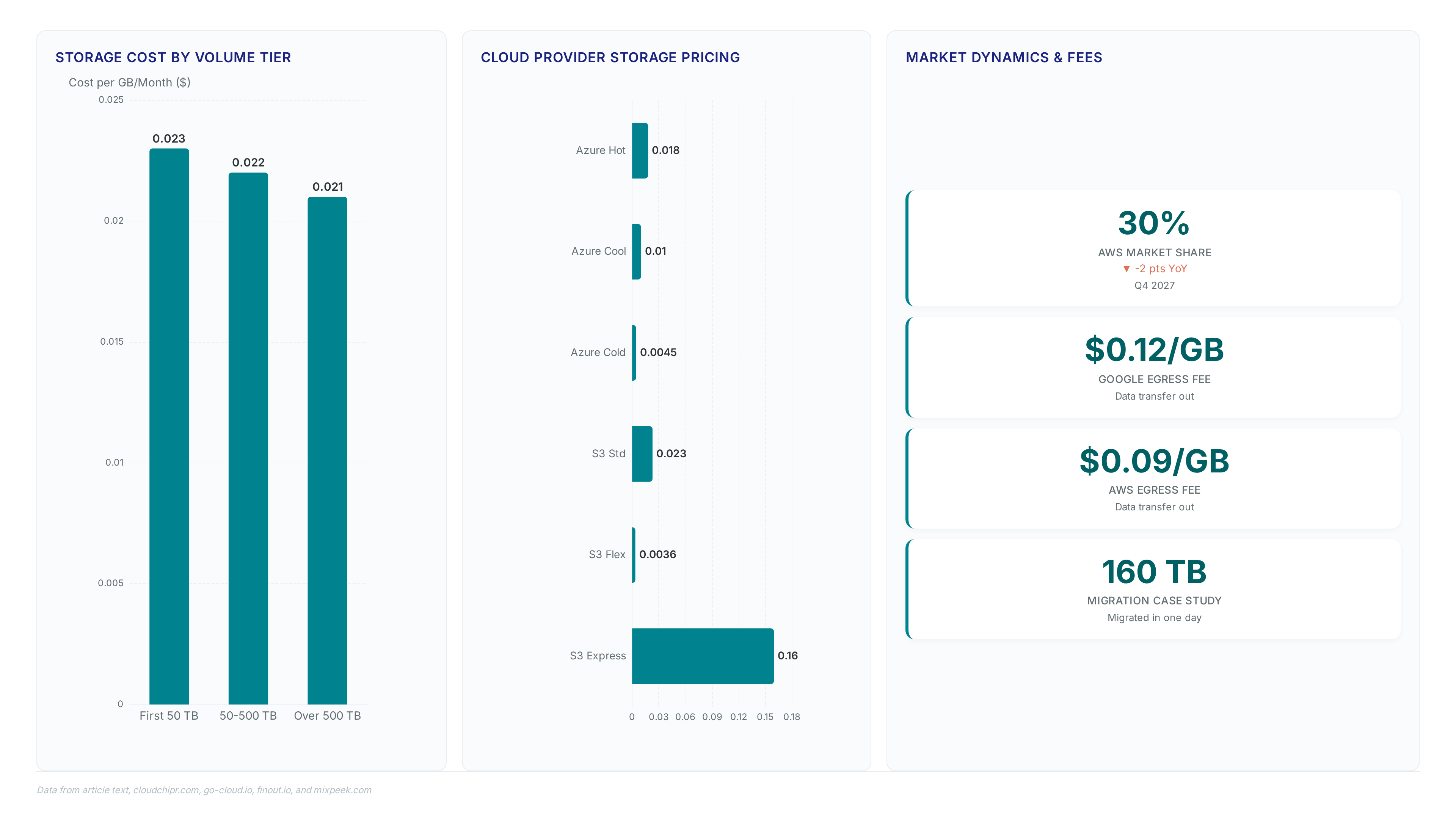
Cooperation data marks Amazon holding 30% market share in Q4 2027, a twopoint dro from the prior year. Aggressive pricing pressure from Microsoft and Google Cloud drives this contraction as rivals target enterprise workloads with lower entry costs. Strategic tension now exists between system lock-in and raw cost efficiency for large-scale deployments. Migrating to cheaper tiers risks egress penalties, particularly with Google charging $0.12/GB for data transfer out. The twopoint sha loss reflects customers moving non-critical archives to competitors while retaining primary application data on AWS. This bifurcation creates a hybrid reality where multi-cloud strategies fragment storage estates rather than replacing the leader entirely. Network architects must model total cost of ownership including retrieval fees instead of just ingress pricing. Market shifts favor specialized workloads over general-purpose dominance. A three-cent difference per gigabyte creates measurable financial divergence when architects plan egress-heavy workloads like analytics pipelines or disaster recovery failovers. Operators moving petabytes face a total cost of ownership shock if they ignore these variances during the initial selection phase.
Decision matrices shift when storage frequency meets network exit requirements. High-volume data lakes often prioritize low storage costs yet frequent access patterns expose the hidden tax of moving data out of the cloud environment. Azure Blob Storage offers a middle ground with fees around $0.087/GB, creating a narrow but the arbitra opportunity for multi-region deployments. A provider with higher transfer fees might deliver superior overall value through performance scaling that reduces job completion time while effectively offsetting the per-gigabyte surcharge. Enterprises must model the total monthly bill rather than isolating line items since a cheaper storage tier can become expensive when paired with inefficient retrieval paths.
Planning involves linking specific workload profiles to the most cost-effective egress fee structure available. Organizations running batch jobs that export massive datasets daily will find cumulative savings from lower transfer rates outweigh minor storage premiums. The architectural constraint remains fixed because once data enters a bucket the exit price is dictated by the hyperscaler's published rate card.
Global Cloud Object Storage Growth Projections Through 2033
Valuation expands from 15.5 billion USD in 2024 to 45.2 billion by 2033 to create intense competition for unstructured data workloads. This nearly threefold increase forces operators to evaluate system integration depth against raw throughput capabilities when selecting a primary vendor. AWS S3 remains the safe default for mixed environments while Google Cloud Storage targets data-intensive analytics with superior stream performance. Microsoft Azure Blob Storage retains dominance in enterprises heavily invested in Active Directory and Hadoop clusters.
| Dimension | Amazon S3 | Google Cloud Storage | Azure Blob Storage |
|---|---|---|---|
| Vector Scale | 2 billion per index | Undocumented limits | Undocumented limits |
| Throughput Model | Parallel per prefix | High single-stream | Optimized for Spark |
| Best Fit | General enterprise | AI training pipelines | Microsoft-centric shops |
Scaling to meet this projected demand introduces complexity in performance scaling strategies that differ by provider. AWS relies on prefix distribution to handle concurrency whereas competitors often optimize for singular high-bandwidth streams. Migrating between these distinct performance models incurs significant application refactoring costs post-deployment. Operators ignoring these architectural divergences face lock-in risks as data volumes approach the upper bounds of the forecasted market size.
About
Alex Kumar, Senior Platform Engineer and Infrastructure Architect at Rabata. Io, brings deep practical expertise to this analysis of Amazon S3's twenty-year evolution. Having previously served as an SRE for high-traffic SaaS platforms and a DevOps Lead at an e-commerce unicorn, Alex has managed massive-scale storage architectures where S3 compatibility was critical for disaster recovery and cost optimization. His daily work designing Kubernetes persistent storage solutions directly mirrors the challenges enterprises face when migrating petabytes of data, such as the transformations seen with Apollo Tyres and Pipedrive. At Rabata. Io, a specialized provider of S3-compatible object storage, Alex uses this background to help AI/ML startups and enterprises eliminate vendor lock-in while achieving superior performance. As the market triples by 2033, the real operational burden shifts from capacity planning to data mobility governance, where moving petabytes between incompatible throughput models becomes prohibitively expensive. Organizations must stop treating storage classes as static buckets and start viewing them as flexible liquidity pools that require active rebalancing to avoid bill shock.
Adopt a strict lifecycle automation policy within the next six months that forces data movement based on access velocity rather than arbitrary age thresholds. Do not rely on default vendor settings; instead, engineer custom transition rules that account for your specific retrieval latency tolerances before committing to long-term retention tiers. This proactive stance prevents the silent accumulation of technical debt that occurs when archival strategies fail to match actual usage patterns.
Start this week by auditing your current S3 Inventory reports to identify any objects sitting in Standard or Infrequent Access tiers that have not been touched in over 90 days. Tag these candidates immediately for a pilot migration to Deep Archive to validate your retrieval workflows before scaling the rule across your entire fleet.
Frequently Asked Questions
Apollo Tyres successfully migrated 160 TB of unstructured data in just one single day. This massive operation utilized the Amazon S3 File Gateway to bypass traditional directory limits during their cutover.
Shutterfly relocated 400 TB of archival assets alongside hundreds of application systems to fix scaling issues. This shift consolidated fragmented assets into a single durability tier for better long-term retention.
Pipedrive efficiently manages 43 TB of data distributed across 100,000 distinct workloads using S3 buckets. This approach leverages flat namespaces to handle growth that would crash conventional file systems.
Amazon S3 now stores over 100 trillion objects, proving its dominance two decades after launch. This scale is enabled by an object-based architecture that scales where hierarchical systems fail.
Amazon currently boasts a 30% market share in the cloud storage sector as of recent reports. However, this figure represents a slight decline as competitors like Microsoft and Google gain ground.