Nutanix revenue hits $2.36B despite supply delays
Nutanix reported $2.36 billion in annual recurring revenue, a 16% surge driven by hybrid multi-cloud adoption despite hardware bottlenecks.
Fiscal performance now hinges on decoupling subscription growth from physical fulfillment delays. Nutanix CFO Rukmini Sivaraman confirmed that while bookings exceeded guidance, supply chain constraints extended server lead times, pushing revenue realization into future quarters even as free cash flow held steady at $191.4 million. Demand outpaces logistics. This is the new normal.
The strategic pivot targets AI-native networking across AWS, OCI, and Azure to bridge these infrastructure gaps. Cash flow mechanics must absorb shipment delays without eroding the 3.1-year average contract duration that stabilizes long-term value. Federal compliance wins, specifically the new AWS Marketplace listing for the U. S. Intelligence Community, serve as a critical lever for enterprise teams navigating sovereign cloud requirements. With 73% of organizations now operating hybrid estates per Nutanix data, mastering these friction points separates market leaders from the rest.
The Strategic Role of Annual Recurring Revenue in Hybrid multi-cloud Growth
Annual Recurring Revenue quantifies the normalized value of active subscriptions, rising 16% from $2.03 billion to $2.36 billion in Q2 FY'26. This metric isolates predictable income streams necessary for funding hybrid multi-cloud infrastructure expansion. Contract stability now outweighs transient project spikes. Average contract duration extended 0.1 year to reach 3.1 years, signaling increased customer retention. Longer commitments reduce churn risk while locking in pricing before market fluctuations occur. Operators interpret this guidance as a mandate to prioritize agentic AI workloads that demand sustained compute resources. Supply chain constraints delay hardware delivery, yet software ARR continues compounding independently of physical logistics. Deferred revenue realization impacts immediate cash flow despite strong booking numbers. Financial models must account for the lag between signed contracts and recognized income. Align capacity planning with these extended lead times to prevent service gaps.
Hybrid multi-cloud Estates Operating at 73% Market Penetration
Seventy-three percent of organizations now operate hybrid cloud estates, creating a fragmented baseline for enterprise infrastructure. This saturation defines the operational reality where Nutanix Cloud Platform (NCP) must unify management across on-premises data centers and public clouds without compromising governance. The term NCP specifically denotes this unified architecture, distinguishing it from legacy private-cloud-only approaches that struggle with edge consistency. Deployments increasingly target AI workloads, yet supply chain constraints delay server provisioning and extend lead times for hardware-dependent nodes.
Rajiv Ramaswami leads Nutanix with a background including executive tenure at VMware, informing a strategy that prioritizes portability over vendor lock-in. The platform supports more than 30,000 customers worldwide, yet federal compliance requirements introduce specific hurdles for sovereign cloud implementations. An IDC white paper documents how one organization reduced rack space by 80% through similar hybrid multi-cloud adoption, proving efficiency gains despite complexity. Unified control planes require strict policy alignment to prevent configuration drift between environments. Operators must balance the agility of public cloud bursting against the latency penalties inherent in distributed data paths. Success depends on automating policy enforcement rather than relying on manual intervention during scaling events.
Nutanix Cloud Platform (NCP) defines a unified hybrid architecture managing on-premises, public, and edge resources without distinct control planes. This capability directly addresses market instability following the Broadcom acquisition of VMware, which triggered widespread hypervisor reappraisal projects across the enterprise sector. Approximately 35% of VMware workloads are projected to migrate to alternative platforms by 2028 due to licensing changes. Nutanix positions its solution as a primary destination for these displaced environments, using a true hybrid multi-cloud model that contrasts with VMware's narrowed focus on private cloud infrastructure.
Financial guidance interpretation requires isolating booking velocity from revenue recognition delays caused by supply chain constraints. Strong new logo additions indicate demand, yet server lead times push cash flow realization into later quarters. Prioritize contract signings now while accounting for hardware delivery lags in fiscal forecasting. This divergence creates a temporary disconnect where operational momentum exceeds immediate reported revenue figures.
Supply Chain Constraints and Cash Flow Mechanics Impacting Fiscal Performance
Revenue Recognition Mechanics in Server Supply Chain Delays
Revenue booking shifts to future quarters when physical server delivery misses the installation acceptance deadline required for GAAP compliance. Signed contracts do not translate to immediate income if hardware remains stuck in transit, creating a disconnect between bookings and reported growth. The 10% revenue increase to $722.8 million reflects only those units successfully deployed before the period close, while delayed shipments push recognition into Q3 FY'26. This mechanical lag obscures underlying demand signals, as hybrid cloud strategies designed to bypass hardware cost spikes still depend on physical node availability for final activation. Operators must distinguish between booked backlog and realized revenue when interpreting financial guidance during supply constraints.
| Recognition Trigger | Status Requirement | Financial Impact |
|---|---|---|
| Contract Signature | Legal agreement only | No revenue impact |
| Hardware Delivery | Physical arrival at site | Defers recognition |
| Installation Acceptance | Customer sign-off | Triggers revenue booking |
Generative AI acts as a primary accelerant for cloud growth, yet infrastructure delays prevent immediate monetization of this demand surge. Companies implementing AI-enabled traceability solutions report measurable improvements in visibility, though these tools cannot accelerate manufacturing cycles. The 40 basis point improvement in GAAP Gross Margin to 87.4% demonstrates pricing power despite volume timing issues. Cash flow mechanics diverge from income statement metrics when delivery slippage occurs, requiring analysts to weight backlog quality over quarterly top-line figures. Track installation acceptance rates alongside bookings to forecast true revenue realization timelines accurately.
Translating Lead Time Variability into Free Cash Flow Forecasts
Delayed hardware arrival shifts billing triggers, directly depressing the $191.4 million free cash flow figure reported for the period. Operators modeling this variance must decouple signed bookings from revenue recognition, as physical node availability dictates the actual cash inflow timeline. A mechanical lag emerges when supply chain constraints extend lead times, preventing the activation of contracts that would otherwise contribute to quarterly liquidity.
- Identify pending deployments stuck in transit awaiting rack-and-stack completion.
- Adjust cash flow forecasts to reflect postponed billing cycles rather than canceled demand.
- Prioritize cloud bare-metal pricing stability to offset on-premises hardware cost spikes during the delay.
Non-GAAP Operating Income increased by $27.7 million, yet this metric masks the timing mismatch caused by logistical slippage. Most operators fail to account for the specific duration of acceptance testing delays when projecting end-of-quarter liquidity. Isolate supply chain variables from demand signals to prevent inaccurate downward revisions of long-term growth trajectories.
Operational Risks of Extended Contract Durations on Cash Velocity
Extending average contract duration from 3.0 years to 3.1 years creates a liquidity trap when supply chain bottlenecks delay service activation. Longer terms lock in Annual Recurring Revenue but defer the billing triggers required to convert signed bookings into actual cash inflows. This mechanical lag depresses quarterly liquidity even as the top-line ARR figure rises, creating a dangerous divergence between reported growth and available capital. Operators attempting to interpret financial guidance must recognize that revenue recognition rules prevent counting deals until hardware is racked and software is active. The tension intensifies because hybrid cloud strategies introduce complexity.
| Factor | Impact on Liquidity | Impact on ARR |
|---|---|---|
| Extended Duration | Delays initial billing cycle | Increases total contract value |
| Supply Delay | Pushes revenue to future quarters | Locks in long-term commitment |
| Activation Lag | Reduces current free cash flow | Inflates forward-looking metrics |
Organizations facing these constraints often overlook how AI-enabled traceability solutions can mitigate visibility gaps in the procurement pipeline. Without real-time tracking, finance teams cannot accurately forecast when delayed units will finally generate cash. Prolonged lead times force operators to carry inventory costs without corresponding revenue offsets. Decouple sales incentives from signing dates to align compensation with actual service activation events.
Federal Compliance and AWS Marketplace Integration Strategies for Enterprise Teams
ICMP Listing Scope for U.S. Intelligence Community on AWS Marketplace
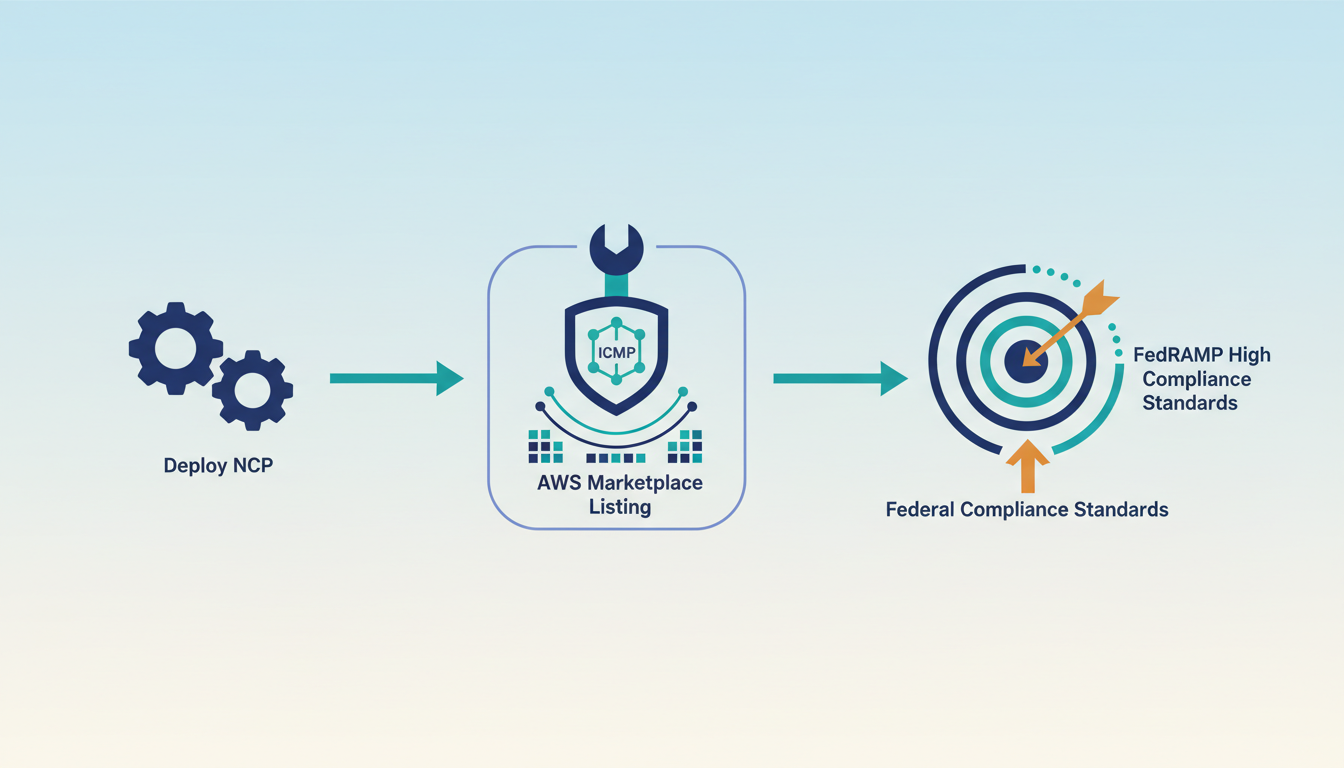
The Nutanix Cloud Platform (NCP) listing in the AWS Marketplace for the U. S. Intelligence Community (ICMP) authorizes deployment within classified enclaves distinct from standard federal channels. This specific designation separates sensitive intelligence workloads from general government applications, requiring operators to validate their procurement path against strict sovereignty mandates. Standard federal listings lack the necessary accreditation for sovereign cloud environments where data residency laws prohibit cross-boundary traffic.
| Data Classification | Unclassified / CUI | Top Secret / SCI |
|---|---|---|
| Network Isolation | Commercial Cloud | Air-Gapped Enclaves |
| Compliance Scope | FedRAMP Moderate | IC Community Directives |
Operators managing traditional virtualized workloads must recognize that the ICMP channel enforces stricter hypervisor controls than commercial equivalents. The inclusion of the Nutanix AHV hypervisor without separate licensing removes a common compliance gap found in competitor stacks requiring external hypervisor contracts. This architectural difference simplifies the approval process for AI applications running on classified data, as the entire stack resides under a single authorization boundary. Supply chain delays affect hardware delivery for these enclaves just as they do commercial deployments, extending the time-to-value for new intelligence contracts. The operational constraint remains physical node availability, not software eligibility, creating a bottleneck for agencies rushing to modernize legacy systems before 2028 mandates take effect.
Deploying Distributed Sovereign Clouds with Unified NCP Management
Federal teams activate the Nutanix Cloud Platform (NCP) via the AWS Marketplace ICMP channel to enforce strict data residency while retaining a single management pane. This configuration isolates classified workloads within sovereign boundaries, addressing the reality that a significant majority of organizations now operate across multiple public providers. Operators map local policy engines to remote clusters, ensuring governance rules travel with the workload rather than remaining static at the edge. The NCP solution functions as a true hybrid multi-cloud solution by abstracting underlying hardware differences, allowing consistent policy application whether nodes sit in a secure government facility or a commercial region.
| Control Plane | Unified dashboard | Must reside within national border |
|---|---|---|
| Data Plane | Distributed storage | Cannot cross classified enclaves |
| Network Fabric | Encrypted tunneling | Requires FIPS 140-2 validation |
Sovereign cloud mandates often demand air-gapped operations, yet unified management requires connectivity for telemetry and updates. Engineers must configure break-glass access protocols to maintain visibility without violating compliance statutes. Unlike Microsoft Azure's adaptive cloud framework, which extends a public control plane downward, this approach keeps the command structure local to satisfy intelligence community requirements. The limitation of this architecture lies in the manual validation of each new node before it joins the federated mesh. Automated onboarding scripts fail when faced with unique federal accreditation checkpoints, forcing operators to insert human verification steps into the deployment pipeline. Document these manual gates explicitly in runbooks to prevent configuration drift during scale-out events. Failure to codify these exceptions results in orphaned clusters that fall outside the central governance view.
AWS Marketplace Integration Steps for Federal NCP Procurement
Federal teams must select the ICMP channel in AWS Marketplace to access the Nutanix Cloud Platform (NCP) for classified workloads.
- Validate agency eligibility against U. S. Intelligence Community (ICMP) procurement mandates before initiating the search.
- Subscribe to the specific NCP listing rather than standard federal offers to enable sovereign cloud boundaries.
- Deploy the unified control plane to manage distributed environments without sacrificing operational simplicity.
This sequence isolates sensitive data while supporting the transition from legacy SD-WAN to AI-Native Multi-Cloud Networking architectures. Operators often overlook that standard listings lack the accreditation required for these enclaves, creating a compliance gap if the wrong SKU is selected.
- Extended engineering hours required for manual workload refactoring
- Temporary performance degradation during parallel run validation phases
- Increased licensing complexity when straddling legacy and new environments
- Additional training cycles for staff adapting to new governance models
Interpreting financial guidance requires distinguishing between booked intent and realized revenue, as supply chain constraints delay hardware availability despite strong demand signals. The unified control plane offered by the Nutanix Cloud Platform abstracts compute and storage layers, allowing organizations to bypass vendor lock-in while maintaining governance. Unlike VMware's shifted focus toward private cloud, this approach supports a true hybrid multi-cloud solution that spans on-premises data centers and public edges. Operators must recognize that migration velocity depends less on software features and more on the availability of certified server hardware to host the new clusters. Delayed deployments compress the realization timeline for Annual Recurring Revenue, creating a temporary gap between strategic planning and financial reporting. Track server lead times as a leading indicator for revenue recognition delays in upcoming quarters.
Telecommunications leads agentic AI adoption at a significant share, creating immediate pressure for hybrid infrastructure that handles distributed inference without latency spikes. Retail follows closely at a significant share, signaling that customer-facing workloads will soon demand similar elastic compute patterns across edge and core. This surge validates investment in Nutanix based on Q2 results, as the platform abstracts complexity that typically stalls AI scaling projects. Operators face a specific constraint: deploying these agents requires Nutanix Agentic AI.
The hidden costs of premature scaling include:
- Excessive north-south traffic when agents poll central models instead of local caches
- Fragmented governance policies across sovereign boundaries lacking unified control planes
- Wasted capital on public cloud egress fees that hybrid architectures could eliminate
- Unplanned network upgrades to handle increased agent communication volume
Infrastructure planners must prioritize modular expansion to accommodate the NKP Metal. Treat current Q2 revenue growth as a signal to lock in long-term contracts before lead times extend.
Supply Chain Delays and Hyperscaler Competitive Pressure
Server lead times now stretch beyond standard procurement windows, delaying revenue recognition despite strong bookings reported by Rajiv Ramaswami. Extended hardware availability creates a tangible friction point where signed contracts do not immediately translate into GAAP revenue. Operators attempting to bypass these hardware cost spikes face a paradox: shifting to public cloud avoids supply constraints but introduces hyperscaler competitive pressure that erodes margin control. The revenue timing mismatch forces finance teams to reconcile healthy order books with delayed cash flow realization.
| Server Lead Times | Deferred revenue recognition | Contract slippage into future quarters |
|---|---|---|
| Hyperscaler Pricing | Increased OpEx for burst capacity | Reduced hybrid model cost advantage |
| Migration Urgency | Rushed deployments without testing | Technical debt accumulation in new stacks |
Hidden costs emerge when organizations accelerate migration to avoid hardware queues.
- Premium pricing for expedited cloud compute instances during peak demand
- Engineering overtime required to refactor applications for public cloud APIs
- Temporary dual-licensing fees while straddling legacy and new environments
- Unexpected data transfer charges during interim hybrid states
Maintaining a unified control plane presents challenges. Investors should view the current revenue deferral as a logistical artifact rather than a demand failure, provided the backlog converts once supply chains normalize. Monitor free cash flow conversion rates in Q3 to validate this recovery trajectory.
About
Alex Kumar, Senior Platform Engineer and Infrastructure Architect at Rabata. Io, brings deep technical expertise to the analysis of annual recurring revenue (ARR) in the cloud storage sector. His daily work designing Kubernetes storage architectures and optimizing infrastructure costs for enterprise clients provides a unique vantage point on how predictable revenue models drive sustainable growth. At Rabata. Io, a specialized S3-compatible object storage provider, Kumar directly observes how transparent pricing and performance advantages convert startups into long-term subscribers, directly fueling ARR. His background as a former SRE and DevOps Lead allows him to articulate why reliable, vendor-lock-in-free storage is critical for retaining high-value AI and ML workloads. By connecting granular infrastructure decisions to broader financial health, Kumar explains how scalable cloud storage solutions create the stable, recurring revenue streams necessary for modern cloud providers competing against hyperscalers like AWS.
Conclusion
Scaling hybrid architectures reveals a critical fracture point where operational complexity begins to erode the theoretical cost advantages of multi-cloud strategies. As enterprises fragment workloads across AWS for general compute, OCI for GPU clusters, and Azure for integrated services by 2027, the overhead of maintaining a unified control plane often exceeds the savings from avoided hardware lead times. This fragmentation creates a hidden tax on engineering velocity that standard margin calculations frequently ignore. Organizations must stop viewing hybrid cloud as a temporary bridge and start treating it as a permanent, high-maintenance operating model requiring dedicated governance.
Commit to a strict 90-day audit window to evaluate whether your current multi-cloud sprawl delivers actual performance gains or merely accumulates technical debt. If your team cannot demonstrate a meaningful efficiency improvement over single-vendor consolidation within this quarter, pivot immediately toward simplifying your stack before Q4 budget cycles lock in further fragmentation. Do not wait for supply chains to normalize before addressing architectural bloat. Start this week by mapping all cross-cloud data transfer charges against your actual application latency requirements to identify immediate consolidation candidates. This granular financial reconciliation exposes wasteful burst capacity spending that masks underlying inefficiencies in your deployment strategy.
Frequently Asked Questions
Bookings exceed guidance while revenue realization shifts to future quarters due to logistics. Free cash flow held steady at $191.4 million despite these specific timing differences in reported financial figures.
Unified architectures allow significant reduction in physical data center footprint requirements. One organization reduced rack space by 80% through similar hybrid multicloud adoption strategies detailed in recent industry documentation.
Licensing shifts drive enterprises to seek alternative platforms for virtualization needs. Approximately 35% of VMware workloads are projected to migrate to alternative platforms by 2028 following recent market acquisitions.
Most enterprises now manage fragmented infrastructure across on-premises and public environments. Seventy-three percent of organizations now operate hybrid cloud estates, creating a complex baseline for unified management solutions.
Profitability metrics improved significantly despite operational expense increases during the quarter. Non-GAAP Operating Income increased by $27.7 million, reflecting strong underlying business performance and cost management efforts.