Native S3 backup jobs slash bandwidth by 62%
Cloud storage spending will hit hundreds of billions by 2032, yet most MSPs still waste margins on fragmented backup architectures. Stop wrestling with disjointed toolchains. The only path forward is native cloud integration that unifies billing and data protection. Native S3 integration kills the need for distinct cloud sign-ups, letting technicians provision customer groups and hybrid jobs in a single workflow. We rely on the architectural superiority of incremental forever schemes powered by the proprietary Data Mover Engine, which streams only block-level changes to slash bandwidth consumption on Windows Server 2025 environments. This guide details the operational steps for deploying multi-tenant backup jobs leveraging global data center certifications like SOC 2 without complicating compliance reporting.
Managing separate storage contracts and opaque tiered pricing is a legacy burden. Consolidate these functions to offer transparent, usage-based models that match the financial realities of small business clients. This shift changes the economic viability of delivering enterprise-grade data durability to the SMB market.
The Strategic Value of Native Cloud Integration for Modern MSPs
Native S3 Integration Between NovaBACKUP and Impossible Cloud
June 2025 marked the debut of a native S3 link embedding Impossible Cloud directly as a provisioned storage destination within NovaBACKUP. Separate account creation steps are gone. The architecture employs the Data Mover Engine to stream compressed blocks straight to immutable object storage the moment a job configuration occurs. This direct path eliminates manual API key handling and cuts administrative overhead for multi-tenant environments. Operators gain immediate access to SOC 2 and ISO 27001 certified data centers without navigating distinct vendor portals.
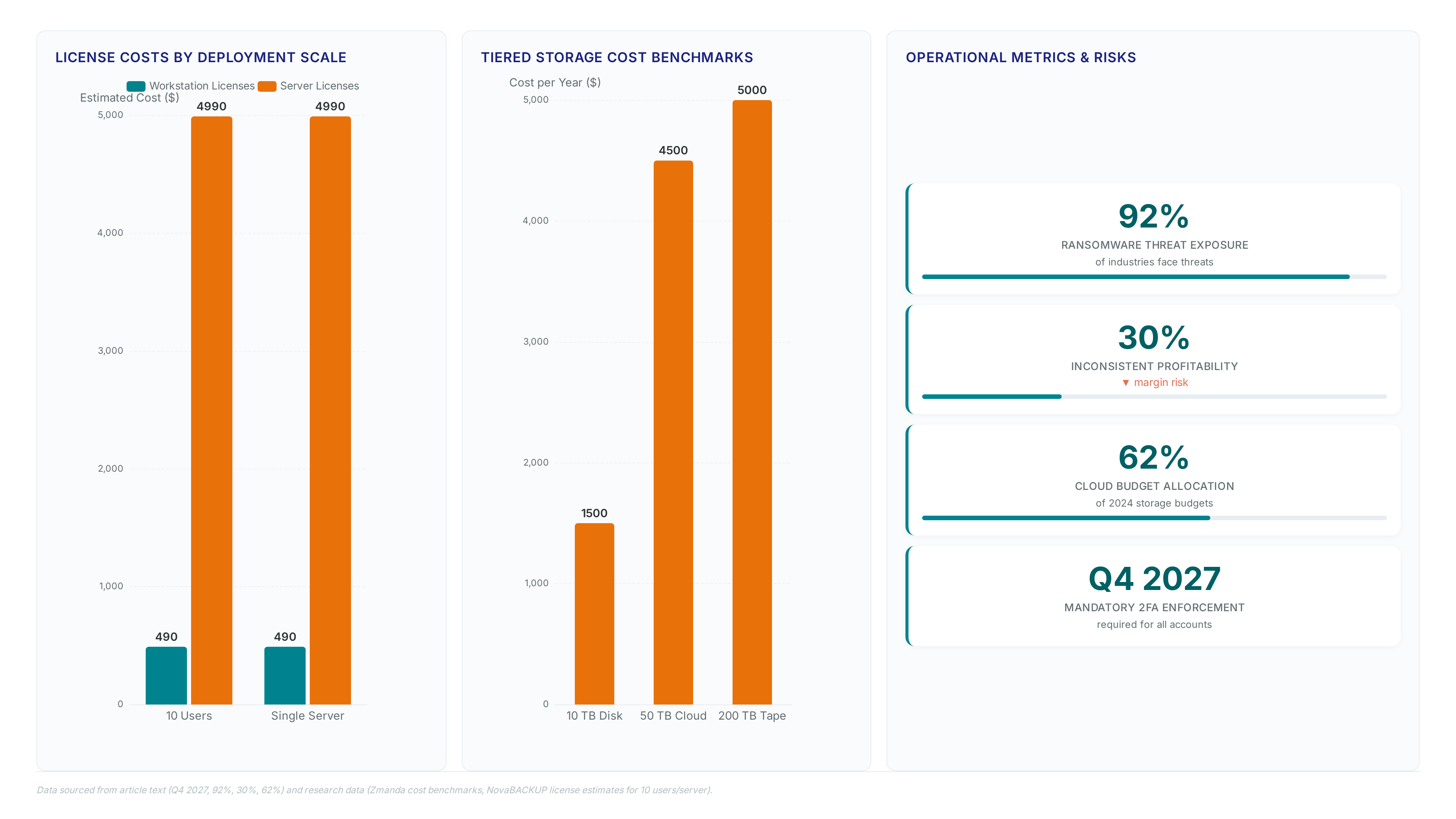
Financial models are shifting away from tiered capacity purchases toward pure consumption billing. Cost control trends indicate 62% of organizations exceeded budgets in 2024 due to hidden egress fees, a friction point this usage-based approach targets. NovaBACKUP Managed Backup removes upfront fees and storage tiers entirely, aligning expenses strictly with actual data volume. Service providers can now construct margins without guessing at future capacity needs.
Technical execution relies on the NovaBACKUP API to query specific metrics like `UsedBytes` and `ComputedFreeBytes` for external monitoring. Such API capabilities 7/articles/Application%20Programming%20Interface%20(API). Html) enable automated reconciliation between backup jobs and cloud consumption records. Native provisioning applies only to the Managed Backup edition. Perpetual license users must still configure standard S3 targets manually. Direct integration simplifies compliance but restricts architectural flexibility for non-subscription deployments.
Automated group provisioning removes separate sign-ups by creating customer isolation and hybrid jobs during initial setup. The NovaBACKUP interface provisions Impossible Cloud storage natively; operators only define individual groups for different clients. This workflow eliminates the administrative burden of managing distinct vendor accounts or API keys for each tenant. Financial pressure remains acute, as roughly 30% of MSPs with managed contracts fail to generate consistent profits due to billing inefficiencies. The integration directly addresses this margin erosion by aligning operational effort with revenue generation.
Contract renewals offer the ideal window for switching to native cloud backup. Existing storage tiers often create budget unpredictability that demands attention. Migrating existing workloads requires mapping current data volumes to the new usage-based model to avoid shock. Operators must verify that their current client mix justifies the shift from perpetual licenses to consumption billing.
| Action Item | Requirement | Outcome |
|---|---|---|
| Group Creation | Define per-customer containers | Tenant isolation |
| Job Configuration | Select cloud or hybrid target | Automated provisioning |
| Billing Review | Analyze usage patterns | Profitability alignment |
Deployment success depends on abandoning legacy tiered storage mentalities in favor of granular tracking. Firms relying on fixed-fee contracts must adjust their pricing structures to match variable consumption. Failure to recalibrate service agreements exposes the provider to margin compression despite reduced administrative overhead. Execute this transition during quarterly business reviews to minimize disruption. NovaBACKUP Managed Backup charges strictly for consumption without tiered capacity penalties or upfront commitments. Competitors like Acronis Cyber Backup mandate annual subscriptions starting at a premium price, creating fixed costs regardless of actual storage utilization.
Architectural Advantages of Immutable S3 Storage Over Traditional Competitors
Immutable S3 Targets and SOC 2 Certified Data Centers
Impossible Cloud introduces an immutable target sitting beside local options like NAS, USB, or RDX-drives to meet strict retention rules. Operators often build a tiered system pairing 10TB disk at $1,500/year with 50TB cloud cool storage costing $4,500/year for a total of $22 per TB annually. These data centers hold SOC 2 and ISO 27001 certifications, allowing compliance in regulated fields without geographic restrictions. Global cyberattacks rose 44% year-over-year, creating urgent demand for verified immutability instead of generic object stores. Retention management separates Local Backup from Cloud Storage types, showing time settings based on the primary target location in the job dialog. Administrators balance the speed of local USB writes against the ransomware resistance found in remote immutable buckets.
Latency presents the main constraint. Local RDX-drives provide instant restore times, yet cloud targets bring network-dependent delays during recovery. This limitation pushes architects toward hybrid workflows rather than single-medium reliance. Configure distinct groups for every client to isolate these storage paths effectively.
Regional Data Sovereignty Selection for EU and US Compliance
NovaBACKUP sign-up demands an explicit selection between Europe or US storage regions to satisfy local data residency laws. This choice directly shapes latency and legal jurisdiction for regulated clients such as medical practices. Operators modeling their business structure within the Central Management console can assign specific regional targets to distinct customer groups. The Q4 2027 release mandates Two-Factor Authentication (2FA) across these accounts, adding a layer of identity verification before region changes occur. Selecting a distant region to meet compliance may increase backup windows beyond acceptable limits for large datasets. Engineers querying the API can filter metrics by `BackupClientLicenseKey` to audit actual storage location versus policy intent. Misalignment between the selected region and client physical location creates unnecessary network hops. Validate regional settings during initial provisioning rather than post-deployment migration.
Backup Execution Speed Benchmarks: NovaBACKUP vs Acronis and IDrive
Independent tests show NovaBACKUP finishing backups in 22:14, trailing IDrive at 12:29 and Acronis True Image at 18:21. Raw throughput often sacrifices speed for the immutable S3 integrity required by regulated sectors. MSPs prioritizing rapid data ingestion face a measurable latency penalty when selecting compliance-heavy architectures over pure performance tools. The slower execution window demands larger maintenance windows or staggered job scheduling to avoid impacting production systems.
Restore operations occasionally invert this performance hierarchy depending on infrastructure constraints. User reports suggest recovering from hardware failures with NovaBACKUP can feel quicker than navigating complex restore workflows in competitor suites despite slower initial writes. This pricing structure offsets the operational cost of longer backup windows for small business clients with static data volumes. Operators must weigh the 10-minute differential against the risk of ransomware encryption targeting mutable backups. The architectural choice favors data survivability over velocity in threat-dense environments. Align backup windows with off-peak hours to mitigate the speed disparity.
Operational Workflow for Deploying Hybrid Backup Jobs Across Multi-Tenant Environments
Defining the Central Management Console for Multi-Tenant Provisioning
Administrators apply the Central Management console as a singular control plane to define customer groups and provision hybrid jobs without separate S3 sign-ups. Operators model their actual business structure by creating isolated tenant containers, granting read-only job visibility to junior technicians while restricting configuration rights. Granular access control prevents accidental policy changes across the multi-tenant environment. The Q4 2027 release enforces mandatory Two-Factor Authentication on all accounts, securing the initial login sequence against credential compromise before any backup task executes.
Provisioning follows a strict linear workflow once the console authenticates the administrator:
- Create a dedicated group for each client entity to isolate metadata and policies.
- Select the hybrid job type to enable simultaneous local and cloud writes.
- Assign the specific Impossible Cloud region (Europe or US) to satisfy data residency laws.
- Deploy the configuration, which automatically instantiates the underlying immutable S3 bucket.
Administrators can query these storage accounts programmatically using the API with filters like `BackupClientLicenseKey` to extract `UsedBytes` metrics for external billing reconciliation. This API capability eliminates manual spreadsheet tracking for usage-based invoicing. Rigid tenancy defines the architecture; merging customer groups post-creation requires full job re-provisioning rather than simple tag updates. Establish the group hierarchy during initial onboarding to avoid disruptive migration later.
Implementation: Executing Regional Data Center Selection for EU and US Compliance
Sign-up requires an explicit selection between Europe or US regions to satisfy local data residency laws for regulated clients. Geographic constraint dictates latency profiles and legal jurisdiction before any backup job executes. Operators must create individual customer groups within the console, assigning specific regional targets to match client location. The process models actual business structures by granting read-only visibility to technicians while restricting configuration rights via Central Management controls. Dental practices like those served by Mytec Services rely on this segregation to secure patient data against cross-border exposure. Performance limitations emerge when compliance mandates force data into distant regions, extending backup windows beyond standard maintenance slots.
- Log into the portal and select the target region during initial provisioning.
- Define isolated tenant containers for each customer entity.
- Configure hybrid jobs pointing to the immutable S3 destination.
- Enable mandatory Two-Factor Authentication for all administrative accounts.
Strict sovereignty conflicts with operational speed, forcing MSPs to stagger job schedules carefully. Raw throughput often sacrifices performance for the integrity required by medical or accounting sectors.
Avoiding Hidden Egress Fees in Usage-Based Cloud Storage Models
Nearly half of organizations exceeding storage budgets cite hidden egress and access fees as the primary cause of financial failure. Traditional tiered pricing models trap MSPs in unpredictable cost structures where retrieving data for restoration triggers unexpected charges that erode thin margins. A usage-based model without storage tiers eliminates these variable penalties, allowing operators to implement transparent billing for clients with zero surprise line items.
- Define customer groups within the console to isolate billing contexts per tenant.
- Select hybrid backup jobs that apply local RDX-drives for fast recovery while offloading archives.
- Verify the immutable S3 target configuration to prevent ransomware encryption of stored sets.
Financial risk extends beyond simple overruns; 92% of industries face ransomware threats that necessitate frequent data retrieval tests, which traditional providers monetize aggressively. Operators ignoring this flexible face a scenario where compliance drills become profit-negative events. NovaBACKUP integrates Impossible Cloud natively to remove these friction points, ensuring that disaster recovery validation does not trigger budget alerts. Support engineers with over a decade of tenure assist in modeling these cost structures accurately during onboarding. This approach converts a potential liability into a predictable operational expense, aligning technical durability with fiscal stability for small business clients.
Measurable ROI and Compliance Gains for SMB-Focused Service Providers
Defining Usage-Based Billing Models for MSP Profitability

Usage-based billing removes storage tiers to tie MSP expenses directly to real data use instead of pre-bought capacity. This structure drops upfront fees so providers serving 10-50 employee firms can scale costs linearly as clients grow. Traditional tiered setups often push operators to over-provision resources, adding financial strain that leaves many managed contract holders unable to reach consistent profitability according to Canalys. Hidden egress penalties cause budget overruns for almost two-thirds of organizations managing cloud assets.
Operators set up managed backup jobs that charge strictly per gigabyte, sidestepping the trap of paying for empty allocated space. Market analysis shows the data storage sector will expand from a substantial sum billion in 2024 to an even larger figure billion by 2029, driven by this shift toward transparent consumption models. Revenue fluctuates with client data growth, which demands flexible margin calculations rather than fixed recurring revenue assumptions. Adopt this variable cost structure to shield thin margins from unpredictable storage spikes.
Deploying Tailored Backup Packages for Doctors and Accounting Firms
Mapping patient records to specific regional buckets satisfies HIPAA residency mandates for dental offices using immutable S3 targets. Operators define isolated customer groups inside the console so sensitive health data never crosses jurisdictional lines without explicit approval. This separation lets one technician manage distinct compliance policies for a medical clinic and an accounting firm at the same time. A specialized dental MSP replaced an unstable legacy product with this architecture to secure critical patient data against network failures Mytec Services. The immutable target stops ransomware from encrypting historical backups, a capability vital since ransomware threatens nearly all industries.
Financial viability for these verticals relies on removing hidden egress fees that usually erode margins during disaster recovery. A usage-based model without storage tiers aligns operational costs with actual data consumption rather than arbitrary capacity blocks. Partners like TLC Netcon show how this flexibility enables MSPs to act as a de facto IT department while keeping billing predictable for clients. The transparent pricing structure eliminates the risk of budget overruns common in traditional tiered offerings.
Operators must weigh strict compliance needs against the performance demands of small business environments. Regional selection happens at sign-up, which locks data geography before any job execution begins. Provision separate tenant containers right away to enforce least-privilege access across these regulated workloads.
Mitigating Hidden Egress Fees and Storage Budget Overruns
Half of organizations blowing past storage budgets blame unexpected egress and access charges for the shortfall. Traditional providers often bury retrieval costs within complex tiered structures, forcing MSPs to absorb margin erosion during disaster recovery events. A flat usage-based model removes these variable penalties by charging only for actual consumption without storage tiers. This approach directly counters the financial leakage where nearly half of over-budget orgs cite hidden fees as the primary cause. Operators gain predictable cash flow necessary for serving clients with revenues between $1 million and $10 million.
Operators must still monitor total volume growth to prevent organic budget drift. Transparent pricing prevents surprise line items but does not cap unlimited data accumulation by end users. Configure strict retention policies alongside immutable S3 targets to control scale.
About
Alex Kumar, Senior Platform Engineer and Infrastructure Architect at Rabata. Io, brings deep expertise in disaster recovery and cloud-native storage to this discussion on managed backup solutions. His daily work designing Kubernetes storage architectures and optimizing backup strategies for enterprise clients directly informs the technical realities of integrating NovaBACKUP with Impossible Cloud. Having previously served as an SRE for high-traffic SaaS platforms, Alex understands the critical need for smooth, native integrations that eliminate complex setup procedures. At Rabata. Io, a specialized S3-compatible object storage provider, he focuses on delivering cost-effective, GDPR-compliant data protection without vendor lock-in. This article reflects his hands-on experience ensuring that AI startups and enterprises can use Impossible Cloud's high-performance storage within familiar backup workflows. His insights bridge the gap between theoretical infrastructure architecture and practical, automated backup execution for modern organizations.
Conclusion
Scaling backup architectures reveals that predictable unit costs often mask the compounding expense of unmanaged data retention. As cloud storage spending projects a fourfold increase by 2032, relying solely on flat-rate subscriptions creates a false sense of fiscal security while organic data growth silently erodes margins. The real breaking point occurs when recovery testing demands high-frequency access to cold archives, triggering performance bottlenecks that cheap storage tiers cannot resolve. Operators must shift from merely buying capacity to actively managing data lifecycles to survive this volume surge.
Adopt a hybrid retention strategy within the next six months that pairs local disk for immediate recovery with cloud archives strictly for long-term compliance. Do not wait for your next budget cycle to address this; the window to optimize before market rates adjust is closing. This approach balances the need for geographic flexibility with the reality of rising global cyber threats, ensuring you do not become a victim of your own success.
Start by auditing your current retention policies this week to identify any data sets older than 90 days that remain on high-performance tiers. Move these immediately to cold storage to realize instant cost savings and establish a baseline for future consumption modeling. This single action creates the operational discipline required to scale without financial surprise.
Frequently Asked Questions
Users no longer need separate signups because provisioning happens automatically during NovaBACKUP setup. This eliminates manual API key handling while reducing the administrative overhead that causes 30% of MSPs to fail profitable managed contracts.
The solution uses a pure consumption billing model with no upfront fees or storage tiers. This transparency directly targets the hidden egress fees that caused 62% of organizations to exceed their IT budgets in 2024.
The architecture leverages global data centers holding SOC 2 and ISO 27001 certifications for secure storage. This ensures regulated clients meet strict standards while avoiding the complex compliance reporting usually required for separate vendor portals.
Yes, users can decide whether to store data in Europe or the US during initial configuration. This geographic flexibility allows providers to optimize performance while strictly fulfilling specific regional compliance requirements for their clients.
The proprietary Data Mover Engine streams only compressed block-level changes to immutable object storage. This incremental forever approach significantly reduces bandwidth consumption on Windows Server 2025 environments compared to traditional full backup methods.