myQNAPcloud One Review: 1TB Pool, Zero Egress
82% of organizations now run hybrid models. QNAP reports that myQNAPcloud One merges NAS backups and S3 object storage into a single subscription. This service kills the operational friction of managing disjointed cloud silos by pooling capacity for both workflows.
The platform addresses the critical need for data immutability through built-in object lock features, directly countering ransomware threats without complex third-party add-ons. By operating across 13 global data centers, the architecture ensures low-latency access while adhering to strict regional compliance mandates for regulated industries. Users gain predictable costing since API request fees and data transfer charges are included, removing the variable expenses that typically plague public cloud budgets.
This hybrid cloud dominance reshapes infrastructure strategies, moving away from fragmented vendor contracts toward consolidated management. The technical integration of unified storage pools dynamically allocates space between local NAS protection and cold archive tiers. We are replacing traditional storage silos with a flexible model that scales from 1TB upwards based on actual consumption rather than rigid licensing tiers.
The Role of myQNAPcloud One in Modern Hybrid Cloud Infrastructure
myQNAPcloud One Unified Capacity Model Explained
MyQNAPcloud One merges NAS backup and S3-compatible object storage into a single shared capacity pool launched February 6, 2026. The architecture eliminates siloed billing by allowing administrators to flexibly allocate purchased storage capacity between workflow types without separate subscriptions. Hyperscalers mandate distinct configurations for different storage classes; this design does not. Operators gain predictable costs through a flat-rate model rather than navigating complex tiered pricing structures common elsewhere. The unified approach directly supports the 82% of organizations currently relying on hybrid cloud models by simplifying management overhead.
Consolidation removes granular cost attribution between backup and object workloads. Finance groups must adopt alternative allocation metrics since storage consumption no longer maps to discrete line items. Network architects implement external monitoring to track usage ratios across the combined pool. Such visibility ensures the hybrid deployment remains aligned with budgetary constraints as data growth shifts between services. Validate chargeback policies before migrating legacy accounts to this consolidated structure.
Administrators allocate shared capacity between workflows based on actual usage rather than maintaining separate subscriptions. Operators define a total pool, such as 1TB, then split it dynamically between NAS backup streams and S3-compatible application data. Early access testing throughout 2025 confirmed this approach reduces operational complexity for the majority of organizations relying on hybrid models. QNAP positions itself as a specialized niche provider integrated tightly with the NAS system for SMB markets instead of competing directly on raw scale.
The cost benefit emerges from eliminating variable traffic charges common on many cloud storage platforms pricing. Monthly plans start at $4.99 for entrylevel tiers, providing predict able expenses without complex tiered calculations. A drawback exists for massive scale deployments where per-gigabyte discounts from hyperscalers might eventually undercut flat-rate models. Operators must weigh the simplicity of unified management against potential volume discounts available elsewhere. Evaluate current data growth rates before committing to a fixed capacity ceiling.
QNAP Niche Strategy Versus AWS and Azure Market Dominance
QNAP targets SMB hybrid workflows while AWS commands 28% global share and Azure holds 21%. The unified capacity model contrasts sharply with hyperscaler silos that enforce separate billing for backup and object tiers. Industry storage costs dropped 15% since 2025, yet egress fees remain a hidden tax on distributed architectures. Microsoft ending standalone OneDrive sales after May 31, 2026 creates a vacuum for integrated NAS vendors. Nfrastructureserviceproviders/ commands 28% global share and Azurehttps://www.qnap.com/en/news/2026/qnap-launches-myqnapcloud-one-official-shared-cloud-storage-for-nas-backups-and-scalable-object-storage stati udinfrastructureserviceproviders/ holds 21%.
Operators face a tension between global scale and local control. Hyperscalers offer vast hybrid cloud reach but complicate cost prediction with complex tiering. QNAP sacrifices global footprint for predictable subscription pricing tied directly to on-premise hardware. This strategy fails for organizations requiring multi-region compute alongside storage. However, the impending OneDrive shift forces many SMBs to re-evaluate standalone cloud plans. A specialized provider eliminates the operational overhead of managing disparate contracts. The market dominance of AWS and Azure does not preclude niche success in specific verticals. Assess total cost of ownership before committing to hyperscaler ecosystems.
Inside the Architecture of Unified Storage and Data Immutability
Object Lock Mechanics for Ransomware Defense
Object lock enforcement prevents data alteration or deletion for a set retention window to stop ransomware encryption. This mechanism renders stored objects immutable, blocking unauthorized changes even if an attacker compromises administrator credentials. Such controls satisfy mandatory audit requirements in regulated sectors like healthcare and finance where data integrity is non-negotiable. The service integrates this functionality directly into myQNAPcloud One, allowing operators to configure retention policies alongside standard backup jobs. Administrators access these settings through familiar interfaces like Hybrid Backup Sync (HBS), which lists the Storage and Object components as distinct cloud providers despite unified billing.
| Feature | Standard Storage | Object Lock Enabled |
|---|---|---|
| Deletion Permission | Immediate | Blocked until expiry |
| Modification | Allowed | Denied |
| Ransomware Durability | Low | High |
Failure to match the bucket region with the API call results in immediate rejection, a common misconfiguration during initial deployment. This architectural constraint forces precise network planning but eliminates the risk of accidental mass deletion across zones. Validate region strings before enabling immutability to prevent lockout scenarios.
Configuring Hybrid Backup Sync with Distinct Cloud Providers
- Select a regional node closest to the primary NAS site to avoid cross-region transfer penalties.
- Configure the Storage target for standard file backups using the portal credentials.
- Map the Object target for application data using specific bucket URLs tied to the chosen region.
Performance inconsistencies often stem from mismatched region selections between the NAS hardware and the cloud bucket location. Unlike hyperscalers charging $0.02/GB for inter-region traffic, this architecture penalizes poor planning with latency rather than direct fees, yet the operational impact remains severe for time-sensitive restores. The distinct cloud providers listing forces operators to manage two connection profiles manually, introducing a potential configuration drift risk if credentials rotate.
| Component | Access Method | Configuration Target |
|---|---|---|
| Storage | Qfile Pro / Portal | File Share Path |
| Object | S3 API | Bucket URL |
Failure to align the bucket URL with the selected data center triggers immediate PUT or DELETE operation errors during backup jobs. Validate region alignment before committing large datasets to prevent silent sync failures.
QNAP Usage-Flexible Subscription Versus Variable Traffic Charges
Predictable budgeting requires eliminating egress fees that plague hyperscaler architectures. Most public clouds levy transfer costs on data retrieval, creating financial uncertainty during large-scale recovery operations. QNAP absorbs these charges within a flat subscription model. This approach contrasts with competitors charging $0.023/GB for standard transfers, which accumulates rapidly during ransomware restoration events. The absence of variable traffic penalties removes the disincentive to access archived data frequently.
| Cost Component | Hyperscaler Standard | myQNAPcloud One |
|---|---|---|
| Data Egress | Billed per GB | Included |
| API Requests | Tiered pricing | Included |
| Storage Class | Complex tiers | Unified pool |
| Billing Model | Variable usage | Flat subscription |
Operational silos dissolve when backup and object workloads share a single capacity reservation. Administrators avoid maintaining separate accounts for distinct storage classes, reducing configuration overhead significantly. The trade-off involves accepting a fixed capacity ceiling rather than infinite elastic scaling found in massive public clouds. Organizations must right-size their initial commitment to prevent over-provisioning unused space. Benchmarking against alternatives reveals Google Drive equivalents at $4.16/TB $5.83/TB. QNAP positions its offering between these points to capture cost-sensitive SMB segments effectively. Validate total cost of ownership across three-year horizons before migration. Hidden transfer taxes often negate apparent savings from cheaper base storage rates elsewhere. Consistent performance stems from removing financial gates that throttle data retrieval speeds during incidents.
Strategic Advantages of Unified Storage Over Traditional Silos
Unified Subscription Economics Versus Separate Backup and Object Plans
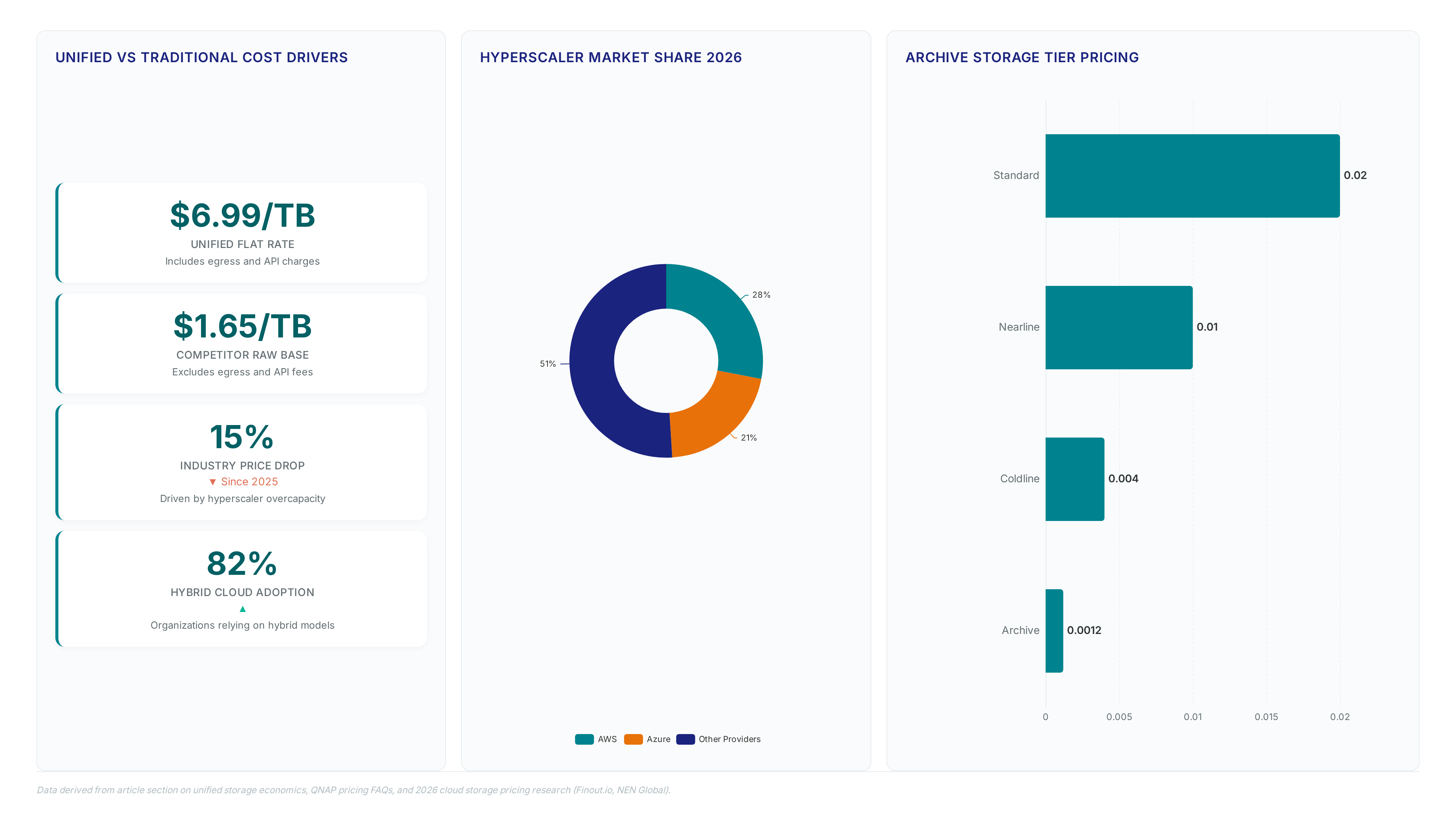
Single-pool billing at 6.99 USD per TB eliminates the dual-subscription penalty inherent in traditional cloud architectures. Operators typically pay distinct base fees for backup repositories and object buckets, creating redundant overhead regardless of actual utilization. The unified cloud storage solution contrasts with hyperscalers that enforce rigid separation between storage classes and billing accounts.
| Cost Dimension | Unified Model | Traditional Silos |
|---|---|---|
| Base Fee | Single charge | Duplicate subscriptions |
| Allocation | Fluid across workloads | Static per service |
| Forecasting | Linear scaling | Variable traffic taxes |
The simplified flat-rate subscription model offers stability. While IDrive offers lower raw costs at $1.65 per TB per month, that figure excludes the egress and API charges that inflate total spend during recovery events. QNAP absorbs these variables, trading raw cheapness for predictability.
However, this economic efficiency introduces a rigid operational constraint: capacity downgrades require full cancellation and repurchase rather than simple adjustment. The financial predictability comes at the cost of granular flexibility. Operators must forecast peak needs accurately, as shrinking the pool triggers administrative overhead not present in pay-as-you-go hyperscaler environments. The service architecture demands precise initial sizing to avoid wasted capital or disruptive migration later.
Scaling Hybrid Workflows from 1TB Entry Tiers to Enterprise Capacity
Operators expanding from entry tiers to enterprise-scale capacity avoid data migration between disparate services by using a single subscription pool. This unified model supports the hybrid deployment scenario where organizations manage data locally while using cloud layers for external backups and scalability. Growth paths remain linear because additional capacity tiers extend the existing ledger rather than forcing a platform switch. However, data isolation persists logically; storage accessed via portal credentials cannot directly read S3 buckets despite shared billing. Administrators must configure distinct targets within backup tools to bridge this architectural separation effectively.
| Scaling Dimension | Unified Pool Approach | Traditional Siloed Model |
|---|---|---|
| Capacity Limit | Scales to a substantial capacity single ledger | Separate caps per service |
| Migration Overhead | Zero during expansion | High during tier jumps |
| Cost Predictability | Fixed rate per TB | Variable egress plus API fees |
| Operational Complexity | Single dashboard view | Dual console management |
The limitation of this architecture appears during downgrades; reducing capacity requires canceling the current plan and purchasing a new one rather than shrinking the allocation. This constraint forces operators to forecast peak needs accurately before committing to higher tiers. Strategic planning mitigates the risk of over-provisioning since the shared capacity model allows flexible splitting between backup and object workloads. Organizations targeting cost-effective scaling should prioritize annual commitments to lock in lower proven rates without sacrificing flexibility. The absence of direct downgrade paths means initial tier selection carries long-term financial weight. QNAP eliminates this variable cost by absorbing all data transfer charges within its flat subscription model. This structure creates financial uncertainty for operators managing unpredictable recovery volumes. The absence of egress fees means operators must weigh lower entry pricing against the risk of exponential cost growth during incident response. A cheap storage tier becomes expensive the moment data must move. Restricting data access to save money contradicts the primary goal of business continuity. QNAP's approach removes this tension by decoupling usage volume from cost variance. Validate total recovery costs before selecting a provider based solely on storage rates. Predictability matters more than marginal savings on static data.
Deploying myQNAPcloud One for Secure NAS Backup and Compliance
myQNAPcloud One Usage-Flexible Storage Subscription Mechanics

Operators configure myQNAPcloud One by selecting a base 1TB capacity tier that dynamically splits between NAS backups and S3 buckets. Allocation shifts without manual intervention as workflow demands fluctuate between local archive and object storage needs.
- Select total subscription size in the QNAP portal interface.
- Assign Hybrid Backup Sync jobs to the unified cloud provider entry.
- Direct S3 applications to the distinct object storage endpoint using region-specific URLs.
- Monitor shared ledger usage to prevent over-allocation of the single pool.
This hybrid deployment scenario uses a simplified flat-rate subscription. The limitation remains logical separation; storage accessed via portal credentials cannot directly read S3 buckets despite shared billing. Treat the two endpoints as distinct infrastructure silos during disaster recovery planning. Operators gain cost predictability but lose the ability to move data between backup and object layers without re-uploading.
Implementation: Configuring Hybrid Backup Sync with Distinct Cloud Providers
Administrators must select separate cloud provider entries for Storage and Object components within Hybrid Backup Sync despite unified billing.
- Navigate to the remote backup section and locate the two distinct cloud provider listings generated by the subscription.
- Configure the NAS backup job using the myQNAPcloud Storage endpoint for file-level replication.
- Establish a second connection for S3 workloads using the myQNAPcloud Object endpoint, noting that data isolation prevents cross-access between these logical pools.
- Assign specific capacity limits to each job to manage the shared ledger effectively.
Operators often misconfigure region-specific URLs for object buckets, causing PUT failures during initial synchronization. The integration tools require explicit endpoint selection because the underlying architecture treats these services as independent entities. Unlike hyperscalers that bundle storage classes under one account ID, this setup demands manual segregation of backup targets. The operational consequence of this dual-entry requirement is increased configuration time, yet it provides granular control over data placement that single-endpoint models lack. Administrators gain the ability to enforce different retention policies per component while drawing from a single financial pool. This separation ensures compliance workflows remain distinct even when budget allocation is consolidated.
Enabling Object Lock for Regulated Sector Compliance
Activating immutability requires setting a fixed retention period in the bucket policy before any data upload occurs. Operators configure Hybrid Backup Sync to target the S3 endpoint, ensuring the `Object Lock` header is present in every PUT request. Early access validation during 2025 testing phases confirmed the system enforces compliance by rejecting any deletion API calls until the retention window expires.
| Feature | Configuration Requirement | Compliance Outcome |
|---|---|---|
| Retention Mode | Set to `GOVERNANCE` or `COMPLIANCE` | Prevents root user deletion |
| Versioning | Enable up to 100 file versions | Supports audit trails |
| Monitoring | Activate 180-day activity logs | Tracks unauthorized access |
A critical limitation exists: enabling Object Lock permanently binds the bucket to the selected region, preventing migration to other zones. Validate regional data sovereignty laws before finalizing the deployment location.
About
Alex Kumar, Senior Platform Engineer and Infrastructure Architect at Rabata. Io, brings deep technical expertise to the analysis of myQNAPcloud One. His daily work designing Kubernetes storage architectures and disaster recovery strategies for enterprise clients directly aligns with the challenges of unifying NAS backups and object storage. Having previously led DevOps initiatives for high-traffic platforms, Alex understands the critical need for smooth, S3-compatible solutions that eliminate vendor lock-in while optimizing costs. At Rabata. Io, a specialized provider of high-performance object storage, he actively engineers scalable infrastructure for AI/ML startups and cost-conscious enterprises. This hands-on experience allows him to critically evaluate how QNAP's unified pool approach impacts real-world backup workflows and data accessibility. His insights bridge the gap between theoretical cloud features and practical infrastructure deployment, offering readers a grounded perspective on navigating the evolving environment of hybrid cloud storage.
Conclusion
Scaling this architecture reveals that egress fees eventually eclipse the predictable entry-level subscription costs, specifically when data retrieval patterns shift from archival to active analysis. The operational burden shifts from simple capacity planning to managing latency penalties inherent in splitting traffic between local NAS and remote buckets. While the dual-entry configuration offers granular policy control, it introduces a persistent configuration debt that grows with every new compliance requirement added to the stack. Organizations should adopt this hybrid model only if their retention policies strictly require immutable storage for less than three years; beyond that timeline, dedicated cold storage tiers offer superior cost efficiency without the regional lock-in risks. Do not commit to a single region for Object Lock buckets until legal teams verify data sovereignty laws for all future expansion markets. Start by auditing your current backup retrieval logs this week to calculate the ratio of read-to-write operations, as a ratio exceeding 1:5 indicates your workflow will incur prohibitive egress charges under this specific pricing structure.
Frequently Asked Questions
Monthly plans for the service start at just $4.99 for entry-level tiers. This predictable pricing model helps organizations avoid complex tiered calculations often found with other providers.
Customers begin their subscription by choosing a total storage amount starting at 1TB. This single pool dynamically splits between NAS backups and object storage based on actual usage needs.
The unified approach directly supports the 82% of organizations currently relying on hybrid cloud models. It eliminates operational friction by merging NAS backups and S3 storage into one subscription.
While AWS commands 28% of the global market, QNAP targets specific SMB hybrid workflows instead. It offers a specialized niche integrated tightly with the NAS ecosystem rather than raw scale.
Data transfer and API request fees are fully included in the flat-rate subscription model. This removes variable expenses that typically plague public cloud budgets for users managing large datasets.