GreenOps cuts cloud costs by stopping data movement
Legacy data architectures are actively sabotaging enterprise returns. With $37 billion spent on generative AI in 2025, the bill for moving data around just to analyze it has become untenable. The fix isn't better compression or cheaper storage tiers; it's abandoning centralized data warehousing for a federated data architecture. This approach decouples storage from compute, letting businesses interrogate data in place rather than dragging petabytes across networks.
GreenOps principles directly counter the "legacy BI hangover" that forces redundant ETL processes and duplicates storage across hybrid clouds. By implementing architectural minimalism, organizations align resource consumption with actual business demand. This turns FinOps from a compliance checkbox into a core engineering constraint.
Inefficient compute usage drives both cloud bills and carbon footprints higher while delivering negligible EBIT impact. Shifting to a model where governance occurs at query time allows firms to process petabytes efficiently without the penalty of data movement. This is a fundamental requirement for scaling AI workloads in 2026.
The Role of GreenOps and Federated Architecture in Modern Data Estates
GreenOps Definition in AI Data Architecture
Sustainability metrics now dictate where compute runs. Enterprise spending on generative AI hit $37 billion in 2025, yet 71% of organizations regularly using generative AI report costs climbing and carbon footprint increasing due to architectural inefficiencies. Legacy models centralize data, forcing energy-intensive extraction. A federated approach decouples storage from compute, allowing engines to access real-time federated query capabilities without duplicating petabytes across clouds. The mechanism eliminates egress waste by pushing logic to the data source instead of pulling data to the logic.
Implementing this shift requires abandoning entrenched ETL pipelines. Gartner projects that 40% of enterprise applications will embed task-specific AI agents by 2027, necessitating strong data access layers that legacy warehouses cannot provide. Operational friction arises when transitioning from batch-oriented consolidation to distributed, on-demand execution. Operators must accept that data gravity becomes a cost driver rather than a technical constraint when scaling AI workloads. Failure to adopt query-in-place patterns locks estates into unsustainable egress bills as agent swarms multiply. Sustainability in AI is a structural requirement for economic viability.
Data gravity forces compute to migrate toward static storage, creating inefficient hybrid AI workloads. Legacy centralization models trigger excessive egress charges and carbon emissions when training large models across distributed clouds. Poor data quality and fragmented architectures linked to these legacy approaches correlate with a 15-25% revenue loss, making the financial stake of architectural inertia explicit. Organizations clinging to batch-oriented ETL pipelines face compounded latency as AI agents demand real-time access to disparate sources.
Hybrid cloud approaches are adopted by 77% of enterprises, yet many retain storage-bound compute patterns. This mismatch forces data duplication to satisfy local processing needs, directly contradicting GreenOps principles. Unlike traditional BI, AI workloads cannot tolerate the latency introduced by moving petabytes for every inference cycle. The result is an architecture that burns budget on transport rather than intelligence.
Mature data practices offer a definitive escape route, delivering a significantly higher digital transformation success rate for those who decouple storage from compute. Federated query engines eliminate the need to physically relocate data, allowing compute to remain ephemeral and localized. This shift prevents the revenue leakage inherent in static models while supporting the scale required for agentic AI. Failure to adopt this model risks obsolescence as competitors use query-in-place strategies to reduce total cost of ownership.
Mission and Vision must prioritize architectural minimalism to prevent further erosion of margins.
Federated Versus Centralized Data Models for GenAI
Centralized models fail GenAI scale because duplicated storage triggers prohibitive egress costs against a $1.3 trillion by 2032 market projection. The legacy approach forces data migration into single warehouses, creating data gravity that stalls agentic workflows. Centralization demands redundant copies for every new model, inflating carbon footprints while starving compute resources. In contrast, federated architecture executes queries in place, eliminating unnecessary data movement entirely.
Adoption barriers remain significant as 61% of companies admit data assets lack readiness under current structures. The shift requires abandoning familiar ETL patterns for real-time federated query capabilities that span hybrid clouds without copying bytes. Operators must accept that governance now happens at the query layer rather than the storage tier. Decentralization introduces complexity in access control policies that centralized systems previously abstracted away.
Immediate query simplicity conflicts with long-term scalability. Centralized systems offer easier initial setup but collapse under petabyte-scale AI training loads. Federated systems demand higher upfront policy configuration but sustain GenAI growth without exponential cost spikes. Organizations ignoring this architectural pivot face obsolescence as model sizes outstrip available budget for data transfer.
Inside Query-in-Place Mechanics Using Trino and Decoupled Storage
Defining Architectural Minimalism in Trino Query Execution
Redundant ETL processes vanish when Trino queries data at its physical location. This distributed SQL engine pushes computation directly to storage layers instead of dragging bytes into a central warehouse. Moving data unnecessarily spikes carbon footprints and inflates cloud bills by burning energy on transit rather than analysis. Spinning up compute resources strictly for the duration of a query creates a fundamental shift that yields rapid financial returns.
| Legacy Pattern | Minimalist Pattern |
|---|---|
| Centralized data warehouse | Federated query-in-place |
| Static compute clusters | Ephemeral compute scaling |
| High egress costs | Zero data movement |
Federated querying spans on-premises databases and cloud lakes without requiring physical migration. Market dynamics currently favor this specialized approach, as Databricks holds a mindshare of 8.2% while competitors focusing on proprietary formats lose ground. Network latency presents a real constraint because interrogating remote sources demands reliable connectivity to prevent timeouts during complex joins. Bandwidth alone cannot overcome data gravity, so engineers must deploy intelligent caching strategies at the edge. Mission and Vision recommend validating connector throughput before decommissioning legacy extraction pipelines.
Executing Distributed SQL Queries Across Hybrid Data Estates
A Coordinator node builds optimized execution plans for SQL across disparate sources without moving data. Trino serves as the core engine that drives computation to storage layers rather than pulling bytes to a central warehouse. Native connectivity supports over 40+ Enterprise data sources, enabling instant joins between on-premises databases and cloud lakes. Eliminating physical data movement directly cuts the carbon intensity associated with redundant ETL processes.
| Legacy Approach | Federated Execution |
|---|---|
| Copies data to central warehouse | Queries data in original location |
| High egress charges | Minimal network transfer costs |
| Static, bloated storage | Flexible, ephemeral compute |
Annual investment in AI averages $6.5 million per organization, yet inefficient architectures waste a significant portion of this budget on storage duplication. The platform has already processed over a vast number of AI queries, proving scale is possible without proprietary lock-in. Data gravity typically forces applications to cluster around static storage, which drives up operational expenses. Decoupling these layers allows compute resources to spin up only for the duration of a specific query.
Geographic dispersion of nodes introduces network latency as a primary limitation. Cross-region joins suffer performance degradation when bandwidth constraints exist between the coordinator and remote workers. Query distribution policies require tuning to match the physical network topology. Slow analytical responses occur despite correct logical configuration if engineers ignore this constraint. Mission and Vision recommends validating network paths before deploying federated workloads at scale.
Mechanics: Mitigating Data Gravity and Cloud Egress Costs in AI Workloads
Gartner defines data gravity as the tendency for compute to cluster around data, forcing expensive egress when legacy systems pull petabytes for training jobs. Survival in the AI era becomes impossible without decoupling storage from compute layers due to this architectural flaw. Repeated data movement generates massive cloud bills and inflates carbon footprints through redundant energy consumption.
The solution employs Trino to execute queries directly at the source, eliminating physical data migration entirely. This open standard approach prevents vendor lock-in while enabling true multi-cloud flexibility, unlike closed ecosystems. Starburst enhances this engine with Warp Speed indexing to accelerate internet-scale workloads without duplicating storage.
| Legacy Pattern | Federated Pattern |
|---|---|
| Centralized warehouse | Query-in-place |
| Static compute clusters | Ephemeral resources |
| High egress fees | Minimal transfer costs |
| Redundant ETL pipelines | Direct source access |
Teams spin up compute only for the duration of a specific query, which improves operational efficiency. Resource usage aligns with actual business demand under this on-demand model rather than static capacity planning. Cost reduction happens immediately, yet organizations must accept increased complexity in managing distributed security policies across domains. Fine-grained access control becomes mandatory when data never leaves its original silo. Mission and Vision recommends adopting this minimalist architecture to bake GreenOps principles directly into the data estate. Enterprises lock themselves into unsustainable cost structures as AI agent usage scales if they fail to decouple.
Implementing Query-in-Place Architecture to Achieve FinOps and GreenOps Goals
Baking GreenOps and FinOps into Architectural DNA
CSRD compliance mandates sustainability reporting before a single workload deploys, forcing architecture decisions over post-deployment fixes. Treating cost efficiency and carbon reduction as core elements prevents the legacy BI hangover from crippling AI initiatives.
- Replace redundant ETL pipelines with federated queries to eliminate the energy waste of moving data unnecessarily.
- Deploy real-time federated query capabilities to align compute usage strictly with actual business demand rather than static provisioning.
- Transition governance models now, as 55% of enterprise architecture teams will shift to AI-based autonomous governance by 2028.
Legacy centralized models fail because they ignore the carbon intensity of shuffling petabytes for model training. A federated approach decouples storage from compute so resources spin up only for the duration of a specific query. Delaying this shift guarantees non-compliance despite the immediate migration effort required. This strategy uses open standards to avoid vendor lock-in while meeting strict CSRD mandates unlike competitors pushing proprietary formats. Teams accustomed to static warehouses must adapt to flexible, ephemeral compute clusters since the limitation is cultural. Mission and Vision recommends embedding these constraints into the initial design phase rather than retrofitting them later.
Implementation: Executing Distributed SQL Queries Across Disparate Data Sources
Deploying a Coordinator requires precise configuration.
- Configure connectors for each target system to expose schemas to the Trino engine directly.
- Define virtual catalogs that map logical table names to physical locations across clouds and on-premises databases.
- Execute standard SQL joins that span these disparate sources while the engine pushes predicates to the underlying storage.
This federated querying model constructs a single virtualized source of truth by joining on-premises databases with cloud data lakes instantly. The data lakehouse architecture avoids the vendor lock-in inherent in proprietary formats that force data migration. Moving bytes repeatedly inflates cloud bills and carbon footprints through redundant energy consumption.
| Legacy Flow | Query-in-Place Flow |
|---|---|
| Extract to central warehouse | Compute pushes to storage |
| Static, always-on clusters | Ephemeral compute per query |
| High egress charges | Zero data movement costs |
Network latency between geographically dispersed nodes can degrade join performance if bandwidth is constrained. Operators must place compute resources closer to the largest datasets to minimize round-trip times during complex aggregations. This architectural choice shifts the burden from storage management to network topology planning. Mission and Vision recommends auditing current egress patterns before decommissioning legacy ETL pipelines to ensure stability.
Validating Architectural Minimalism to Eliminate Redundant ETL
Identifying redundant ETL pipelines requires auditing storage layers for duplicate datasets that inflate the carbon footprint without adding analytical value. Teams must verify that compute resources spin up only for query duration rather than maintaining persistent clusters for data movement.
- Inventory all data copies created solely for downstream consumption and flag those exceeding 17.2% of total storage volume as candidates for elimination.
- Replace batch extraction jobs with federated queries executed by a Coordinator node.
- Validate that the query engine pushes predicates to storage, ensuring no raw bytes traverse the network unnecessarily.
| Validation Step | Legacy Indicator | Minimalist Target |
|---|---|---|
| Data Location | Centralized warehouse | Dispersed object storage |
| Compute Model | Persistent clusters | Ephemeral query execution |
| Governance | Post-ingestion rules | Real-time access control |
Redundant processes often persist because teams fear latency penalties. Yet pushing computation to the air-gapped data architectures certified by substantial cloud providers demonstrates performance parity without data gravity. Engineers accustomed to controlling physical data copies may resist trusting virtualized catalogs until proven otherwise since the limitation remains cultural. Mission and Vision advises organizations to treat this shift as a mandatory architectural refactor rather than an optional optimization. Eliminating physical migration reduces egress costs immediately while aligning infrastructure with sustainability mandates. Transition governance models now, as 55% of enterprise architecture teams will shift to AI-based autonomous governance by 2028.
Strategic Lessons from Enterprise AI Infrastructure Transformations
Defining AI Readiness Through Federated Data Architecture
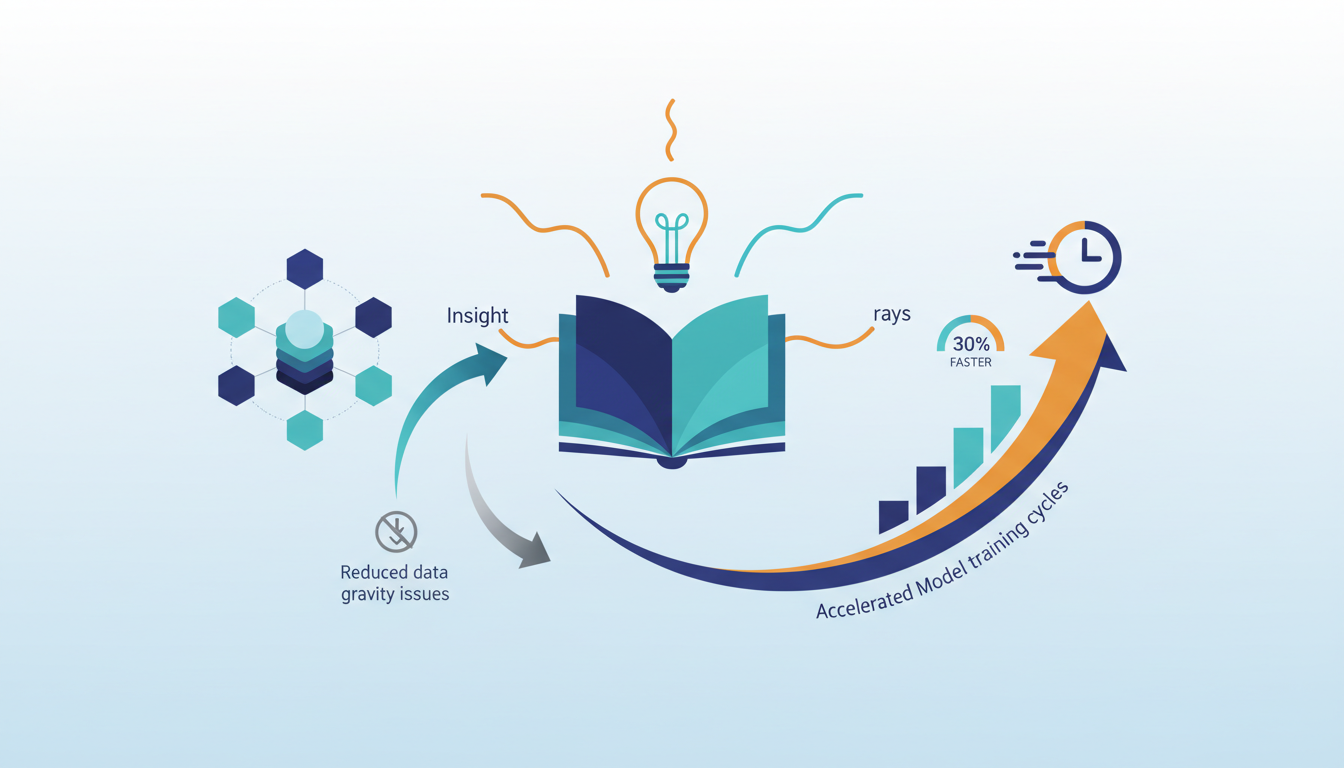
AI readiness requires a federated data model where 66% of CEOs confirm their current business models fail to support agentic workloads without architectural bridging. True readiness extends beyond model availability to include autonomous governance structures that manage data gravity before deployment. Organizations ignoring this shift face compliance gaps under CSRD mandates while burning budget on redundant data movement. The architectural penalty for centralized storage manifests as unmanageable egress fees and inflated carbon reports. Enterprise AI OS deployments at scale prove that disjointed storage layers break agent coordination logic. Tension exists between maintaining strict data sovereignty and enabling the fluid access patterns required for training. Mission and Vision advises treating sustainability as an architecture decision rather than an operational tweak. Decoupling storage from compute eliminates the energy waste inherent in pulling petabytes across hybrid clouds. Operators must prioritize data lakehouse patterns that allow SQL engines to interrogate sources without copying bits. This approach satisfies both FinOps constraints and GreenOps reporting requirements simultaneously. Failure to adopt this model renders existing data assets unusable for next-generation AI tasks.
Operationalizing Query-in-Place Models to Defy Data Gravity
Gartner defines data gravity as the force pulling compute toward storage, creating massive egress costs for AI training jobs. Organizations counter this by deploying federated querying to join datasets across on-premises databases and cloud lakes without physical migration. This approach uses a distributed SQL engine to push predicates directly to source systems, eliminating the need for redundant ETL pipelines that inflate carbon footprints. Teams can now query dbt models directly through the platform, governing logic where it resides rather than copying it to a central warehouse. The architectural shift reduces energy consumption by spinning up compute resources only for the specific duration of a query. However, consumption-based pricing introduces financial volatility compared to fixed-license models, requiring strict FinOps guardrails to prevent budget overruns. Operators must balance the speed of ad-hoc analysis against the unpredictability of variable spend during peak inference loads.
| Legacy Pattern | Query-in-Place Alternative |
|---|---|
| Centralized data copying | Virtual catalog mapping |
| Persistent compute clusters | Ephemeral query execution |
| High egress fees | Zero data movement |
Network latency presents a hard constraint; joining terabytes across wide-area networks still demands careful predicate pushdown configuration to avoid timeout failures. Successful deployment requires treating cost efficiency and sustainability as core architecture decisions rather than post-deployment optimizations. Mission and Vision recommends starting with the Starburst Galaxy Basic Tier, which provides $500 in credits to validate performance before scaling. This hands-on trial allows engineers to measure actual query latency against legacy baselines without committing to long-term contracts. Eliminating data movement transforms the physical constraints of hybrid infrastructure into a logical advantage for agentic AI workloads.
The Carbon and Cost Risks of Ignoring CSRD in AI Deployment
CSRD compliance mandates architectural validation before a single AI workload deploys, rendering legacy centralized models non-compliant by default. Ignoring this constraint forces organizations into redundant data movement that inflates both carbon emissions and egress bills simultaneously. A federated model interrogates data where it lives, avoiding the physical migration that drives cloud billing headaches. Centralized architectures fail this test because they treat sustainability as an optimization problem rather than a core design principle.
| Architecture Type | CSRD Alignment | Egress Impact |
|---|---|---|
| Centralized Lake | Non-compliant | High |
| Federated Query | Compliant | Minimal |
| Redundant ETL | Non-compliant | Severe |
Regulatory penalties compound operational waste, creating a financial sinkhole before model training begins. Teams must verify that their query engine supports distributed execution to meet these dual mandates effectively. Failure to decouple storage from compute guarantees that GreenOps goals remain unreachable while FinOps metrics deteriorate under unnecessary data transfer fees.
About
Alex Kumar serves as a Senior Platform Engineer and Infrastructure Architect at Rabata. Io, where he specializes in Kubernetes storage architecture and cost optimization for cloud-native applications. His daily work designing scalable, S3-compatible object storage solutions directly informs his perspective on federated data architecture. As organizations struggle with fragmented data estates hindering AI initiatives, Kumar's expertise in eliminating vendor lock-in and managing distributed systems across EU and US regions provides critical practical insights. At Rabata. Io, a provider focused on democratizing enterprise-grade storage for AI/ML startups, he routinely addresses the complexities of unifying disparate data sources without compromising performance or budget. This hands-on experience building high-performance, transparent storage infrastructure allows him to articulate how abstracting legacy complexity is necessary for sustainable GreenOps and efficient federated data strategies in modern enterprises.
Conclusion
Scaling federated architectures reveals a critical breaking point: query coordination latency spikes when agent swarms exceed fifty concurrent connections across disparate clouds. The initial savings from avoided egress quickly erode if governance policies do not evolve from static rules to flexible, context-aware enforcement at the query layer. Organizations ignoring this shift will face compounding operational debt as AI agents demand real-time access to fragmented sources without human mediation. You must adopt a hybrid governance model by Q3 2026, specifically conditioning adoption on the ability to enforce row-level security across non-native data sources without replication. Waiting for perfect data unification is a strategic error; the market rewards those who orchestrate access over those who hoard assets. Start by auditing your current predicate pushdown capabilities against your top three high-volume AI use cases before Friday. Identify exactly where full table scans occur despite available indexes in source systems, as these represent immediate financial leaks that federated logic should have prevented. This specific technical validation provides the concrete evidence needed to justify architectural refactoring before regulatory deadlines tighten.
Frequently Asked Questions
Poor data quality in legacy systems correlates with significant financial damage. Research indicates these outdated approaches directly contribute to a 25% revenue loss for organizations failing to adopt modern federated structures.
Most companies operate across multiple clouds but retain inefficient storage-bound compute. Specifically, 77% of enterprises adopt hybrid cloud approaches yet often duplicate data, contradicting GreenOps principles and increasing carbon footprints unnecessarily.
Decoupling storage from compute provides a definitive escape route for struggling data estates. Mature practices utilizing this federated model deliver a 42% higher digital transformation success rate compared to traditional centralized warehousing methods.
Centralized models force data migration that triggers prohibitive egress costs against massive market growth. This architectural flaw prevents scaling because moving petabytes for every inference cycle burns budget on transport rather than intelligence.
Enterprise spending on generative AI reached $37 billion, yet inefficiencies persist. Currently, 71% of organizations regularly using generative AI report climbing costs and increasing carbon footprints caused by their outdated data architecture.