Failure domains break multicloud: The 15-hour truth
The 15-hour AWS us-east-1 outage in October 2025 stripped away the pretense. Most multi-cloud strategies are security theater. True durability demands redefining the failure domain beyond superficial vendor switching to address deep architectural coupling. We need to dissect the anatomy of cloud concentration risk, exposing how unified tooling creates invisible choke points even across different providers. Look at the millions of Windows machines disabled by a single update as a case study for systemic fragility. Finally, we must compare hyperscaler durability against emerging neocloud alternatives, a shift contextualized by the 32% surge in European sovereign cloud deployments driven by demands for digital independence.
The "Big Three" dominance creates an environment where operational simplicity fuels existential risk. Packet loss in one region inevitably corrupts dependent networks that appear independent on paper. Stop relying on the illusion of protection offered by standard disaster recovery plans. Your backups likely share the same fatal flaws as your primary systems.
The Anatomy of Cloud Concentration Risk and Failure Domains
Failure Domains and Control Plane Dependency Set
Define a failure domain not by physical location, but by the boundary where a single fault cascades across dependent services. Operators must map shared dependencies, not just geographic regions. The us-east-1 outage lasting 15 hours on October 20, 2025 proved that retained dependencies on authentication or DNS collapse architectures even when compute runs elsewhere. Control plane dependency happens when management functions like billing, identity, or orchestration remain consolidated within one provider while workloads scatter. This hidden coupling creates a single point of failure that bypasses multi-cloud strategies entirely.
Here is the hard data: 92% of large enterprises use multi-cloud strategies, yet most fail to achieve true independence because deployment location differs from dependency structure. The bill for this oversight is steep. Cloud interconnectivity spending rose to billions of dollars in 2025 as operators attempt to stitch together fragmented infrastructures that share a common control plane. Unified tooling reduces integration effort, yes, but it concentrates risk faster than diversification efforts can mitigate it. Teams usually discover these hidden dependencies only during incidents, when recovery paths fail because they rely on the same failing infrastructure.
Without explicit failure domain mapping, multi-cloud deployments merely distribute compute while consolidating risk in the management layer. The result is total service collapse, not reduced functionality. Decouple these critical layers to achieve actual fault tolerance instead of theoretical diversification.
Mechanics of Cascading Failures in Monolithic Cloud Architectures
Untested Failover Mechanisms and Configuration Drift
Recovery paths that exist only on paper collapse during incidents because configuration drift alters production state from documented baselines. Teams assume communication tools remain independent of failing infrastructure. The 2017 OAuth incident proved otherwise: Hangouts and Meet relied on the same broken authentication system. Operators lose coordination channels precisely when manual intervention becomes necessary. Configuration drift accumulates silently between tests, causing failover scripts to reference deprecated endpoints or missing credentials. A Global Financial Services Organization avoided this by continuously assessing resources against security best practices to prevent misconfigurations in Atlassian deployments. Without automated remediation, manual recovery attempts frequently introduce new errors under pressure.
| Failure Mode | Trigger Condition | Operational Consequence |
|---|---|---|
| Silent Drift | Untested configs over months | Failover script executes against wrong API version |
| Shared Auth | Centralized identity provider outage | No secure channel remains for engineer coordination |
| Tooling Gap | Unfamiliar recovery interface | Increased mean-time-to-recovery due to hesitation |
Skipping regular failover drills to preserve premium pricing structures associated with specialized AI instances carries a measurable cost. Organizations accept higher risk for short-term budget alignment. Most operators lack explicit failure domain mapping, leaving indirect dependencies undocumented until a cascade occurs. Treat failover as a routine operational task, not an insurance policy filed away. Integrate failure simulations into standard change-management windows to validate recovery logic before an actual outage strikes.
Amplify's Modular Architecture to Counter 10x Egress Fees
Amplify's AWS egress fees grew to 10x storage costs as customer dataset downloads increased, forcing a complete architectural restructure. CTO Ameya Pathare evaluated Azure, Google Cloud, Digital Ocean, and Wasabi before selecting Snowflake for transformation and Backblaze B2 for staging. This modular approach decouples compute from storage, allowing data to reside in low-cost tiers while processing occurs elsewhere. The migration delivered 70% cost savings with zero downtime over a two-week window. Enterprises adopting similar hybrid cloud deployments report significantly lower operational expenses compared to single-vendor reliance.
| Component | Monolithic Setup | Modular Architecture |
|---|---|---|
| Storage | AWS S3 (High Egress) | Backblaze B2 |
| Change | AWS Glue | Snowflake |
| Output | AWS Redshift | BigQuery / Tableau |
| Cost Driver | Data Exit Fees | Fixed Compute |
Managing federated identity and access across disparate platforms without siloed credentials presents the primary limitation. Centralized IAM systems become mandatory to enforce consistent policy, adding initial configuration complexity. However, this overhead prevents the hidden coupling that caused cascading failures during the October 2025 outage. Map explicit failure domains; do not assume geographic separation guarantees independence. Without this mapping, authentication layers remain single points of failure even when compute scatters.
Document all indirect dependencies before executing any migration plan. Billing APIs and logging ingestion points create subtle tethering to the primary vendor that operators often overlook. Starting May 1, 2025, AWS implemented tiered ingestion pricing for Lambda logs, altering serverless cost structures further. Ignoring these control-plane dependencies renders physical workload distribution ineffective during regional incidents. Break the economic and technical bonds that keep architectures monolithic.
Vendor Lock-In Risks from Unified Tooling and Switching Costs
Unified tooling adoption reduces initial integration friction but creates switching costs that change cloud platforms from options into defaults. Teams build vendor-specific expertise to accelerate deployment, yet this operational simplicity masks the rising expense of future migration. As systems integrate deeper, the architecture shifts from a strategic choice to an involuntary dependency.
| Factor | Short-Term Gain | Long-Term Constraint |
|---|---|---|
| Unified CI/CD Pipeline | Quicker deployment cycles | Single-vendor script dependency |
| Proprietary Agents | Reduced config management | Incompatibility with other clouds |
| Consolidated Billing | Simplified procurement | Loss of granular cost visibility |
Recent platform enhancements further embed these workflows, making agentic processes difficult to replicate elsewhere without significant re-engineering. While some providers advocate for interoperability, the practical reality involves steep penalties for departing established ecosystems. The tension lies between immediate efficiency and long-term agility; optimizing for today's speed often mortgages tomorrow's flexibility. Audit your automation layers for hidden couplings before an outage forces a costly, reactive migration.
Strategic Comparison of Hyperscaler Durability and Neocloud Alternatives
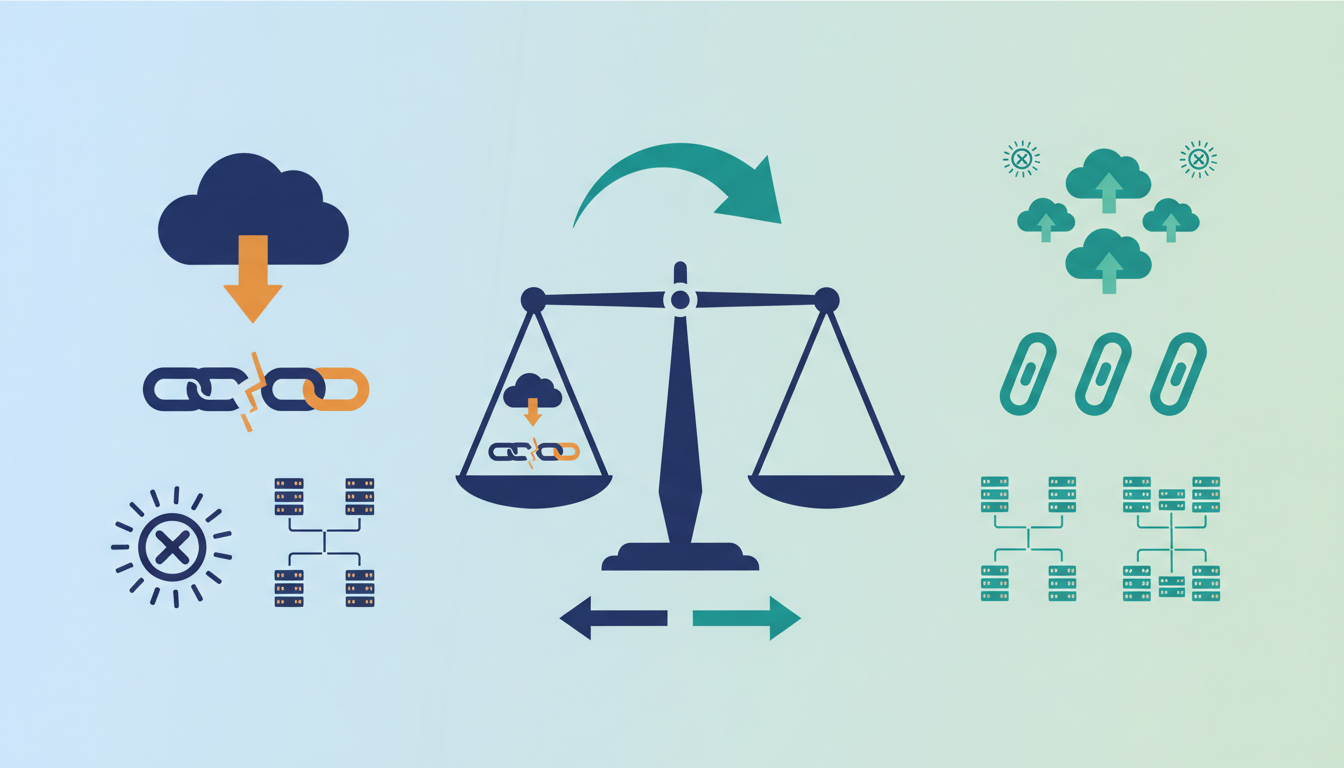
Neocloud specialization isolates failure domains by decoupling compute from the monolithic control planes that bind hyperscaler ecosystems. Organizations selecting best-of-breed providers avoid the correlated dependencies where a single vendor outage collapses authentication, DNS, and monitoring simultaneously. The market share held by Others and Neoclouds now reaches 37%, offering viable alternatives to the consolidated triad. Hyperscalers respond with price cuts, yet multi-cloud interoperability remains the only structural defense against systemic risk. True durability requires mapping dependencies so that no single control plane governs the entire stack.
| Dimension | Hyperscaler Model | Neocloud Alliance |
|---|---|---|
| Control Plane | Single vendor ownership | Distributed across providers |
| Failure Propagation | Cascades through shared services | Contained within layer |
| Switching Cost | Prohibitive due to integration | Modular by design |
Managing distinct APIs increases initial complexity compared to unified tooling. This friction, however, enforces failure domain separation, preventing the silent coupling that doomed previous diversification attempts. Operators gain the ability to route traffic around a failed provider rather than waiting for a global fix. Unified simplicity costs total dependency; modular architectures trade convenience for survivability. Audit every service for hidden control plane ties before declaring a deployment multi-cloud.
Real-World Collapse of Apparent Multi-Cloud Strategies During AWS Outages
The October 2025 us-east-1 failure proved that retaining Route 53 or Cognito dependencies collapses compute running on Google Cloud. Organizations migrating workloads often keep these control-plane anchors, creating a single point of failure disguised as diversity. ThousandEyes observed packet loss cascading from direct customers to dependent networks, blinding teams when coordination mattered most. Operators lose authentication channels precisely when manual intervention becomes necessary.
| Dependency Layer | Apparent Independence | Actual Failure Mode |
|---|---|---|
| Authentication | External IDP | AWS Cognito regional lock |
| DNS Resolution | Global records | Route 53 health check stall |
| Content Delivery | Edge caching | CloudFront origin timeout |
Most enterprises claim multi-cloud status yet consolidate monitoring and orchestration within one vendor stack. This operational simplicity masks rising switching costs that change platforms from options into defaults. Recovery mechanisms untested before incidents routinely fail when needed, as seen when Google's 2017 OAuth incident took down Hangouts and Meet simultaneously. Map indirect dependencies so no single control plane governs the entire stack. Separate failure domains by decoupling compute from monolithic hyperscaler ecosystems. Research reflected in org/html/2512.06800v1 indicates a need for flexibility beyond single-provider constraints.
Price wars cannot fix single points of failure embedded in the platform architecture. Evaluate whether lower unit costs justify continued exposure to correlated dependency risks. Map failure domains before signing contracts based solely on GPU rates.
Implementing Cloud-Agnostic Systems with Continuous Recovery Testing
Explicit Failure Domain Mapping and Indirect Dependencies

Explicit failure domain mapping documents components failing together, capturing indirect dependencies like centralized IAM that often escape visual diagrams. Teams frequently assume compute separation equals durability. A single federated identity creates hidden coupling; migrating workloads to new regions offers false security if authentication anchors remain fixed. Audit beyond direct connections to include shared control planes. A unified CI/CD pipeline often becomes the weak link. The cost of this oversight appears during incidents when coordination tools vanish alongside primary services.
| Dependency Type | Visibility | Failure Impact |
|---|---|---|
| Direct Compute | High | Isolated outage |
| Managed DNS | Medium | Regional blackout |
| Shared IAM | Low | Total lockout |
Most organizations neglect testing these indirect paths until production traffic halts. Historical data shows recovery mechanisms lacking prior exercise routinely fail under pressure. Mapping requires listing every service touching the control plane, not just data stores. Treat indirect dependencies as primary risks rather than secondary concerns.
Race algorithms query multiple providers simultaneously to select the fastest response, eliminating single points of failure. Sardius Media demonstrates this by routing every API call through competing CDNs, ensuring graceful degradation. Break infrastructure into interoperable components rather than relying on monolithic bundles. Configure application logic to fire parallel requests and accept the first valid return packet, discarding slower duplicates.
| Step | Action | Risk Mitigated |
|---|---|---|
| 1 | Dispatch parallel queries | Latency spikes |
| 2 | Validate first response | Provider outage |
| 3 | Discard late packets | Resource waste |
| 4 | Log winner metrics | Blind spots |
Increased egress traffic from firing redundant calls across all configured endpoints drives up costs. Federated identity complexities often cause deployments to fail because teams neglect to test these paths under load before an incident occurs. Smartsheet embraced this complexity to handle demand surges, resulting in a more secure infrastructure capable of catering to diverse needs. Audit indirect dependencies before enabling race modes to prevent control-plane collapse. Recovery mechanisms must function without manual intervention during regional blackouts.
Application: Untested Recovery Paths and Configuration Drift Failures
Cloudflare's October 30, 2023 incident proved deployment misconfiguration propagates instantly when Workers KV becomes unreachable, collapsing Pages, Access, zero-trust, Images, and the Cloudflare Dashboard simultaneously. Treating failover as an insurance policy ignores how configuration drift silently invalidates recovery scripts between quarterly tests. Operators relying on automated remediation capabilities often miss that shared tooling creates a single failure domain across distinct environments. Recovery paths fail because communication channels depend on the same downed infrastructure they aim to restore.
Continuous testing exposes gaps where indirect dependencies break orchestration logic. Validate federated identity regularly. Without failure injection, operators cannot distinguish between documented procedures and actual executable recovery. Untested durability costs total service blackout rather than graceful degradation.
| Failure Mode | Root Cause | Detection Gap |
|---|---|---|
| Auth Collapse | Shared Control Plane | No isolated test env |
| Data Stale | Replication Lag | Monitoring blind spot |
| Route Blackhole | BGP Withdrawal | No path validation |
Map every control plane anchor before declaring any architecture multi-cloud. Break the assumption that geographic separation equals functional independence.
About
Alex Kumar serves as a Senior Platform Engineer and Infrastructure Architect at Rabata. Io, where he specializes in Kubernetes storage architecture and disaster recovery strategies. His daily work designing resilient, S3-compatible storage solutions directly addresses the critical vulnerabilities exposed by massive cloud outages like the recent AWS us-east-1 failure. Having previously operated as an SRE for high-traffic SaaS platforms, Kumar possesses firsthand experience mitigating the cascading failures that occur when organizations rely on a single failure domain. At Rabata. Io, he actively engineers alternatives to vendor lock-in, ensuring enterprises and AI startups can distribute data across independent regions to prevent total service collapse. This article uses his deep technical background in backup architectures to explain how diversifying storage providers eliminates the internet's largest single points of failure. By applying his expertise in cost-effective, multi-region deployment, Kumar provides actionable insights for building infrastructure that withstands the fragility of centralized cloud ecosystems.
Conclusion
Scaling infrastructure reveals that geographic distribution often masks a unified control plane, creating a fragile illusion of durability. As sovereign cloud mandates accelerate in Europe, the operational cost of maintaining distinct failure domains will surpass simple compute expenses, forcing a reckoning with hidden tooling dependencies. Relying on shared identity providers or unified observability stacks across regions invites cascading collapses during localized blackouts. Treat configuration drift as an active threat rather than a maintenance nuisance; untested recovery paths degrade quicker than documentation updates.
Adopt a sovereign-first architecture for all new workloads by Q2 2026, mandating completely isolated authentication and control layers for any system requiring greater than near-total availability. Do not wait for regulatory pressure to decouple your critical dependencies from hyperscaler monopolies. Start this week by auditing your identity provider topology to confirm that failover credentials exist outside your primary cloud tenant's boundary. If your emergency access relies on the same directory service as your production workload, your disaster recovery plan is currently theoretical. Execute a manual failover test using only out-of-band communication channels to verify that your team can restore services without accessing the compromised management console. This specific validation exposes whether your redundancy is architectural or merely aspirational.
Frequently Asked Questions
Most strategies fail because they retain shared control planes like AWS Cognito or Route 53. Despite 92% of large enterprises utilizing multi-cloud setups, hidden dependencies cause total collapse when a single provider's management layer goes down.
Operators spend heavily to stitch together infrastructures that share a common control plane. Cloud interconnectivity spending rose to $9.6 billion in 2025 as companies attempt to fix fragmentation without truly decoupling their critical dependencies.
The "Big Three" providers currently hold 63% of global infrastructure, driving enterprises toward unified tooling. This concentration creates invisible choke points where operational simplicity directly fuels existential risk during cascading failure events.
Yes, modular architectures using alternatives like Backblaze B2 can deliver significant savings. One migration delivered 70% cost savings with zero downtime by avoiding massive egress fees and maintaining access through alternative paths during issues.
The faulty update disabled 8.5 million Windows machines, proving systemic fragility in monolithic architectures. This event demonstrated how a single failure in a shared dependency layer can cascade across entirely different organizations and sectors.