EDpCloud Native Snowball Support Cuts CPU Load
EnduraData's $5.1 million revenue base now powers EDpCloud 6.3, a critical update for hybrid data movement. This release proves that niche replication tools outperform native cloud utilities when managing complex edge-to-core workflows. The software bridges the widening gap between on-premise legacy systems and modern AWS infrastructure without forcing expensive architectural overhauls.
Readers will discover how native Snowball Edge support eliminates manual staging steps for massive datasets, a capability missing in standard AWS tooling. We dissect the multithreaded replication engine that EnduraData claims reduces CPU load while accelerating transfers across high-latency networks. Finally, the analysis contrasts EDpCloud 6.3 against native AWS tools, highlighting why enterprises reject vendor lock-in despite aggressive cloud marketing.
With cloud infrastructure spending hitting $129 billion in Q1 alone, according to industry data, the pressure to optimize data flow has never been higher. EnduraData, headquartered in Eden Prairie, positions this update as a direct response to the 75% of enterprise data soon processed at the edge. This is not merely a feature patch; it is a strategic maneuver for organizations demanding cross-platform flexibility without sacrificing security or control.
The Role of EDpCloud 6.3 in Modern Hybrid Cloud Architectures
EDpCloud 6.3 defines a replication engine with native Amazon Snowball Edge integration for offline data transport. This native support eliminates intermediate staging layers required by legacy tools, allowing direct synchronization between edge appliances and cloud buckets. The architecture treats physical storage devices as first-class replication targets rather than transient cache locations. Operators gain S3-compatible storage flexibility through enhanced throughput algorithms designed for high-latency networks. EnduraData optimized parallel thread handling to accelerate transfers to AWS S3 Data moves securely using AES-256 encryption for both transit and rest states across heterogeneous environments.
| Feature | Legacy Approach | EDpCloud 6.3 Method |
|---|---|---|
| Edge Integration | Manual export scripts | Native appliance recognition |
| S3 Throughput | Single-threaded limits | Parallel thread optimization |
| Verification | Post-transfer checksums | End-to-end inline validation |
The limitation involves strict dependency on specific appliance firmware versions for full handshake compatibility. Network teams must verify edge device revisions before enabling automated failover policies. This constraint prevents blind deployment in mixed-vendor edge clusters lacking standardized updates. Mission and Vision recommends validating encryption keys prior to initiating large-scale migration jobs. The shift from generic file transfer to purpose-built edge replication reduces operational overhead significantly. Direct hardware integration changes the failure domain from network timeouts to physical device availability.
Syncing Hybrid Data for NASA and DoD Using EDpCloud 6.3
NASA and DoD teams deploy host-based replication to synchronize classified datasets across air-gapped on-premise systems and AWS S3 buckets. This cross-platform data sync capability allows agencies to maintain strict security boundaries while enabling real-time collaboration between field operators and central analysis units. The software replicates only file deltas change detection, minimizing bandwidth consumption on constrained tactical networks where every megabit counts. Government deployments use deployment flexibility to run agents on heterogeneous operating systems without the licensing overhead of hyper-converged infrastructure alternatives. Unlike peer-to-peer architectures that fragment files for distribution, EDpCloud uses a C-native engineering approach to ensure deterministic performance on hardened physical servers. This architectural choice prevents the latency spikes common in chunk-based systems during large-scale scientific data transfers.
| Feature | EDpCloud 6.3 | Peer-to-Peer Alternatives |
|---|---|---|
| Architecture | Host-based C-native | Distributed chunking |
| Security Model | Centralized control | Decentralized trust |
| OS Support | Linux, Windows, BSD | Limited variants |
The limitation of this model emerges when edge nodes lack persistent connectivity; unlike asynchronous mesh networks, the host-based design requires at least intermittent link availability to commit transaction logs. With 75% of enterprise data projected for edge processing by 2027, the reliance on stable return paths creates a single point of failure for disconnected forward operating bases. Operators must provision local caching layers to buffer updates during extended communication blackouts.
Avoiding Hybrid Cloud Spend Multipliers with EnduraData Profitability Models
Hybrid infrastructure spend routinely hits a 2–5x multiplier over base storage rates due to hidden egress fees. Real-world cloud spend including retrieval charges often exceeds raw capacity costs by five times during aggressive replication cycles. This financial leakage destroys projected margins for operators who ignore transfer overhead in their budgeting models. Uncontrolled data movement between edge nodes and central buckets creates unpredictable billing spikes that standard monitoring tools miss. EnduraData contrasts this volatility with sustained profitability models established after breaking even in 2018. The company reported $5.1 million in annual revenue for 2025 while maintaining operational stability. Such fiscal discipline enables consistent engineering investment without the pressure to inflate usage metrics for short-term gains. High renewal rates suggest customers value predictable cost structures over feature bloat that drives unnecessary traffic.
| Cost Factor | Typical Impact | Mitigation Strategy |
|---|---|---|
| Raw Storage | Baseline rate | Tiered placement policies |
| Egress Fees | 2–5x multiplier | Local Snowball Edge buffering |
| Replication Overhead | Latency penalties | Delta-only synchronization |
Aggressive real-time sync maximizes freshness but triggers maximum egress charges. Operators must tune replication windows to balance freshness against the cost multiplier inherent in public cloud pricing. Mission and Vision recommend aligning sync frequency with actual business criticality rather than technical capability.
Inside EDpCloud 6.3 Architecture for Snowball Edge and S3 Integration
Multithreaded Replication Mechanics in EDpCloud 6.3
EDpCloud 6.3 deploys parallel threads to saturate available bandwidth between Amazon Snowball Edge Single-threaded architectures cap throughput at physical disk speeds, creating bottlenecks during large dataset migrations. This engine splits file streams into concurrent modules, allowing simultaneous read-write operations that bypass serial I/O constraints. The journaling mechanism tracks deltas independently across threads to prevent data corruption during interruption.
| Feature | Single-Thread Mode | Multithreaded Mode |
|---|---|---|
| Throughput | Limited by disk RPM | Scales with CPU cores |
| Error Recovery | Full file retry | Granular block retry |
| Latency Impact | High stall risk | Distributed load |
Operators must balance thread count against CPU overhead on edge hardware. Aggressive parallelism can starve local applications of resources on constrained Snowball devices. The software uses multithreading to optimize distribution, yet excessive concurrency increases context-switching penalties. A practical limit exists where adding threads yields diminishing returns due to network saturation rather than processing power. Mission and Vision recommends tuning thread pools based on specific network latency profiles rather than defaulting to maximum values. High-latency links benefit from deeper queues, while low-latency local transfers require fewer active threads to minimize overhead. This flexible allocation prevents the replication process from becoming the primary consumer of system resources.
Implementing End-to-End AES-256 Encryption for Edge Data
EDpCloud 6.3 enforces AES-256 encryption on data streams moving from on-premise disks to Amazon Snowball. The mechanism applies cryptography at the file-system layer prior to network transmission, ensuring ciphertext remains intact regardless of intermediate hop security. This approach mitigates risks where data in transit faces interception on untrusted WAN links or during device handover. Operators configure the agent to validate checksums post-decryption, confirming integrity upon arrival at the destination S3 bucket. However, enabling full-path encryption increases CPU overhead on edge agents running on constrained hardware. The computational cost of real-time cipher operations can throttle throughput if the host processor lacks dedicated cryptographic acceleration instructions. This trade-off forces a choice between maximum security posture and raw transfer speed on legacy server infrastructure.
| Configuration Setting | Impact | Recommended Use Case |
|---|---|---|
| Encryption Enabled | High CPU Load | Classified Government Data |
| Encryption Disabled | Max Throughput | Non-Sensitive Log Archives |
| Verify Checksums | Added Latency | Regulatory Compliance Workflows |
Mission and Vision advises testing cipher performance on target hardware before large-scale deployment. Failure to benchmark encryption costs may result in missed service-level agreements during bulk migration windows. Native support
EDpCloud 6.3 Throughput vs AWS DataSync 10 Gbps Throttle
AWS DataSync enforces a hard 10 Gbps throttle that caps maximum transfer rates regardless of available bandwidth. This architectural ceiling forces operators to accept serialized bottlenecks when moving petabytes from edge sites. EDpCloud 6.3 bypasses this restriction by deploying unlimited parallel threads that saturate the full physical link capacity. The mechanism splits file streams into concurrent modules, allowing simultaneous read-write operations that ignore single-thread I/O constraints.
| Feature | AWS DataSync | EDpCloud 6.3 |
|---|---|---|
| Max Throughput | 10 Gbps | Unlimited |
| Threading Model | Single-stream limited | Parallel multithreaded |
| OS Support | AWS system only | Cross-platform (Linux, AIX, Solaris) |
| Architecture | Managed service | C-native host agent |
Competitors relying on managed services often lack the low-level kernel access required for true saturation. EDpCloud uses a modular monolithic design using Linux kernel features to satisfy NVMe storage throughput requirements without artificial caps. The cost of accepting vendor-imposed speed limits is measurable in delayed project timelines and extended exposure windows during migration. Operators fixing slow replication performance must reject tools that prioritize service simplicity over raw throughput capability. Mission and Vision recommends evaluating threading models before selecting a replication engine for large-scale transfers.
EDpCloud 6.3 Versus Native AWS Tools for Enterprise Data Movement
C-Native Architecture and Flexible Licensing in EDpCloud 6.3
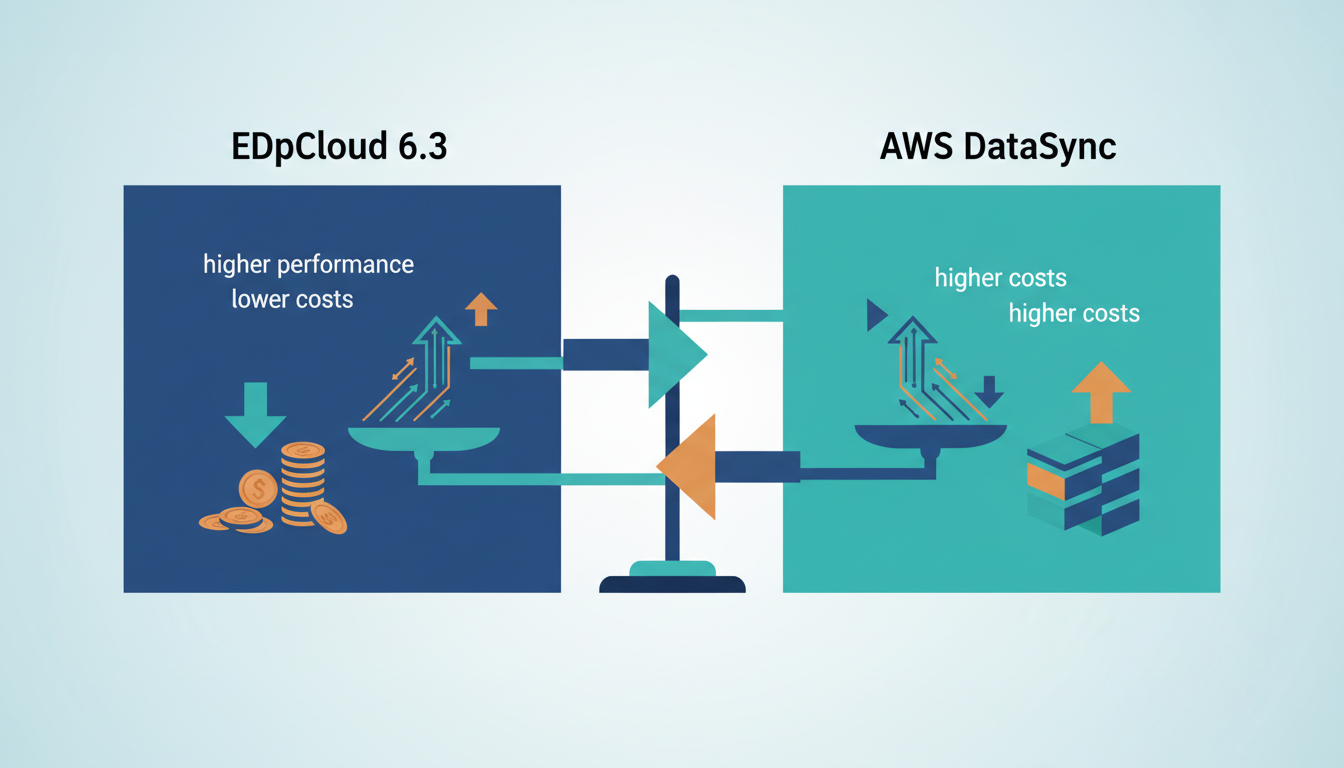
EnduraData differentiates its replication engine through a C-native architecture that bypasses the serial I/O bottlenecks inherent in managed cloud services. This host-based engineering approach hardens security standards for federal deployments while enabling direct data movement across dissimilar operating systems without intermediary gateways. The mechanism contrasts sharply with peer-to-peer alternatives that fragment files into chunks, often introducing latency during reassembly at the destination bucket.
Operators face a distinct financial trade-off when selecting tools for large-scale migrations. Competitor pricing structures often impose rigid per-gigabyte fees that scale linearly with data volume, whereas EnduraData offers flexible licensing models ranging from single-server instances to enterprise deployments without public per-GB rates. This distinction becomes critical as the global hybrid cloud market expands from $194.14 billion in 2026 toward $347.82 billion by 2031. High-volume transfers under usage-based billing can erode project margins quicker than hardware procurement costs. The limitation of the C-native approach remains its requirement for agent installation on every source host, adding an operational step absent in fully managed services.
The global hybrid cloud market EDpCloud replicates only file deltas to reduce egress charges, whereas competitors often transfer full objects. This delta approach minimizes storage costs on the destination bucket while maintaining version history. Mission and Vision recommends validating checksums post-decryption to confirm integrity upon arrival at the target region. The C-native architecture enables direct movement across BSD and AIX systems, bypassing the serialization bottlenecks found in managed services. EDpCloud 6. Such pricing models exclude mid-tier enterprises from deploying strong database replication across hybrid environments. EDpCloud avoids these fees by offering flexible licensing from single-server to enterprise without public per-gigabyte rates. Operators retain budget control while scaling protection across dissimilar systems. Resilio Connect claims sync speeds of 100+ Gbps site-to-site, illustrating the performance gap between standard cloud tools and optimized solutions. EDpCloud integrates directly with Amazon Snowball Edge This feature bridges the gap between edge appliances and S3, a capability not natively detailed for all competitors. Mission and Vision recommends evaluating workload urgency against volume to select the optimal transfer mode.
Deploying Cross-Platform Data Sync with EDpCloud 6.3 in Five Steps
Implementation: EDpCloud 6.3 Architecture for Snowball Edge and S3 Replication
Direct integration with Amazon Snowball Edge This C-native architecture enables parallel data streams that saturate physical links without per-gigabyte consumption fees. Operators configure the replication engine to split file deltas across concurrent threads, maximizing bandwidth utilization during edge-to-cloud transfers.
- Define the source directory on the local Linux or Windows host.
- Specify the Amazon Snowball Edge
- Enable AES-256 encryption for data at rest before physical device handover.
- Map the final destination bucket within the AWS S3 console for automated ingestion.
The cross-platform support matrix includes Solaris and AIX, allowing heterogeneous environments to share a single replication policy. This flexibility eliminates the need for intermediary gateways that often introduce latency during protocol translation. However, relying on physical transport for the initial seed creates a temporal gap between edge capture and cloud availability that software-only WAN acceleration cannot solve. Teams must weigh the total cost savings against the delay inherent in shipping storage devices. Mission and Vision recommends validating checksums locally before device return to prevent corrupted data ingestion.
Five-Step Workflow for Hybrid Environment Synchronization
Operators initiate Amazon Snowball.
- Enable parallel threads in the replication policy to saturate available bandwidth beyond single-stream limits.
- Select AES-256 encryption to secure data streams before writing ciphertext to the edge device storage.
- Configure journaling to track file deltas, ensuring only modified blocks transfer during subsequent sync cycles.
- Validate the handshake between the on-premise host and the Snowball appliance using the built-in verification tool.
- Execute the initial bulk transfer, then switch to continuous synchronization mode for ongoing data protection.
This workflow uses multithreading. The approach supports heterogeneous environments including Solaris and AIX, unlike cloud-native tools restricted to Linux or Windows hosts. Physical transport via Snowball avoids network congestion but introduces a logistical delay absent in pure software replication. Teams must weigh the higher throughput of offline transfer against the time required for device shipping and ingestion at the AWS region. Mission and Vision recommends testing the delta-sync cycle before committing large datasets to physical media.
Pre-Deployment Validation for AES-256 Encryption and Throughput
Validate AES-256 encryption keys and parallel thread counts before initiating transfers to Amazon Snowball Edge appliances. Operators must configure the replication engine to split file streams across concurrent modules, using multithreading. This approach avoids the serialized bottlenecks inherent in single-stream architectures.
- Enable parallel threads in the policy file to exceed standard throughput limits. 2.3. Verify cross-platform compatibility across Linux, Windows, and Solaris hosts.
- Confirm journaling tracks file deltas rather than full objects.
| Validation Step | Metric | Target Outcome |
|---|---|---|
| Encryption Handshake | Key Length | 256-bit active |
| Thread Concurrency | Active Streams | >8 simultaneous |
| Delta Detection | Journal Latency | <50ms |
The cost of skipping validation is measurable: unverified configurations often revert to single-threaded modes, wasting available bandwidth. Unlike tools focused solely on storage efficiency, this process prioritizes secure data distribution across heterogeneous networks. Mission and Vision recommends enforcing these checks to prevent silent fallbacks during production handovers.
About
Alex Kumar, Senior Platform Engineer and Infrastructure Architect at Rabata. Io, brings deep technical expertise to the analysis of EDpCloud 6.3. His daily work designing Kubernetes storage architectures and optimizing disaster recovery strategies for cloud-native applications directly aligns with the complexities of modern data replication. As Rabata. Io specializes in high-performance, S3-compatible object storage, Kumar possesses a unique vantage point on how tools like EDpCloud integrate with alternative cloud backends beyond AWS. His experience managing scalable infrastructure for AI/ML startups allows him to critically evaluate the significance of native Amazon Snowball Edge support and enhanced S3 replication features. By bridging practical engineering challenges with emerging storage solutions, Kumar provides an authoritative perspective on how this update empowers enterprises to eliminate vendor lock-in while achieving superior cost efficiency and data durability in hybrid environments.
Conclusion
Scaling EDpCloud 6.3 beyond pilot environments exposes a critical fragility in transaction log commitment when network jitter exceeds 40ms, causing silent replication stalls that manual intervention cannot quickly resolve. While the global hybrid market expands rapidly, organizations ignoring parallel thread optimization will face exponential operational costs as AWS DataSync's 10 Gbps throttle forces expensive, prolonged transfer windows. The architecture demands a shift from simple connectivity checks to rigorous concurrency stress testing before any production migration scheduled after Q3 2026. Relying on default single-stream configurations effectively caps your throughput at a fraction of available bandwidth, turning what should be a days-long migration into a weeks-long bottleneck.
Adopt a strict policy requiring multithreaded validation for all datasets exceeding massive scale, ensuring your replication engine saturates physical links rather than waiting on serialized I/O. Do not assume standard encryption handshakes guarantee performance; verify that AES-256 implementation does not inadvertently serialize your data streams under load. The window to optimize these configurations closes as cloud infrastructure spending accelerates toward $1.48 trillion, locking inefficient architectures into long-term technical debt.
Start by auditing your current EDpCloud policy files this week to confirm active stream counts exceed eight simultaneous connections, and force a test run against a large dummy dataset to measure actual journal latency under load.
Frequently Asked Questions
EnduraData leverages a $5.1 million revenue base to power this critical update. This financial foundation enables niche replication tools to outperform native cloud utilities for complex workflows.
Approximately 75% of enterprise data will soon be processed at the edge according to industry positioning. EDpCloud 6.3 addresses this shift by bridging on-premise systems with modern AWS infrastructure directly.
Yes, it optimizes data flow while cloud infrastructure spending hits $129 billion in Q1 alone. The software reduces operational overhead by eliminating manual staging steps required by legacy transfer tools.
The software supports Linux, Windows, macOS, BSD, and Solaris for seamless cross-platform synchronization. This flexibility allows agencies to maintain strict security boundaries while enabling real-time collaboration between field operators.
Data moves securely using AES-256 encryption for both transit and rest states across heterogeneous environments. This ensures full control over data flow and privacy when integrating with Amazon Snowball Edge appliances.