Sovereign tape archives beat hyperscaler egress fees
Pink Elephant's new Dutch archive spans three data centers to guarantee 15 nines of durability while slashing power costs.
Regulatory pressure, not just preference, drives the shift toward sovereign cold storage. The EU Data Act and NIS-2 compliance mandates force European entities to abandon US-centric hyperscalers. Localized, energy-efficient architectures now ensure data residency without bankrupting operations. This deployment proves that object storage systems with integrated tape tiers offer the only viable path for multi-petabyte retention in 2026.
ActiveScale architecture automates multi-site distribution to mitigate ransomware risks through air-gapped immutability. Disk-and-tape hybrids outperform pure flash arrays for long-term archival needs, delivering stark total cost of ownership advantages.
The Role of Sovereign Cold Storage in European Data Compliance
DMaaS Clouddrive Cold and Sovereign Tape Architecture
DMaaS Clouddrive Cold merges disk performance with tape economics across three Netherlands data centers. Data sovereignty rules mandate physical residency inside EU borders, rejecting hyperscaler designs that obscure tape usage behind proprietary deep-archive APIs. Pink Elephant implements this strategy using Quantum ActiveScale Cold Storage, which embeds magnetic media directly into the object storage namespace instead of isolating it as a distinct tier. This design yields 15 nines of durability while curbing the energy expenses dominating 2026 operational budgets.
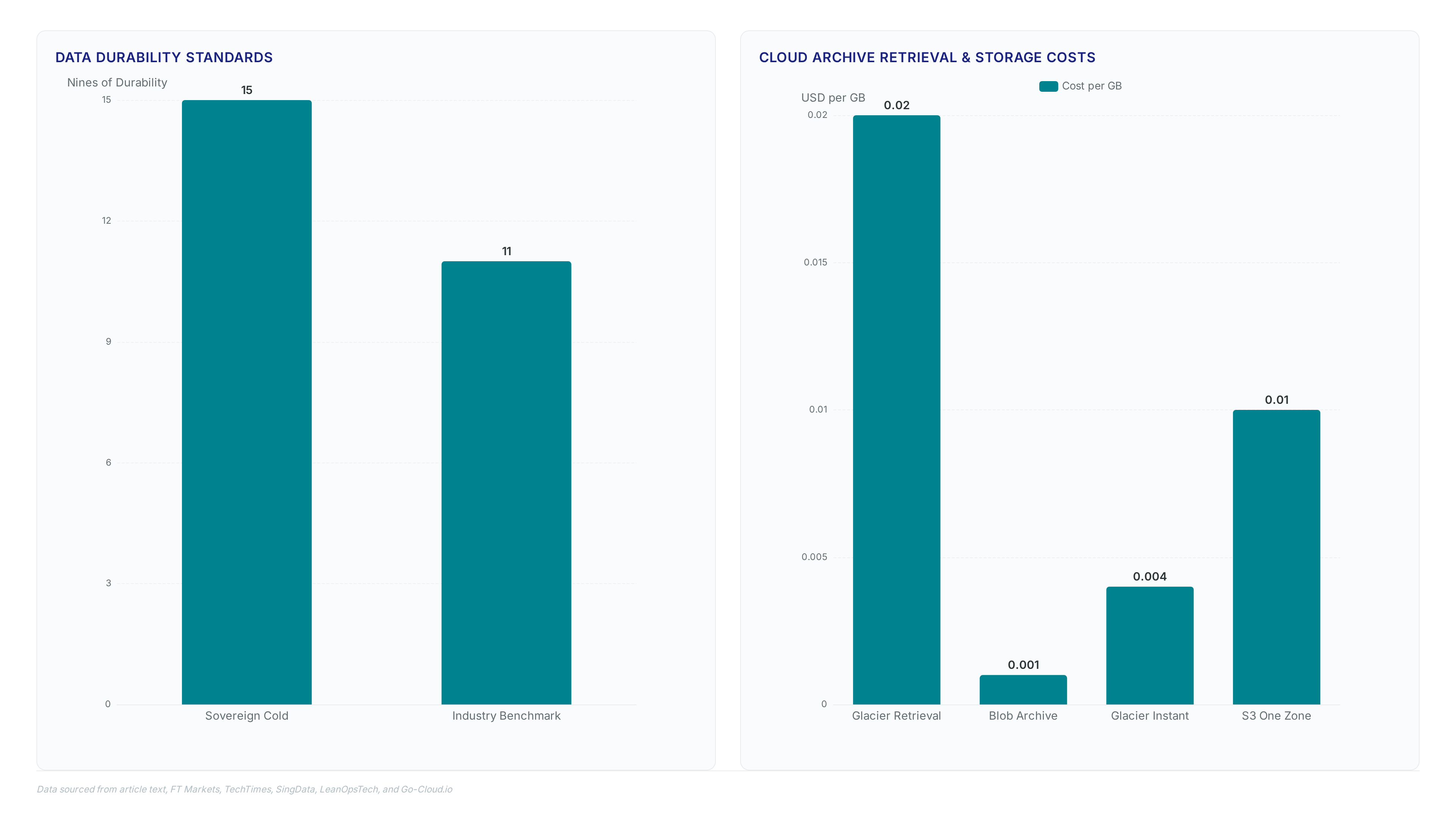
Hyperscaler options frequently lock operators into variable egress fees, inflating a 100 TB workload from a base of $2,304 to over $3,200 monthly. The tape-integrated approach avoids these penalties through fixed-price modeling and reduced power draw per gigabyte. Physical media dependency introduces retrieval latency unsuited for hot data rehydration scenarios. Operators must enforce strict lifecycle policies to prevent performance drops during unexpected access spikes. Compliance with the EU Data Act now demands verification that archive providers maintain transparent, multi-site distribution without relying on US-based backbones. Sovereign control requires infrastructure where the cold tier stays visible and manageable within a single S3-compatible interface.
Scaling Multi-Petabyte Archives Under EU Data Act and NIS-2
European enterprises confront exploding data volumes from IoT and AI workloads that strain traditional disk-only archives. DMaaS Clouddrive Cold deploys multi-petabyte capacity across three Netherlands sites to satisfy NIS-2 retention mandates. The EU Data Act forces architectural shifts away from US hyperscalers where hidden egress fees inflate operational budgets unpredictably. Pink Elephant selected Quantum ActiveScale Cold Storage to build a sovereign foundation avoiding these variable cost traps.
The system integrates a tape cold tier directly into the S3-compatible namespace, enabling automatic data distribution without manual tiering policies. Operators balance immediate access needs against long-term durability requirements when designing these archives.
Inside ActiveScale Cold Storage Architecture and Durability Mechanics
15 Nines Durability Mechanics in Three-Center Netherlands Deployment
Achieving 99.9999999999999% durability requires erasure coding data across exactly three geographically distinct sites within the Netherlands. Standard hyperscaler archives typically advertise 11 nines, a figure that assumes global region redundancy often incompatible with strict data residency laws. The ActiveScale architecture writes every object shard to multiple physical locations automatically, ensuring survival even if two entire facilities fail simultaneously.
This mechanical distribution exceeds the reliability of single-region deep archives while satisfying GDPR mandates for local storage. Operators gain predictable economics by avoiding the variable retrieval penalties common in US-centric clouds. The cost is a fixed site count; expanding beyond these three nodes requires additional sovereign infrastructure rather than using elastic public regions. Such a constraint forces a deliberate balance between maximum theoretical availability and verified legal compliance. S3-compatible access allows applications to read data from any surviving node without manual reassembly. The system maintains a single namespace despite the underlying complexity of tape-tier integration. Validate erasure coding parameters against specific RTO requirements before committing to a fixed-site topology.
Energy-Efficient Data Distribution Using Built-in Tape Cold Tiers
Magnetic tape integration within object namespaces eliminates idle disk spin for archived data, cutting power draw by roughly a significant share versus all-flash tiers. Operators transitioning from disk-only arrays to hybrid media architectures observe immediate reductions in operational expenses and physical footprint. The tape cold tier within ActiveScale automatically migrates inactive objects to magnetic media while retaining S3-compatible accessibility, ensuring continuous availability without manual policy intervention.
This approach contrasts sharply with hyperscaler models where deep archive retrieval incurs prohibitive egress fees, such as $0.12/GB on competing platforms. The limitation of this architecture lies in initial write latency; tape spooling introduces a brief delay before data reaches the deepest storage layer, unsuitable for hot transactional logs. For regulatory retention spanning decades, the total cost of ownership drops precipitously as energy bills vanish. Deploy this configuration for datasets exceeding a very large volume where access frequency remains below monthly intervals. Such deployments secure continuous availability while neutralizing the volatile pricing structures inherent to public cloud providers.
Sovereign Storage Risks Mitigated by GDPR and NIS-2 Compliance Design
S3-compatible storage functions by mapping object identifiers to physical shards distributed across three sites. This architecture enforces data residency boundaries that US hyperscalers cannot guarantee under current extraterritorial access interpretations. Standard cloud providers offer region selection, yet their global management planes introduce sovereignty gaps for entities bound by GDPR and NIS-2 mandates.
Operators avoiding hidden fees gain predictable budgeting absent in commercial cloud contracts where retrieval spikes distort forecasts. The system writes data automatically to multiple locations, eliminating manual tiering errors that often compromise regulatory compliance. Hyperscalers charge roughly nothing for storage but bleed cash on retrieval.
Realizing $12 Million Savings with Pink Elephant Media Tape Deployment
Pink Elephant generated $12 million in customer savings over two years by replacing disk-only archives with a hybrid tape architecture. This financial gain stems from eliminating idle power draw, a capability enabled by the energy-efficient design of the ActiveScale cold tier. Operators often miss that built-in immutability and air-gapped tapes provide ransomware defense without the performance tax of continuous disk spinning. The tape cold tier automatically migrates inactive objects, ensuring data remains accessible while consuming minimal electricity compared to spinning media. Reliance on magnetic media introduces higher initial latency for first-byte retrieval compared to all-flash tiers.
Implementing Multi-Site Data Distribution and Immutable Archives
Configuring Policy-Driven Retention with Built-in Immutability
Operators must define retention schedules via object metadata tags to activate the tape cold tier without manual migration scripts.
- Assign a `retention-period` tag matching the specific regulatory retention dockey=600-202603250800BIZWIRE_USPRX____20260325_BW060618-1) mandate for the dataset class.
- Enable the `immutable-flag` parameter to lock the object state against deletion or modification.
- Verify the policy applies across all three geographic nodes before ingesting production data.
This configuration creates an air-gapped logical barrier that satisfies NIS-2 obligations while preventing ransomware encryption of backup chains.
Establishing sovereign residency requires configuring object storage to replicate across exactly three distinct data centers within the Netherlands. Operators must first define a geo-redundant topology that strictly confines data boundaries to satisfy EU regulatory compliance mandates like GDPR and NIS-2. This architectural choice eliminates jurisdictional risks associated with US-based hyperscalers while maintaining continuous availability during regional disruptions. The system automatically writes data copies to all sites, ensuring that a single facility failure does not compromise access or durability.
- Select three physical sites located exclusively inside national borders to guarantee data residency.
- Enable the integrated tape cold tier to reduce power consumption without sacrificing the 15 nines durability target.
- Apply immutable flags to all ingested objects to create logical air gaps against ransomware encryption attempts.
The trade-off involves higher initial coordination overhead compared to single-region cloud buckets, yet this complexity prevents costly egress penalties during routine audits. This three-center approach serves any enterprise requiring verifiable control over long-term archives. The resulting architecture protects against disruptive events while meeting strict retention windows without hidden variable costs.
Validating BaaS and DRaaS Integration Against 15-Nine Durability Standards
Achieving 15 nines of durability requires verifying that BaaS and DRaaS workflows span all three Netherlands data centers before activation. Operators must confirm that continuous availability persists during cold-tier migrations, a requirement validated by service integration testing across the DMaaS portfolio.
- Assert that object replication completes across every geographic node within the set retention window.
- Validate that immutable-flag parameters prevent modification during simulated ransomware attacks.
- Confirm that retrieval latency meets recovery time objectives without triggering hidden variable costs.
The service promises Skipping this step risks missing recovery windows during actual disasters. Schedule quarterly restore drills to verify end-to-end integrity.
About
Alex Kumar, Senior Platform Engineer and Infrastructure Architect at Rabata. Io, brings deep technical expertise to the evolving environment of data archive services. His daily work designing Kubernetes storage architectures and optimizing disaster recovery strategies directly aligns with the industry's shift toward sovereign, energy-efficient cold storage solutions. Having previously led DevOps initiatives for high-traffic platforms, Kumar understands the critical balance between cost efficiency and data durability that modern enterprises demand. At Rabata. Io, a specialized provider of S3-compatible object storage, he uses this experience to build scalable infrastructure that eliminates vendor lock-in while ensuring GDPR compliance. This background makes him uniquely qualified to analyze partnerships like Quantum and Pink Elephant, as he routinely evaluates how integrated tape cold tiers and scalable object systems can deliver tangible value to AI/ML startups and cost-conscious organizations navigating complex data retention requirements.
Conclusion
Scaling archive operations reveals that egress volatility destroys budget predictability long before capacity limits are reached. While base rates appear stable, the operational reality involves compounding retrieval costs that spike during compliance audits or disaster recovery drills. Organizations relying solely on cloud object tiers face a structural financial leak where verification routines alone can inflate monthly spend by nearly forty percent. This model fails when data gravity increases, turning routine access into a prohibitive expense that fixed-cost media avoids entirely.
Enterprises managing over massive volumes of regulated data must migrate to hybrid tape architectures within the next two fiscal quarters to lock in predictable unit economics. Do not wait for the next audit cycle to expose these variable cost traps. The window for optimizing legacy cold storage contracts closes as providers tighten tiering rules, making immediate action critical for maintaining fiscal control.
Start by auditing your last six months of retrieval logs this week to calculate the actual cost per gigabyte accessed during non-emergency operations. Compare this realized rate against your contracted base storage fee to expose the hidden multiplier affecting your total cost of ownership. Use this specific variance data to justify the capital expenditure required for on-premises tape integration before the next budget planning session begins.
Frequently Asked Questions
Hidden fees inflate hyperscaler bills significantly compared to fixed tape economics. Specifically, variable charges raise a 100 TB workload from a base of $2,304 to over $3,200 monthly, creating unpredictable budget burdens for operators.
Fixed tape economics provide substantial savings by eliminating variable retrieval penalties found in public clouds. Analysis shows that hidden fees inflate 100 TB hyperscaler bills by 39% versus the predictable pricing of integrated tape storage solutions.
Base rates of $0.00099 per GB appear competitive until operators trigger additional API request costs during standard audits. These accumulated retrieval charges rapidly distort budget forecasts, making initial low prices deceptive for long-term archival planning.
The system automatically writes data across three Netherlands data centers within a single namespace. This multi-site distribution guarantees 15 nines of durability while providing continuous availability without requiring manual intervention or complex custom scripting.
Retrieval charges around $0.02 per GB accumulate rapidly when validating data during standard audits. These variable costs can reach $0.09 per GB for the first 10 TB, severely impacting operational budgets for compliance verification tasks.