Flash storage costs: Reclaim 70% capacity now
NAND flash prices have risen by 234% in 2026. Enterprises cannot simply buy their way out of this constraint. Komprise Flash Stretch argues that intelligent analytics can reclaim over 70% of primary storage without the vendor lock-in plaguing proprietary tiering solutions. This approach directly counters "Memflation" by shifting cold data to cheaper tiers while maintaining transparent access for users and applications.
Storage economics are collapsing under supply constraints. Gartner estimates a 130% surge in combined DRAM and SSD costs by year-end. (Gartner's komprise) The analytics engine quantifies savings of over $350,000 per petabyte by identifying inactive data ready for migration without rehydration penalties. These standards-based tiering strategies stand in stark contrast to traditional vendor solutions that trap IT departments in costly hardware refresh cycles.
IDC projects NAND supply growth at only a modest rate year-over-year. Optimizing current assets is no longer optional; it is a survival tactic. Demandsage data reminds us that 90% of global data is unstructured, creating immense pressure on infrastructure that can no longer rely on cheap capacity expansion. Organizations must adopt precise lifecycle management to preserve budgets for high-priority AI investments instead of sinking funds into overpriced flash arrays.
The Role of Komprise Flash Stretch in Modern Storage Economics
Komprise Flash Stretch and the 2026 Memflation Crisis
Komprise Flash Stretch defines an enterprise IT assessment targeting the 234% surge in NAND flash costs to reclaim primary capacity. Market conditions labeled Memflation drive urgent action, as Gartner estimates a 130% price increase for DRAM and SSDs by year-end. The assessment models financial relief at current rates, projecting savings exceeding $350,000 per petabyte of flash storage. Vendor lock-in typically occurs when proprietary tiering forces data rehydration penalties during migration, trapping organizations on expensive hardware.
Optimization requires avoiding unintended limitations while squeezing value from existing assets. Aggressive tiering without analytics risks breaking application dependencies on specific file attributes. Freeing capacity alone fails if the tiered data becomes inaccessible or slow to retrieve. Strategic deployment demands validating access patterns before moving inactive files to object storage destinations.
The mechanism compares primary flash costs against object storage rates to calculate net savings per petabyte. Moving cold data eliminates the premium paid for performance tiers that inactive workloads do not require. The assessment helps enterprises quantify optimization through standards-based tiering. The process identifies specific datasets ready for movement based on age and access patterns.
Operators must balance immediate cash flow relief against potential egress charges during data rehydration events. High retrieval frequency negates the economic benefit of moving data to cheaper tiers. The analysis reveals that 85% of organizations expect higher spending this year, yet many overlook the savings from eliminating Native vendor tiering often forces re-purchasing hardware if policies change, whereas open standards preserve flexibility.
Strategic deployment requires validating that network bandwidth supports the initial bulk transfer without impacting production traffic. Audit current NAS growth rates before committing to a tiering policy. Failure to model these variables results in unexpected operational expenditures that erode projected gains. Vendor lock-in traps IT teams when capacity expansion relies on proprietary tiering that blocks future migration.
Squeezing data into existing arrays often forces organizations to unwittingly commit to undesirable limitations. This risk escalates as IT departments face unusual price hikes while preserving capital for AI initiatives. Proprietary solutions frequently embed data rehydration penalties, making vendor switching prohibitively expensive once cold data becomes inaccessible without buying more original hardware. Intelligent data tiering counters this by analyzing usage patterns to move inactive files to standard object storage.
The Komprise Flash Stretch assessment quantifies these risks by projecting capacity Freed up across multi-vendor NAS environments. Operators must distinguish between analytics-driven policies and vendor-specific hooks that create dependency. A failure to validate export formats before migration locks the enterprise into a single supplier system.
Most organizations expect higher spend in 2026, yet few audit their tiering contracts for exit clauses. The Komprise Flash Stretch service identifies ideal policies by department to ensure business alignment without locking data. Validate data mobility before signing any capacity extension deal.
Inside the Analytics Engine Driving Storage Capacity Reclamation
KAPPA Data Services and Serverless File-Level Tiering Mechanics
KAPPA Data Services execute serverless metadata extraction to analyze NAS usage without hardware thresholds. This architecture contrasts sharply with block-level solutions like NetApp FabricPool, which often enforce rigid constraints such as requiring SSDs to reach 50% capacity before tiering begins. Komprise instead applies file-level tiering across multi-vendor environments including Dell PowerScale and Nutanix, enabling immediate identification of cold data based on age and access patterns. The engine scans file attributes directly, bypassing the need for proprietary agents or dedicated indexing servers that consume primary resources. Operators gain the ability to tier data regardless of underlying array fullness, a flexibility absent in systems bound by physical capacity limits. Successful deployment requires accurate initial policy definition to avoid moving active datasets. Misconfigured rules can degrade application performance if hot files are incorrectly classified as cold. This tension between aggressive capacity reclamation and performance preservation demands precise analytics rather than blunt automation. Validate tiering policies against actual I/O logs before full enactment.
Identifying Tier-Ready Data via Type, Age, and Usage Attributes
Storage assessments isolate cold files by filtering type, age, and usage without proprietary hardware thresholds. Operators initiate this process by scanning NAS environments to map file-level attributes against access logs. Unlike block-level systems requiring specific capacity triggers, this engine identifies tier-ready data regardless of underlying disk fullness. A health system storage director utilized Deep Analytics to gain visibility into folder ownership, enabling automated cleanup of inactive datasets. The analysis separates active AI workloads from static archives based on last-access timestamps rather than arbitrary vendor rules. Komprise acts on data already moved by CloudPools to ensure native format retention without requiring additional Isilon capacity for rehydration.
Strategic Advantages of Standards-Based Tiering Over Vendor Solutions
Defining Standards-Based Tiering Versus Proprietary Vendor Lock-In
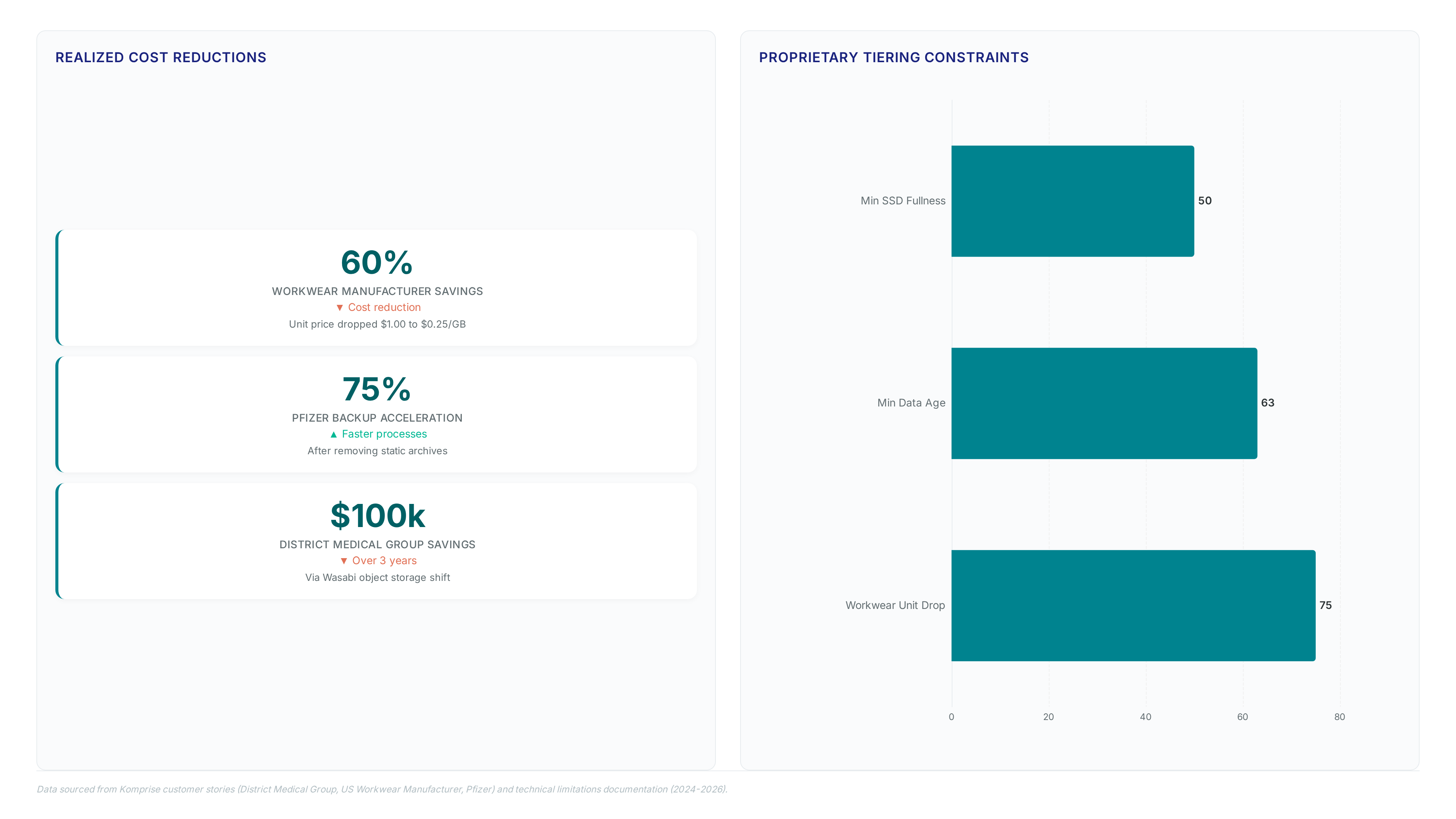
Physical storage hardware and data placement logic operate independently within standards-based tiering frameworks. Adopting vendor-specific architectures too quickly creates undesirable limitations constraining future budget options. Proprietary tools such as NetApp FabricPool Komprise generates verified savings by moving data from cloud NAS to less expensive cloud object classes, bypassing intermediate filesystem fees entirely. This specific architectural choice dictates whether an enterprise pays for full replica sizes or optimized object storage bills.
Block-level approaches reveal hidden costs during migration events. Files trapped in proprietary formats often demand purchases of additional original capacity for rehydration before movement occurs. Komprise restores native formats for data moved by competitors without expanding Isilon footprints. A serverless metadata strategy removes the data rehydration penalty forcing IT teams to buy more hardware solely to switch vendors. Organizations overlooking this distinction encounter compounded expenses as they scale, effectively paying twice for capacity during migration windows. Audit current tiering policies to spot hidden filesystem charges before renewing support contracts.
Real-World Cost Reduction: District Medical Group and US Workwear Manufacturer Case Studies
District Medical Group secured $100,000 in savings over three years by shifting cold files to Wasabi object storage. A US workwear manufacturer achieved a 60% cost reduction, dropping unit prices from $1.00/GB to $0.25/GB through similar architectural changes. These deployments demonstrate that standards-based tiering provides immediate budget relief without waiting for hardware refresh cycles. Operators must define tiering policies by department to align data movement with specific business workflows rather than global averages. The mechanism separates logical data placement from physical array constraints, allowing IT to target inactive datasets regardless of vendor. District Medical Group Network engineers face a clear implication: failing to tier by usage attributes leaves expensive flash capacity occupied by dormant data. Storage directors should determine whether to tier cold data to cloud based on access latency requirements rather than cost alone. Low-cost targets suit archives, while active collaboration sets demand higher-performance tiers. This strategic separation prevents the inadvertent commitment to undesirable limitations warned by industry leaders.
Transparent Move Technology eliminates the mandatory rehydration step forcing competitors to restage data into expensive primary arrays before migration. Proprietary block-level systems like NetApp FabricPool This architectural constraint creates a rehydration penalty where operators must purchase additional flash capacity simply to enable data egress. Komprise Transparent Move Technology bypasses this by maintaining native file formats in the cloud, allowing direct access without intermediate staging. Standards-based approaches decouple data logic from physical hardware constraints.
Competitor solutions often restrict destinations to specific partners, limiting migration flexibility for enterprises seeking optimal pricing across AWS S3 or Azure Blob. The hidden drawback of vendor-tiering involves paying for cloud file system costs even after data leaves the primary array. Komprise acts on data already moved to ensure native format retention without requiring additional Isilon capacity for rehydration. This distinction allows organizations to avoid unwittingly committing to undesirable limitations while preserving budget for AI investments. The technical mechanism ensures that cold data remains accessible without triggering expensive hardware procurement cycles.
Measurable ROI and Implementation Pathways for Enterprise Teams
Komprise Flash Stretch Assessment Launch and Scope

The official launch occurred on March 26, 2026, delivering an immediate analytics tool for IT teams to evaluate primary storage optimization without hardware replacement. This assessment functions by analyzing data growth and usage across multi-vendor NAS environments to identify cold files ready for tiering. Operators gain a quantified view of potential savings modeled at current market prices, avoiding the guesswork inherent in manual capacity planning.
- Identifies data ready to tier based on type, age, and usage patterns. * Projects capacity freed up across various cloud and object destinations. * Calculates elimination of storage-tiering rehydration penalties during vendor transitions. * Models backup savings by shrinking the entire primary file footprint.
Replicating the US-Based Workwear Manufacturer success requires a four-step deployment sequence targeting specific cold data subsets. Operators must first execute the Flash Stretch assessment to isolate inactive files without disrupting active workflows. The second phase involves defining tiering policies that align with departmental access patterns rather than global storage thresholds.
| Phase | Action | Target Metric |
|---|---|---|
| 1 | Analytics Scan | Identify cold data volume |
| 2 | Policy Definition | Set age and usage rules |
| 3 | Cloud Integration | Connect Azure or Wasabi endpoints |
| 4 | Transparent Move | Migrate data with zero rehydration |
Healthcare entities like District Medical Group The architectural benefit lies in bypassing proprietary block-level constraints that typically force expensive data restaging during vendor transitions. However, operators face a tension between aggressive tiering and potential latency for rarely accessed files requiring immediate availability. This trade-off demands careful calibration of access policies to prevent user friction while maximizing capacity reclamation. Failure to model these access patterns risks shifting costs from storage to compute during unexpected retrieval events. Validate tiering rules against historical access logs before full-scale migration. The final step confirms that logical pointers remain intact on primary arrays, ensuring smooth user transparency. This method avoids the lock-in risks associated with hardware-specific tiering appliances.
About
Marcus Chen serves as a Cloud Solutions Architect and Developer Advocate at Rabata. Io, where he specializes in optimizing S3-compatible storage for AI and enterprise workloads. His deep expertise in cloud storage architecture and data infrastructure makes him uniquely qualified to analyze Komprise Flash Stretch. In his daily role, Chen helps organizations eliminate vendor lock-in and reduce primary storage costs, directly aligning with the article's focus on freeing up flash capacity without compromising performance. Having previously engineered solutions at Wasabi Technologies, he understands the critical balance between high-speed access and cost efficiency that modern IT departments require. Chen connects Komprise's capacity optimization strategies to Rabata. Io's mission of providing transparent, high-performance object storage. This perspective allows him to evaluate how enterprises can use analytics-driven management to fund priority AI investments while avoiding the price hikes plaguing traditional flash storage markets today.
Conclusion
Scaling this architecture exposes a critical fracture: retrieval latency spikes when cold data policies ignore departmental workflow bursts. As global data production accelerates toward 221 zettabytes by 2027, the operational expense of unplanned rehydration will quickly erase initial capital savings. Organizations relying solely on static age thresholds face rising compute bills that outpace storage reductions. You must shift from reactive tiering to predictive access modeling within the next two quarters to sustain economic viability. Do not wait for hardware refresh cycles; implement flexible policy engines now that adjust to real-time usage signals rather than historical averages. Start by auditing your top five most-accessed directories this week to identify false-positive cold candidates before enabling automated migration rules. This immediate validation prevents user productivity loss while securing the projected unit price reductions. Successful deployment depends on treating data movement as a continuous optimization loop, not a one-time cleanup event. Validate your tiering logic against actual access logs before committing to full-scale migration to ensure latency tolerances remain within acceptable bounds for critical applications.
Frequently Asked Questions
The tool quantifies methods to free up over 70% of occupied space by isolating cold data. This reclamation allows enterprises to stretch existing assets significantly without purchasing new hardware during price surges.
Komprise Flash Stretch models financial relief projecting savings exceeding $350,000 per petabyte of flash storage. These figures help organizations preserve budget for high-priority AI investments while avoiding costly hardware refresh cycles.
NAND flash prices have risen by 234% in 2026, forcing teams to stretch existing capacity rather than buy more. This urgent action counters Memflation by shifting cold data to cheaper tiers efficiently.
Standards-based tiering prevents traps where proprietary solutions force data rehydration penalties during migration. This flexibility ensures IT departments are not stuck in costly hardware refresh cycles or blocked from future migrations.
Gartner estimates a 130% price increase for DRAM and SSDs by year-end, making optimization critical. With procurement lead times extending, stretching capacity helps avoid budget overruns and significant project delays.