Amazon S3 storage: 500 trillion objects deep
S3 now serves over 200 million requests per second across 39 AWS Regions. It is the backbone. The engineering behind 11 nines durability scaled AWS from 15 racks in 2006 to 123 Availability Zones today without breaking existing PUT and GET primitives. You need specific strategies for Intelligent-Tiering as global cloud data approaches 200 zettabytes by 2027. Metadata optimization now drives performance for massive 50 TB objects, a 10,000-fold increase from the initial 5 GB limit.
North America commands 38% of cloud revenue, but the real story is abstraction. AWS data shows the service grew from a one-paragraph announcement by Jeff Barr to an invisible utility where failure is assumed and handled automatically. This isn't a history lesson. It is a technical audit of the system that makes the modern internet possible.
The Evolution of S3 from Web-Scale Storage to AI Data Foundation
Amazon S3 Definition: From 5 GB Objects to 11 Nines Durability
Amazon Simple Storage Service launched on March 14, 2006 with a strict 5 GB maximum object size limit. That constraint defined it as a basic web-scale repository, not an enterprise data lake. The architecture relied on approximately 400 storage nodes to deliver roughly one petabyte of total capacity. Modern deployments now support objects up to 50 TB, enabling massive dataset consolidation without sharding. Durability targets reached 99.999999999% across 123 Availability Zones through continuous microservice inspection.
Engineers apply formal methods to mathematically prove consistency properties within the index subsystem. This verification approach eliminates logical errors that traditional testing misses during code check-ins. Storage growth now exceeds 500 trillion objects globally, stressing metadata indexing layers. The system scales automatically, yet partitions remain a bottleneck for high-frequency access patterns. Developers must design key namespaces to distribute load evenly across physical shards.
Amazon S3 now underpins over 1,000,000 data lakes, functioning as the primary storage layer for modern AI workloads. This scale supports native vector storage capable of indexing up to 2 billion vectors per instance, eliminating the need for separate database layers in Retrieval-Augmented Generation architectures. Operators asking whether to use S3 for vector storage must weigh this integrated capability against egress fees, which reach $0.09 per GB for data movement.
Data egress costs can exceed storage fees for highly iterative model training. Teams must architect pipelines to minimize cross-region traffic or face budget overruns despite the platform's massive scalability. This architectural pivot eliminates the single-point bottlenecks inherent in the original 400-node design. Operators must recognize that achieving maximum throughput requires active prefix distribution strategies rather than passive storage allocation. The cost of ignoring this distribution model is measurable in throttled GET requests during peak ingestion windows. While the system offers massive elasticity, the burden of partition management shifts entirely to the application layer.
Inside the Architecture of S3 Durability and Backward Compatibility
The Methods and Automated Reasoning in S3 Index Subsystems
Engineers apply formal methods to mathematically prove code correctness before any commit reaches the index subsystem. This automated reasoning process verifies consistency guarantees for cross-Region replication logic and access policy enforcement without human intervention. The mechanism relies on logical proofs that validate state transitions rather than relying solely on runtime testing suites. Automated proofs block merges if any potential execution path violates set safety properties.
Increased latency during the development cycle results from this rigor, as complex proofs require significant compute time to complete. Developers cannot bypass these checks even for minor configuration updates, creating a hard constraint on release velocity.
| Verification Target | Method | Scope |
|---|---|---|
| Index Subsystem | Consistency Proofs | State Transitions |
| Replication Logic | Equivalence Checking | Cross-Region Flows |
| Access Policies | Model Checking | Permission Grants |
Production data confirms that automated reasoning eliminates entire classes of concurrency bugs at compile time. Operators gain absolute certainty in data integrity but lose the ability to hot-patch logic without re-verifying the entire dependency tree. Stability takes priority over short-term agility. Adopt similar verification pipelines for control-plane components where single errors cause cascading failures.
Microservice Auditors Triggering Automatic Repair on Byte Degradation
Dedicated microservices inspect every single byte across the entire fleet to detect silent corruption before it propagates. These auditor components function as independent processes that continuously scan stored objects, comparing checksums against expected values to identify any sign of degradation. Upon detecting a mismatch, the system automatically triggers repair routines that reconstruct lost data from redundant copies without human intervention. This mechanism sustains the service's lossless design goal by treating disk failures as routine events rather than exceptional crises.
Scanning hundreds of exabytes requires dedicating substantial fleet capacity to background verification tasks, creating significant compute overhead. Engineers mitigated this latency burden by rewriting performance-critical code in the request path using Rust, using its memory safety guarantees to eliminate entire classes of bugs at compile time. The shift to type-safe languages reduces the probability of auditor logic errors that could falsely flag healthy data as corrupted.
| Component | Function | Language Priority |
|---|---|---|
| Auditor Service | Byte-level inspection | Rust |
| Repair Trigger | Automated reconstruction | Rust |
| Index Subsystem | Consistency verification | The Proofs |
Automatic repair relies on sufficient remaining redundancy. If multiple drives fail simultaneously within a rack, the repair systems may lack the parity data required for reconstruction. The architecture assumes failures are uncorrelated, meaning a physical event destroying an entire rack challenges the durability model despite automated healing.
Rust vs Legacy Code in S3 Request Paths for Blob Movement
AWS rewrites the request path in Rust over 8 years to eliminate memory safety bugs during blob movement. Legacy C++ components handled disk storage with manual pointer management, creating runtime risks that static analysis could not catch. The migration targets blob movement and disk storage layers specifically, using the compiler to prevent use-after-free errors before deployment. This shift removes entire classes of concurrency defects that previously required complex runtime guards.
| Component | Legacy Risk Profile | Rust Guarantee |
|---|---|---|
| Blob Movement | Runtime race conditions | Compile-time thread safety |
| Disk Storage | Manual memory leaks | Automatic resource dropping |
| Index Logic | Pointer invalidation | Borrow checker enforcement |
Performance scales per prefix because the new code avoids global locks that bottlenecked parallel requests. Operators observe lower tail latency as the request path in logic executes without garbage collection pauses. A steeper learning curve awaits engineers accustomed to imperative memory models. Compilation times increase slightly due to strict borrow checking, delaying immediate feedback loops during development. Memory safety guarantees that microservices prevent silent corruption from propagating across the fleet. Existing legacy modules still interoperate with new Rust services, requiring careful FFI boundaries. Isolate these boundaries to prevent panic unwinding from crashing adjacent processes.
Optimizing Costs and Performance with Intelligent-Tiering and Metadata
S3 Intelligent-Tiering Mechanics and Metadata Limits
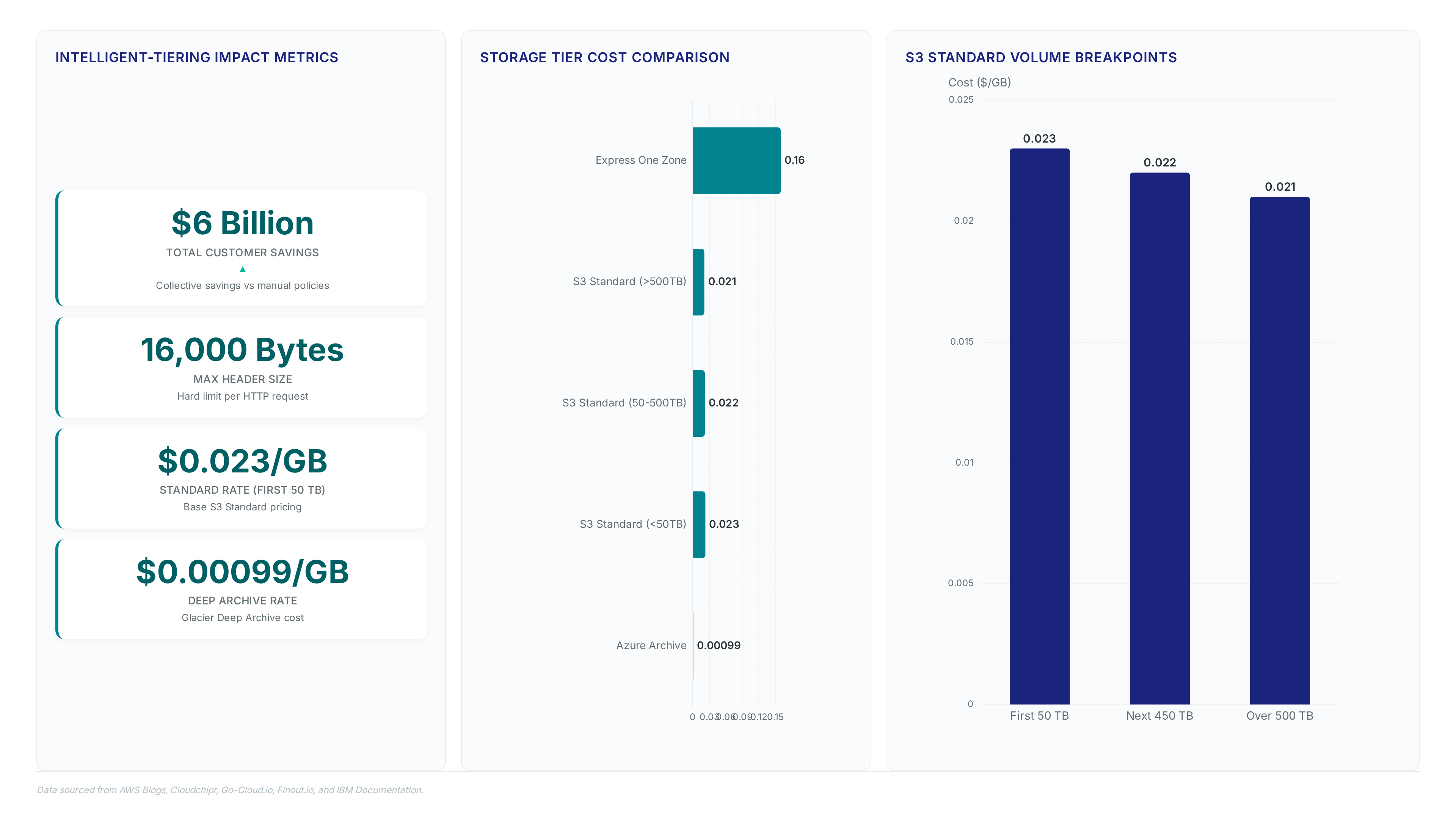
S3 Intelligent-Tiering automates cost optimization by moving objects between access tiers based on changing usage patterns without performance impact. The mechanism monitors access frequency and shifts data to lower-cost layers when inactive, then instantly restores it upon the next request. Customers have collectively saved more than $6 billion using this approach compared to manual lifecycle policies. However, the system incurs a small monthly monitoring fee per object that can outweigh savings for datasets with millions of tiny files. Operators must weigh automation benefits against per-object overhead for high-churn workloads.
Metadata operations face a hard constraint where a single HTTP request cannot exceed 16,000 bytes for header information. This limit applies to the aggregate size of all user-set keys and values attached to an object during PUT operations. Exceeding this threshold causes the API to reject the request entirely, forcing architects to externalize large attribute sets into separate index objects or database tables. The design prioritizes request parsing speed over flexible annotation depth.
| Feature | S3 Standard | S3 Intelligent-Tiering |
|---|---|---|
| Base Cost | $0.023/GB | Tiered variable rates |
| Monitoring Fee | None | Per-object charge |
| Small File Penalty | None | Potential overhead |
| Access Latency | Milliseconds | Milliseconds |
Validate object counts before enabling automated tiering to avoid fee accumulation on small assets. This architecture removes the need for separate vector databases, collapsing storage silos into a single data lake. Operators avoid egress charges by querying semantic indexes directly where objects reside.
The financial impact depends heavily on storage class selection and object granularity. Standard tier pricing drops to $0.022/GB for usage between 50 TB and 500 TB, creating distinct cost breakpoints for large AI datasets. High-performance workloads might apply Express One Zone at a premium rate, but this premium is often unnecessary for batch inference tasks.
Access pattern volatility drives the 23x price variance between hot storage and the $0.00099/GB Glacier Deep Archive tier. S3 Standard charges a flat rate for immediate access, making it ideal for frequently accessed data where latency is non-negotiable. Intelligent-Tiering introduces a small monitoring overhead to automate movement between frequent and infrequent access tiers without operational latency. This mechanism eliminates manual lifecycle policy errors but requires consistent object sizes to avoid inefficiency. Azure applies a 128 KiB minimum billable size for cold tiers, whereas AWS bills actual object size in Standard classes. Small file workloads therefore see different cost curves depending on the chosen class and cloud provider.
The drawback involves the monitoring fee per object, which can erode savings for datasets containing billions of tiny files. Operators must calculate the break-even point where automation costs exceed manual management overhead. Static archival data belongs in deep archive tiers immediately, while unpredictable AI training datasets benefit most from automated tiering. Deploy Intelligent-Tiering only when access frequency fluctuates unpredictably over time. Static logs should move directly to archive classes to bypass monitoring fees entirely.
Deploying Native Vector Indexes and Apache Iceberg Tables for AI Workloads
S3 Vectors and S3 Tables: Native AI Infrastructure Definitions

S3 Vectors reached General Availability in January 2026 with a forty-fold scale increase to support native semantic search [[1]](https://www.hpcwire.com/bigdatawire/this-just-in/amazon-s3-vectors-now-generally-available-with-increased-scale-and-performance/). Operators gain sub-100ms query latency without maintaining separate vector database clusters, though index creation throughput may bottleneck during initial bulk ingestion phases. The implication is a collapsed network topology where embedding generation and retrieval occur in the same fault domain.
Meanwhile, S3 Tables provide fully managed Apache Iceberg support with automated maintenance routines that optimize file compaction and metadata synchronization [[3]]( This service became available in AWS GovCloud regions on February 23, 2026, extending compliance-grade table management to sensitive workloads [[4]](https://aws.amazon.com/about-aws/whats-new/2026/02/amazon-s3-tables-aws-govcloud-us/). Control over specific compaction schedules decreases compared to self-managed Iceberg implementations, potentially delaying cost optimization for highly volatile datasets. Network teams must account for control-plane API calls during maintenance windows when calculating rate limits.
Implementing RAG Pipelines with 40 Billion Ingested Vectors
Rapid adoption following General Availability in January 2026 resulted in 40 billion vectors ingested across the platform. Operators construct retrieval-augmented generation systems by defining vector buckets that natively store embeddings alongside source objects. This storage-first approach eliminates the data movement tax inherent in disjointed vector database deployments. Users have executed over 1 billion queries since launch, validating the throughput capacity for production AI workloads.
The implementation workflow requires configuring index parameters before bulk ingestion begins.
- Define the metric space (cosine or Euclidean) matching the embedding model output.
- Allocate shard counts based on the target query concurrency levels.
- Enable automatic scaling policies to handle ingestion spikes without manual intervention.
- Integrate the index endpoint with the language model context window builder.
- Monitor shard rebalancing metrics during high-volume write operations.
A sharp tension exists between ingestion velocity and index consistency during the initial load phase. High-throughput bulk uploads can temporarily degrade query performance if shard rebalancing lags behind write operations. The constraint forces operators to schedule heavy ingestion windows during off-peak hours or implement back-pressure mechanisms in the data pipeline. Collapsing the storage and search layers removes egress costs but centralizes failure domains within the region. Network partitions affecting the storage engine simultaneously block both object retrieval and semantic search. Teams must design application-level fallbacks to cached contexts when the native index becomes unavailable.
Regional Deployment Checklist for S3 Tables in GovCloud and APAC
S3 Tables launched in AWS GovCloud. Operators must verify Apache Iceberg compatibility within isolated enclaves to satisfy federal compliance mandates. The subsequent expansion to Asia Pacific (Taipei). Native vector indexing performance degrades if compute nodes reside outside the specific availability zone hosting the table metadata.
| Region Cluster | Launch Date | Compliance Constraint |
|---|---|---|
| AWS GovCloud (US) | February 23, 2026 | FedRAMP High Baseline |
| Asia Pacific (Taipei) | May 29, 2026 | Local Data Sovereignty |
| Asia Pacific (New Zealand) | May 29, 2026 | Cross-Border Transfer Limits |
Deploying S3 Tables without confirming regional enablement results in immediate API rejection errors during table creation. The cost of misconfiguration involves substantial engineering hours spent debugging connectivity rather than optimizing query plans. Audit regional endpoints prior to integrating vector datasets for RAG pipelines. This validation step prevents silent failures where data ingests successfully but remains inaccessible to local compute resources.
About
Marcus Chen serves as a Cloud Solutions Architect and Developer Advocate at Rabata. Io, where he specializes in S3-compatible object storage and AI/ML data infrastructure. His two decades of experience in cloud architecture, including prior roles at Wasabi Technologies and Kubernetes-native startups, uniquely qualify him to analyze the twenty-year evolution of Amazon S3. Chen's daily work involves optimizing storage performance and eliminating vendor lock-in for enterprise clients, directly connecting his practical expertise to the article's examination of S3's historical impact and future trajectory. At Rabata. Io, a provider dedicated to democratizing enterprise-grade storage through transparent pricing and superior speed, Chen uses his deep understanding of the S3 API to build reliable alternatives for cost-conscious organizations. This hands-on engagement with the very protocols discussed in the article ensures his insights are grounded in real-world implementation challenges and opportunities within the modern cloud environment.
Conclusion
Scaling vector indexes to petabyte magnitudes exposes a critical fracture: latency spikes occur when compute clusters decouple from the specific availability zone hosting table metadata. While storage durability remains absolute, query performance collapses across regional boundaries, turning distributed AI training into a bottleneck of network wait times. The operational burden shifts from managing sharded clusters to orchestrating strict zone-affinity for compute resources, a requirement that intensifies as global cloud data approaches 200 zettabytes by 2027. Teams ignoring this topology constraint will face unpredictable inference delays that no amount of horizontal scaling can resolve.
Organizations must mandate co-located deployment for all production RAG pipelines by Q3 2026, ensuring compute nodes reside within the same availability zone as their S3 Tables. This is not merely an optimization but a structural necessity for maintaining sub-millisecond retrieval speeds in high-throughput environments. Delaying this architectural alignment guarantees technical debt that becomes exponentially harder to refactor as dataset volumes grow.
Start by auditing your current VPC subnet assignments against S3 Table locations this week. Identify any cross-zone dependencies in your existing vector search workflows and draft a migration plan to consolidate these resources before the next fiscal planning cycle begins.
Frequently Asked Questions
S3 now supports objects up to 50 TB, a massive increase from the original 5 GB limit. This 10,000-fold growth enables consolidating huge datasets without complex sharding strategies for modern applications.
Customers have collectively saved more than $6 billion by utilizing S3 Intelligent-Tiering compared to standard storage costs. This automated tiering moves data frequently to optimize spending without impacting application performance or availability.
S3 maintains a durability target of 99.999999999% across 123 Availability Zones through continuous microservice inspection. This legendary eleven nines reliability ensures data remains safe even when individual hardware components fail unexpectedly.
Data egress fees reach $0.09 per GB, which often exceeds storage costs for active AI training jobs. Moving large datasets out of S3 for processing can quickly inflate bills beyond simple monthly storage retention fees.
The platform now serves over 200 million requests per second across 39 AWS Regions worldwide. This immense throughput proves S3 acts as the undisputed backbone for modern data infrastructure and AI workloads.